


Results 41 to 60 of 99
Thread: Roll cage
-
03-10-2010 #41
 Registered User
- Join Date
- Mar 2010
- Location
- Sparta, Michigan
- Posts
- 41
It was mentioned in here that DOM weighs as much as c-moly... This would be true if the wall thickness was the same. Drag racing is typically the only place c-moly is widely used and it is due to weight. By the NHRA rules, you could build out of either .134 wall mild steel or .083 wall c-moly - up to a certain point and then everything is c-moly (but no one with a street car will ever come near that point- Rod Sabuory excluded) The .083 wall c-moly offers comparable strength to the .134 wall mild steel and is much, much lighter.
The heat affected zone (HAZ) with the tig process is much better controlled - and it is the ONLY acceptable process to weld c-moly. Also, someone mention stress relieving after Tig welding. I guarantee that EVERY tig welded c-moly 250mph pro-mod doesn't bake in an oven to stress releive the chassis. All that would accomplish is to turn a nice square and level chassis into a twisted mess. Control of the HAZ by a good welder is critical.
Purchasing a prebuilt bolt in roll bar is a complete waste of time and money. Also, as indicated earlier, there are a ton of competent fabricators who are experiencing the same economic downturn the rest of the country is... Take advantage of this. $100 a point is a good deal for a tig welded dom cage.
You shouldn't even consider a mig welded cage. Good for NASCAR and the disposable chassis, but not right for anyone who plans on having their car for more than a half season.
If you really can't find someone to do the work for you PM me and I'll fix you up with a good chassis guy in your neck of the woods.
-
03-11-2010 #42
Registered User
- Join Date
- May 2007
- Location
- Las Vegas
- Posts
- 670

I am working on a street car. I boxed my frame and added in some additional bracing. I don't want a cage in the car as it will be a daily driver. I do, however, want some more triangulation so it doesn't flex as much. I had two ideas.
1. Add a bar that runs along the bottom of the dash from side to side and tie it into the lower A-pillar. The plan was to weld on a plate to distribute the load. Then drill the plate and insert the bar so it actually sits inside the factory sheet metal, then weld in place. I would use this to hang the IDIDIT column and Wilwood pedals from AND - Run some down bars through the firewall and to the front frame horns. This would give me a 3D structure to eliminate front frame flex without actually intruding into the passenger compartment.
* Will this work? * Is it worth the effort? * Will it help or hurt if there was an accident?
2. A removable harness bar. Not sure how yet.
~~ One idea was to have some 3/8" thick tabs welded to the floor and near the wheel wells. That would give two mounting points per side for a triangle shape with one corner being at the back of the seat. Then run a bar from one side to the other. That would be the harness bar.
~~ Another idea was similar to the dash bar. Plate the area below the 1/4 window where the back of the seat would be. Then just tie both sides together and that would be the harness bar. Not sure how to attatch it. I've seen some roll cages with a swing out side bar with a spring loaded lock or back to the tab idea.Rich
1969 Camaro (in hibernation)
1972 K5 Blazer - LQ9, 4L80e, NP205, D60, AAM 14BFF => http://67-72chevytrucks.com/vboard/s...d.php?t=423432
03-11-2010 #43
Registered User
- Join Date
- Mar 2010
- Location
- Sparta, Michigan
- Posts
- 41
^^^What car are we talking about?
03-11-2010 #44 Registered User
- Join Date
- Apr 2001
- Location
- Rockford Illinois
- Posts
- 3,949
I would think that in a front end collision that dash bar and front down tubes would have the possibilty to start to come right back at you and bring the steering wheel with it. In a small collision it would be a help but in a major one it needs the support from the rear to keep it there. Just attaching some small tubes to the front upper control arms to the firewall will stiffen up the ride quality. Originally Posted by MCMLXIX

Stick to what is proven to work unless you can really engineer what you are going to do and know it is going to work from some kind of testing done somewhere.
Hope this makes sense to you?May The Horsepower Be With You !!!
03-11-2010 #45 -Moderator-
- Join Date
- Jul 2005
- Location
- Mountain View, CA
- Posts
- 9,583
This I agree with. Originally Posted by chopsmitty
This however is going to need some backup on your part. Originally Posted by chopsmitty
True T.
Whats new with Project 1/2-Trak?
Follow my wisecracks on Sports, Food, Politics and other BS on Twitter.
My blog
When they kick out your front door, How you gonna come?
With your hands on your head, Or on the trigger of your gun?
03-11-2010 #46 Registered User
- Join Date
- Apr 2009
- Location
- san diego
- Posts
- 5,101
Chromoly does work harden. So old chromoly chassis are not a strong. Where mild steel does not work harden and an old mild steel chassis has teh same characteristics as when it was built.
Something else to consider, a chromoly chassis can be modified and have tubes cut out and repaired mild steel cant.My build thread: https://www.pro-touring.com/showthre...ing&highlight=
The mustang build thread: https://www.pro-touring.com/showthre...el)&highlight=
03-11-2010 #47
Registered User
- Join Date
- May 2007
- Location
- Las Vegas
- Posts
- 670
Originally Posted by chopsmitty
1967 Chevelle...
https://www.pro-touring.com/forum/sh...ight=LS3%2FT56Rich
1969 Camaro (in hibernation)
1972 K5 Blazer - LQ9, 4L80e, NP205, D60, AAM 14BFF => http://67-72chevytrucks.com/vboard/s...d.php?t=423432
03-11-2010 #48 Registered User
- Join Date
- Dec 2006
- Location
- Out of the Burbs of Detroit to SoCal, then onto my ancestral homeland, the woods of Cascadia
- Posts
- 1,753
Originally Posted by falcon65
Aware of brittle weld joints in the HAZ that may require heat treating to normalize. Not sure what you mean by work hardening?
Also am interested in why you believe a MS chassis can't be repaiedGreg Fast
(yes, the last name is spelled correctly)
1970 Camaro RS Clone
1984 el Camino
1973 MGB vintage E/Prod race car
(Soon to be an SCCA H/Prod limited prep)
03-11-2010 #49
Registered User
- Join Date
- Mar 2010
- Location
- Sparta, Michigan
- Posts
- 41
4130 chromoly tubing is a superior material for any rollcage or chassis structure. One of the greatest advantages is its strength to weight ratio. You can achieve an equal or in most cases stronger assembly when using an alloy tubing. The weight of an average rollcage can be reduced by almost 40 percent when using appropriately sized 4130 materials. The other great benefit to using alloy tubing is its ability to flex without breaking or bending immediately. The spring-back of 4130 tubing is almost double that of ordinary mild steel tubing, leaving the chassis to flex without breaking. Other than the additional cost, welding chromoly tubing is the only other disadvantage, as it has to be tig welded. Even so, with todays technology of filler materials, as well as square wave welding technology (pulse welding), it is much easier to learn to tig weld. There are also better blends of filler material to create a more desirable weld. All the options weighed, chromoly is the best way to go.
When material is bent it actually increases the tensile strength of the material in the bend area substantially, as long as the material has been cold formed. Cold forming is the process of bending or shaping material without heat. Cold forming is one of the only ways to strengthen some types of material. The tensile strength of some material can increase more than 50 percent when cold formed. Cold forming introduces a certain amount of work hardening. Work hardening occurs when material is being stressed but not strained. When applied correctly, work hardening can significantly add to the tensile strength of the material.
If your chassis, after installation of a properly designed cage or other structural support system, is flexing enough to induce work hardening - you have a design problem AND a terrible vehicle! And you can repair/replace and add to either 4130 or mild steel.
03-11-2010 #50
Registered User
- Join Date
- Mar 2010
- Location
- Sparta, Michigan
- Posts
- 41
Unfortunately, if you were my customer I would talk you out of anything but the addition of a real roll bar or cage. I'm afraid the ideas you've presented won't offer you any real advantage. Additionally the cage needs to be tied to the frame and the body needs to be mounted on solid bushings. Originally Posted by MCMLXIX
03-13-2010 #51
Starting The Transformation
- Join Date
- Sep 2009
- Location
- Arizona
- Posts
- 446
why? Originally Posted by chopsmitty
03-13-2010 #52
Starting The Transformation
- Join Date
- Sep 2009
- Location
- Arizona
- Posts
- 446
are you serious? Originally Posted by chopsmitty
03-13-2010 #53
Registered User
- Join Date
- Mar 2010
- Location
- Sparta, Michigan
- Posts
- 41
MIG-welding heats the metal much faster and is more violent to the base material, thus causing more internal stress, thus most racing sanctioning bodies require all alloy steel structures to be TIG welded.
If you do decide to MIG-weld chromoly, you should use at least ER70S-or better yet-ER80S wire, and consider having the chassis stress relieved from an experienced heat treater. If you are serious about welding, you will quickly learn that MIG welding chromoly will be more labor intensive and slower than using the TIG process.
03-14-2010 #54
Registered User
- Join Date
- Sep 2007
- Posts
- 457
I've done some reading about the various welding methods for 4130. It seems really surprising but NOBODY seems to be able to settle this debate. There are lots of different "legitimate" sources for advice one way or the other, but nobody actually has concrete comparative testing data to back their opinions up. The proof is only a lot of "The _____ people have been doing it this way for _____ years and trust me it works."
The only thing that seems clear & unchallenged is that oxy-acetylene gas welding is very safe for 4130 tubing. That's what was originally recommended for 4130 field repairs in the aeronautical industry. (Gas-welds on 4130 may not produce the stiffest weld possible. But in a triangulated structure where most of the stiffness comes from the arrangement of the tubes, gas welds on 4130 are very safe not to fatigue and crack/fail.)
TIG is more officially recognized for 4130 in the auto racing world. But more than a few people have suggested that this requirement may have been made to encourage chassis builders to pay pro welders, and any engineering reasons to prefer TIG have been invented to explain it after the fact.
TIG is prettier and more expensive. It's "better" if better means cleaner looking. But the HAZ produced by TIG is very narrow, and IMHO the embrittlement that this causes would seem to be more of a risk than MIG welding the same joint. Regardless of how strong the weld itself is, I get the feeling that the worst joint-failure risk is more often in the HAZ around the weld. Just my opinion.
There is also TIG's murkier penetration appearance - TIG seems more apt to fool the welder with good looking welds that didn't penetrate as far as they should have. (No, I'm NOT saying TIG welds can't ever penetrate well in general. I'm just saying that under-penetrating TIG welds are frequently more deceptive looking than under-penetrating MIG welds.)
Combine the HAZ abruptness of TIG, with the penetration questions . . . it really makes you wonder whether TIG is better than MIG for chro-mo after all.
-----------
03-14-2010 #55
Starting The Transformation
- Join Date
- Sep 2009
- Location
- Arizona
- Posts
- 446
Originally Posted by chopsmitty
What was your whole reasoning for coming on here and posting? To discredit others or simply to stir up something? You talk about 250+ MPH cars as if that is what others were suggesting. There is a difference between pro drag cars and what this thread was started about. Did you even read the original post or just read what others suggested and decided to start an argument? Just so your not confused here is the original post for this thread...
"So I've never welded, just started practicing on scrap metal. If I buy one of the pre fabbed 4, or 6-point cages for my 67 Camaro would I have any chance at installing it myself if I learn fast, or is it best I leave it to a professional. I know 6 point cages run around 400 for chromoly. And I heard around $100 per point so 600 install. $1000 overall, if I remove and reinstall interior. But I look at some costs guys have into their cages and its anywhere from 1500 to 2800? I'm looking through internet and in magazine build in PHR, Hot Rod, and Chevy Hi-perf. I really want to be able to use harnesses since the lap belt isn't too reassuring, especially if i rolled. And I plan on driving this car hard so alwaya risk. Plus a 6 point would provide side protection if I got T-boned."
How does this situation compare to a 250+ MPH drag car???
Either way your WRONG!
TIG is NOT the only way to weld 4130, that has been proven time and time again. DOM / 4130 and MIG are more then fine for just about EVERY application except a top level drag chassis. There are a lot of people who only TIG weld chassis and when it comes down to it they really should not. The majority of TIG welded chassis are cold single pass welds that are more dangerous then a decent MIG weld.
I guess the pictures of MIG 4130 below are not safe enough...

You have made some very bold statements about MIG welded structures.... care to back them up with more explanation?
jason
03-14-2010 #56 Registered User
- Join Date
- Mar 2007
- Location
- Florida
- Posts
- 2,391
I keep watching this thread and it seems to have gotten off track from helping the original poster. (I've included his posts below.) To me it doesn't sound like he even NEEDS a bar or cage at all. He simply has a high powered street car. He does not mention any intention of any track use of the car. He would like to make the car safer for street use over his current lap only belts in his 67 Camaro. He has not mentioned any desire to add chassis stiffening. I am all for discussions concerning bar/cage materials, design, and construction so perhaps another thread dedicated to those topics would be a good idea.
My thoughts about Scotts needs based on the information provided.
Having a bunch of horsepower does not require a bar or cage.
Even driving "hard" on the street is nothing like track use. There is little likelyhood of driving the car at it's limits on the street.
Harnesses are a pain on the street when used properly.
Rolling a car on the street is not very probable.
Getting T-boned is also not very likely.
Having had several cars with added safety equipment for track use, I've found having a bar/cage and harnesses is a nuisance I'm only willing to put up with so that I can also use the car on track. If I wasn't going to exceed the speeds where rollbars or cages were required at sanctioned events I wouldn't put them in.
In Scotts case it sounds to me it sounds like a 3 point retractable belt system as an upgrade over the lap belts would be a good choice considering the indicated usage of the car. No bar/cage or harnesses seem necessary from the information given in the posts by the OP listed below. The car would then be safer than stock and if he decides to, he could enter entry level classes at drag races, Auto-X, Open Road, and HPDEs at road tracks. If he then decides to go further in one of those arenas he could add the safety equipment necessary. From the information provided it doesn't seem that the nuisance, expense, and limitations involved with adding a bar/cage and harnesses are justified.
John
Originally Posted by ScottT
Well I guess I have alot to study. I just don't want to take out my car thinking how great it will stop and handle without the cage and harnesses to save me incase. I'm thinking 8 point cage now. But the tigercage does look good
__________________________________________________ _______
I will be driving it mainly on the street, but will have 550hp out of the gate, but want to get it to 800 rwhp with a turbo kit by next year. So I think a cage with harnesses is a good idea. Plus if I get in a wreck the la belts won't do much good, and can't mount a harness without a cage. I just want to be safe, and am willing to pay more for a custom cage if that's what I need to be safe driving it on the street without a helmet. On that note, anyone know a good custom cage builder in WA state?
__________________________________________________ _______
and yes the tiger cage looks cool. But I don't think if I get T-boned or roll its going to help much.
03-17-2010 #57
Registered User
- Join Date
- Mar 2010
- Location
- Sparta, Michigan
- Posts
- 41
Originally Posted by The GMR
This is my position as well. ^^^your words!! Tig welded 4130 is still the best choice. Anytime I am welding something to the structure of the vehicle, the best advise is to do it one time. You can't get stronger or lighter than this material. You can challenge anything I say all you want, and what I am saying isn't an attempt to stir the pot, but proper Tig welding is still the process of choice. FACT. Will a Mig welded 4130 roll bar work in a car that really doesn't need anything anyway? Sure.
03-18-2010 #58
-Moderator-
- Join Date
- Jul 2005
- Location
- Mountain View, CA
- Posts
- 9,583
Again. Bring the tech. Originally Posted by chopsmitty
If this is your opinion that is fine say so. But you are going to need more than you have offered if you intend to foist these points as statement of fact. In particular the bolded bit below.
That is not the case with SCCA and NASA.MIG-welding heats the metal much faster and is more violent to the base material, thus causing more internal stress, thus most racing sanctioning bodies require all alloy steel structures to be TIG welded.True T.
Whats new with Project 1/2-Trak?
Follow my wisecracks on Sports, Food, Politics and other BS on Twitter.
My blog
When they kick out your front door, How you gonna come?
With your hands on your head, Or on the trigger of your gun?
03-18-2010 #59
Registered User
- Join Date
- Mar 2007
- Location
- Florida
- Posts
- 2,391
"Foist" Excellent word choice! I'm never playing Scrabble with True!
03-19-2010 #60
Registered User
- Join Date
- Mar 2010
- Location
- Sparta, Michigan
- Posts
- 41
Originally Posted by Damn True
Again, I don't mean to stir the pot, but if you think this is something to pay homage to...
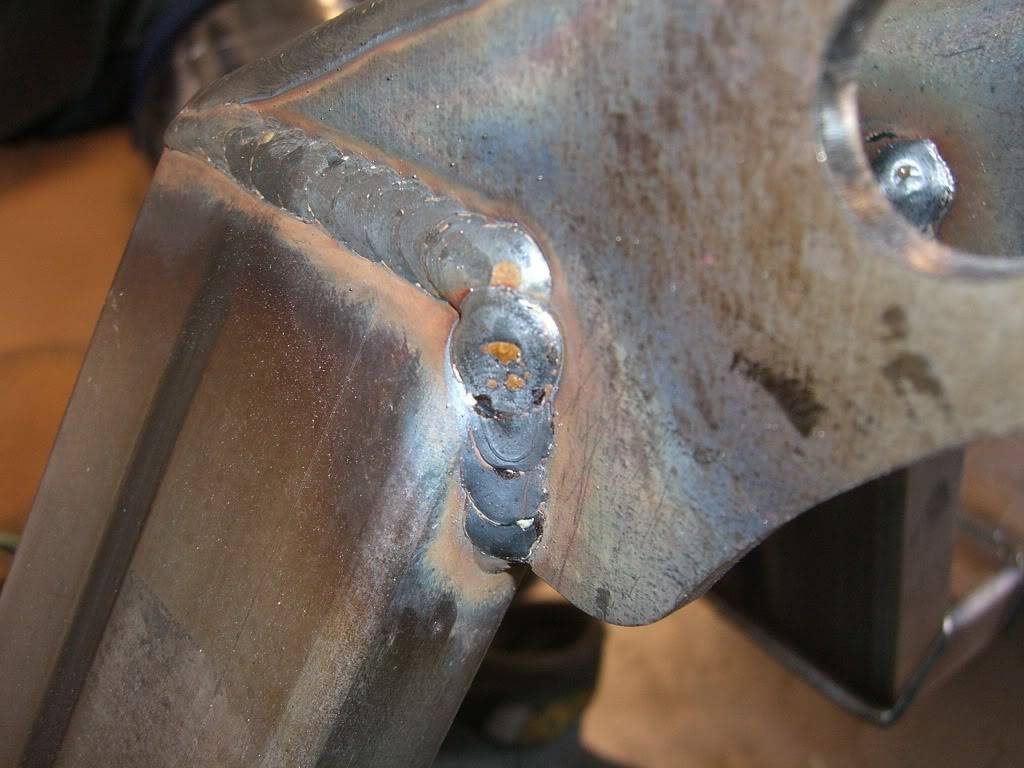
Then you need some 'tech'. I, however, am tiring of ....
....
My Tig welder can weld alum, mild steel, stainless and 4130 with nothing but a change of rod, consumables and settings.
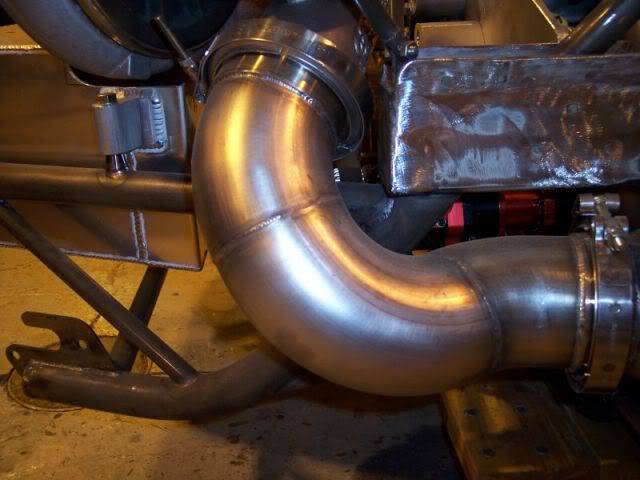
This type of work is the standard of our craft. Mig welding doesn't have a place in this equation. Sure we use the Mig to replace/repair sheet metal and burn base plates to sheet metal when installing a cage, but no way is the main structure going to be Mig'd. This is just my $.02 but I am not an oddball...

 Reply With Quote