


Results 21 to 40 of 44
Thread: High vs low RPM
-
10-30-2010 #21

 Registered User
- Join Date
- Aug 2008
- Location
- Pgh, PA
- Posts
- 2,177
A standard block pontiac does Originally Posted by rogue


Just yanking your chain. I know what you were trying to say. Us "off brands" are just a little sensitive, and us pontiac guys give instructions to chebbies every day on what torque is REALLY all about
 '66 GTO Vert Project "Red Ink", 462ci of stroked pontiac power, TKO600, SC&C Stg II+, Tubular lowers, Currectrac Rear suspension, Moser 12bolt w/Truetrack, Wilwood Master and discs all around, too much fun for words...
-
10-30-2010 #22
Registered User
- Join Date
- Aug 2008
- Location
- Pgh, PA
- Posts
- 2,177
Lee, I have to say that I'd love to get into a conversation with you over this and a couple of beers. There's a lot you said I agree with, and a good bit that I strongly disagree with. There are advantages and disadvantages to both small and big blocks - considering that you're also leaving out a whole lot of blocks. To use the 409 as an example is defective from the start. The 409 was a relative unique situation, and the entire combustion chamber difference is enough to keep it out of this contrast.
IMHO, forget about the block in your analysis, Lee. Think about the rotating assembly and the induction system and valve train. These days, big blocks and long rod motors can easily be built to spin fast - but the real point is how quickly the motor accelerates. Not just where the torque is. I've got a "harley type" motor as an example. It's a 113" long rod motor with both the bore and stroke a good big larger than "stock". Now normally that means it would be even more "torkey" but would have issues in the whole "increase rpm over time" equation. However, the superb R&R heads in that S&S case allow the motor to rev REALLY quick - through it's rpm range. Now, the entire Evo V-Twin design is obviously limited in terms of RPM range, so while it gets there real quick, there is only so far to go. I'm not running that motor past 6500, and peak torque is at around 4800 - though it's still pulling hard through 6500. The correct analogy in car engines for the whole tq vs rpm debate would be better shown by a F430 vs a 427 or something. The debate there is NOT the block design. It's the rotating assembly and valvetrain. There is IMHO far too little difference between a BBC and a SBC for the debate to be very accurate these days in this regard.
For the OP, the real question is what do you want to do with the car, how much, what are you willing to spend, and how much time are you willing to devote. The question why wouldn't 600hp at 4000rpm be as good as 600rpm at 8000rpm is again easily explained by us motorcycle guys. The working RPM range, when larger, allows for more flexibility in gearing and speed. But that's assuming you're making relatively equal amounts of torque through most of the power band, which is difficult to do. Otherwise, you're simply adjusting your gearing to take advantage of whichever design you have. At that point, weight and reliability become the largest factors.
But for the OP, let's keep it simple. If your car will be mostly driven on the street, building tq from idle up is simpy wonderful. There is nothing like being in 5th (overdrive in a TKO600) and being able to simply press the gas pedal a bit to increase speed up a hill and pass somebody. And, the motor is not being pushed - and I'm using less fuel. OTOH, if it's mainly a track car (I'm talking road and not drag) then a lighter motor helps with weight distribution. Don't forget though that I'm betting I'll go far longer between rebuilds as I'm making over 550lbs tq pretty much ALL of the time - through my entire rpm range - meaning I won't have to hammer my motor quite as much as somebody running for example a large displacement SBC. And I've got more material in my cylinder walls, etc.
This debate will never get resolved. It can't be. Too many variables. But I'm thinking that just for this debate, LS is pretty hard to beat.'66 GTO Vert Project "Red Ink", 462ci of stroked pontiac power, TKO600, SC&C Stg II+, Tubular lowers, Currectrac Rear suspension, Moser 12bolt w/Truetrack, Wilwood Master and discs all around, too much fun for words...
-
10-30-2010 #23
Banned
- Join Date
- Dec 2009
- Posts
- 256
wmhjr - just for clarrification...
But for the OP, let's keep it simple. If your car will be mostly driven on the street, building tq from idle up is simpy wonderful. There is nothing like being in 5th (overdrive in a TKO600) and being able to simply press the gas pedal a bit to increase speed up a hill and pass somebody. And, the motor is not being pushed - and I'm using less fuel
Thats Big Block?
Don't forget though that I'm betting I'll go far longer between rebuilds as I'm making over 550lbs tq pretty much ALL of the time - through my entire rpm range - meaning I won't have to hammer my motor quite as much as somebody running for example a large displacement SBC. And I've got more material in my cylinder walls, etc.
Thats Big Block also? Going far longer between rebuilds, saying the engine will last a lot longer (more durable/reliable)?
While SB = lighter/better weight distribution? This can be overcome via other means if the choice is BB though cant it?
-
10-30-2010 #24
Registered User
- Join Date
- Aug 2001
- Posts
- 924

Shifting takes up valuable track time. If you can wind a little higher instead of shifting I think that time from point a to b will be faster.
-
10-30-2010 #25
 Registered User
- Join Date
- Apr 2001
- Location
- Rockford Illinois
- Posts
- 3,949
Especially at an autox track that keeps you in 1st gear looking for and needing 2nd ! Originally Posted by Charley Lillard
May The Horsepower Be With You !!!
-
10-30-2010 #26
 Registered User
- Join Date
- Mar 2009
- Location
- SoCal
- Posts
- 1,240
That works both ways. Ideally, your engine makes torque everywhere and can rev high. If it's one versus the other, the high revving engine might save you from upshifting at the end of a straight, but the torquey engine might save you from downshifting in another scenario. Originally Posted by Charley Lillard
Brett H.
1979 Pontiac Firebird Trans Am
1991 Mazda Miata
2005 Ford Mustang GT
1987 Ford Mustang GT - Sold 06-29-2014
1988 Oldsmobile Cutlass Ciera - RIP 9-17-2011
1992 Chevrolet Corvette - Sold 10-12-2017
-
10-30-2010 #27
 Registered User
- Join Date
- Sep 2006
- Location
- Henderson,NV
- Posts
- 2,870
That's an awful lot of speculation. The day you out run Mark Stielow in anything, I'll be the first to congratulate you. You have a looong way to go. Originally Posted by ratman67
Todd
-
10-31-2010 #28
Registered User
- Join Date
- Aug 2008
- Location
- Pgh, PA
- Posts
- 2,177
What I was trying to say is that you can certainly build a SB to generate tons of low end torque, but you'll make sacrifices. How exactly do you generate torque low? Think about it. Really it's like I said, this discussion isn't really about high vs low rpm. It's about more than that. Take for example the engine in a Honda S2000. Great little engine that makes good power. But down low it's not a rocket. You need to KEEP the motor revving high to make power. Now, if you could generate a flatter tq curve it would be a different story. Originally Posted by G-man
But yes, I stand by my point that a flatter and higher tq curve motor that doesn't need to spin as hard and has more meat (like for example a long stroke BBC, a poncho SB) may be a more "driveable" and "reliable" choice for a mainly street car. For a pure race car it's way different.'66 GTO Vert Project "Red Ink", 462ci of stroked pontiac power, TKO600, SC&C Stg II+, Tubular lowers, Currectrac Rear suspension, Moser 12bolt w/Truetrack, Wilwood Master and discs all around, too much fun for words...
-
10-31-2010 #29
 Registered User
- Join Date
- Aug 2001
- Location
- Wilton, CA. (Sacramento)
- Posts
- 2,995
uh.....yeah. Originally Posted by Vegas69
I haven't ridden in Marks newest car, but I rode with him at Thunderhill in the Mule, and the power was not an issue, we were flying through the field of track cars and race rubber in a street car with full street tires. He has a lot of experience driving high horsepower cars with street tires.
Jody
-
10-31-2010 #30
Registered User
- Join Date
- Aug 2004
- Location
- Belle Plaine, MN
- Posts
- 1,221
Until the 'speculators' show up on-track and prove their points, I'm not buying their logic. There are too many guys who actually have running cars and show up at events to listen to philosophers like this who either don't have running cars or don't show up at events to showcase them.
With regard to the original post, I humbly submit that compromise is key. We (as a group) are fielding street cars. That immediately firms up a few things - like sub 9,000 rpm engines. So, make the best sub-9,000 rpm engine you can. Whether that's a small- or big-block is less important than the car's ability to put that power down and the driver's ability to control it.
It also matters if we're talking about a tight, twisty auto-cross course (adequate power to get out of shape is relatively low), a road course (longer straights and a wide range of tight and sweeping turns challenge the driver and suspension to stick all the way around), or an open road deal like Silver State (power and aero become priorities as the road is pretty much straight and flat, and the engine's durability will be tested as it must make steady power for more than an hour under high duress).
Building one, single car than can perform well at all of these places is an even greater challenge, and engineering a car capable of such performance borders somewhere between art and technical genius.Scott Parkhurst
2011 Car Craft Real Street Eliminator Winner
-
10-31-2010 #31 Registered User
- Join Date
- Oct 2005
- Location
- Toronto
- Posts
- 1,465
For the kind of power you're looking for and the requirements/budget you're speaking of,,,,,, I can't see where there is any other choice than a newer LS type build...... Originally Posted by G-man
In my opinion I'd concentrate on the suspension/braking area first and use what is let for the drive train as far as budget balances go.... That is one heavy car and if you want to cheat the odds's a little look into stock appearing light weight panels for the car. I've been playing with Carbon composites on my TA's (and soon on my 2nd Gen Camaro's)..... Hell loose a pile of weight up front (and anywhere else) and balance out the car a little and you'd be surprised how much of a difference that'll make...
Also be smart and ask the king of Charger corner carvers (fellow board member/moderator Bill Howell) for some advise...... I'm unaware of anyone with half the seat time in any single Charger as he has...... Bill is a "great guy" who would likely put you on the right path with pleasure..... I believe Mrangry on the board here is a big Mopar player too (and has a sick 68 or 69 come to think of it)..... I believe he is extremely knowledgeable as well (just don't know him as well as I know Bill so sorry for not immediately mentioning him as well)...
Continue looking for impute from knowledgeable sources,,,, "make a solid build plan and stick to it" because after all this is your dream car,,, build it your way.Carbon Kustoms Limited
A.K.A. Albert from Toronto
10-31-2010 #32
Registered User
- Join Date
- Apr 2001
- Location
- Rockford Illinois
- Posts
- 3,949
I have always looked at the whole thing about what it takes to beat someone and I always get reminded of the spinning tire and loss of time and acceleration. It doesn't matter what makes the tire go it is how it wants to make it go that counts. That is where driver input and output make the whole thing beter for one person and not another.
I have found I like more RPM's on tap and the control I get from it in the lower gears. Think of it in pedal travel/rpm and you get the idea of how your foot has more control. With just the tap of the pedal the high tq low rpm engines start to spin the tires fast and in corners that is not going to make you faster.
It's all about how you can drive a car to me and the more experience I get at the track the more I like the extra RPM's.May The Horsepower Be With You !!!
10-31-2010 #33
Registered User
- Join Date
- Aug 2008
- Location
- Pgh, PA
- Posts
- 2,177
Scott, not sure which "speculators" you're talking about here. I kinda agree with you here. Remember that some of us haven't had the opportunity to get to some of the tracks you've been at, but may well be putting their cars through the paces as much as possible. For me, though I know I don't have the kind of build to really challenge Penny or Mary (that term compromise comes to mind) you can expect to see me at MMCC and/or the Motor State Challenge, and likely RTTH in 2011! I know I'm gonna get smoked but at least it ought to be some good guys laughing at me while it's going on. Originally Posted by Scott Parkhurst
Couldn't agree more. That's why I'm more comfortable with torquey motors. JMHO. Because when you add in the activity of just cruising down the road, we've all got to admit that low end torque is really optimal for cruise driving. It all depends on what you are trying to do. There's no one recipe for success. If there were, we'd all be building exact clones. Originally Posted by Scott Parkhurst
'66 GTO Vert Project "Red Ink", 462ci of stroked pontiac power, TKO600, SC&C Stg II+, Tubular lowers, Currectrac Rear suspension, Moser 12bolt w/Truetrack, Wilwood Master and discs all around, too much fun for words...
10-31-2010 #34
Registered User
- Join Date
- Aug 2004
- Location
- Belle Plaine, MN
- Posts
- 1,221
Agreed- and I'm anxious to see your GTO 'vert come out and play! Love the Ponchos (just sold my '65 project...) and yours is better than most.
Check your PMs, too!Scott Parkhurst
2011 Car Craft Real Street Eliminator Winner
10-31-2010 #35 Registered User
- Join Date
- Dec 2006
- Location
- oshawa ontario
- Posts
- 1,607

To the OP.....if your running a 68 Charger I would say build a big block 440/512 or whatever with alum heads/intake.....you need torque to move a heavy car.
This guy runs an all aluminum BBC in this track/street car and it eats Murcialagos for lunch at the track (the guy actually owns a couple of Ferrari's) .....he says in the article that hes had small blocks in heavy track cars before and they cant beat the torque of a big block so he built this all alum engine as the best of both worlds...big block torque/small block weight.
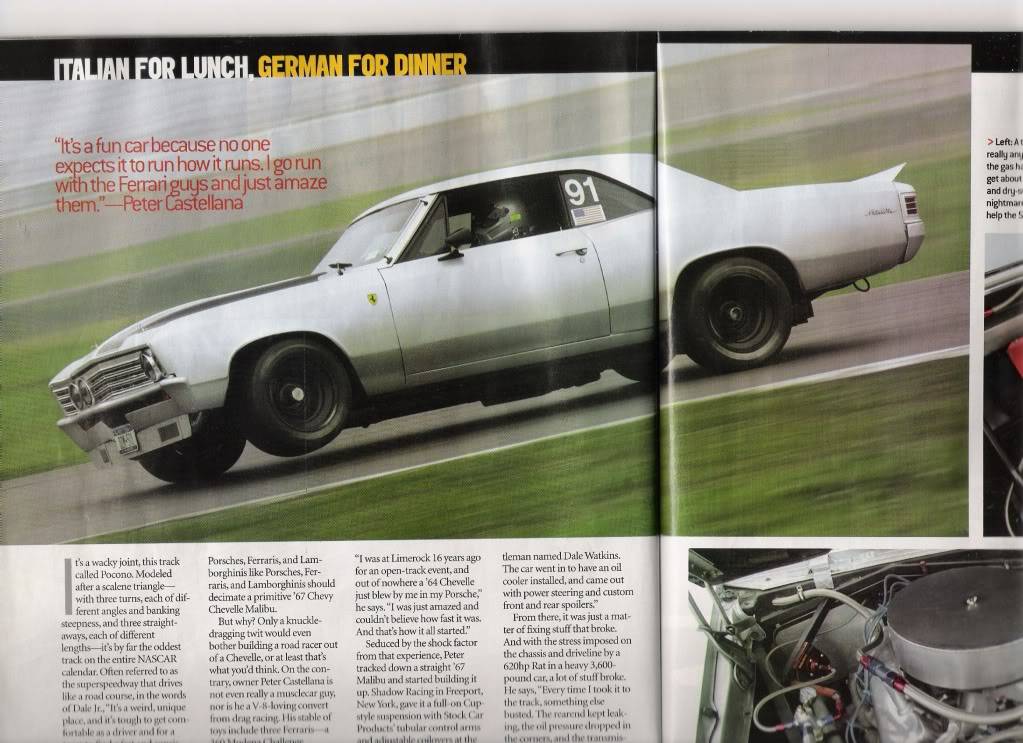 Nascar 69 Chevelle project, 1999 Hutch Pagan Nascar chassis, 69 Chevelle body,700hp, Penske's, slicks, roadrace track day https://www.pro-touring.com/showthre...le-Cup-project
89 Iroc 406 Fitech 5 spd
01 chevy 2500HD 4x4 8.1 Allison
31 Scarab 2 x 454
10-31-2010 #36
Registered User
- Join Date
- Oct 2005
- Location
- Toronto
- Posts
- 1,465
I love Aluminum BB's,,,, that is the BB aluminum domain that I was eluding to in my earlier comments....
A way expensive way to go,,, but one Hell of a lot of fun doing it....
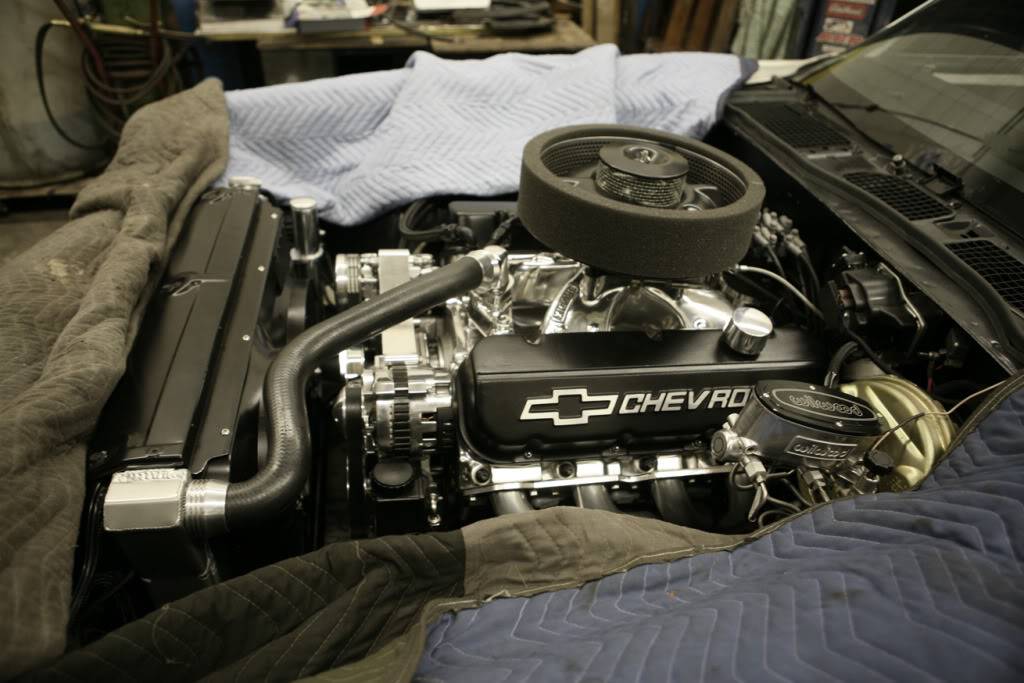
I hear him on the Ferrari-Lambo front, it's a blast when you see their jaws drop in surprise ;-)Carbon Kustoms Limited
A.K.A. Albert from Toronto
10-31-2010 #37
Registered User
- Join Date
- Jan 2005
- Location
- Netherlands
- Posts
- 1,012
Some time ago i posted a post about me and my car battling it out on the dutch and german high way. against modern great euro cars.
never lost of any of them beat the snot out of porses(panamera 911 gt3 ecetera ferarri,s. ecetera..
Biggest scalp i took was a brand spanking new Aston Martin Vantage past him at 190 mph!!.
Afther i duct out of his slip stream.. at 6200 rpm with my 462ci 4.25 stroke Pontiac powerd 68 firebird!!! 530hp 577lbs feet of torque. 3.42 rear ratio 0.67 overdrive tr2004r...
This old set up never lost a highway battle. Right now we are working on a 475ci 4 inch stroke aluminium Pontiac engine 730 hp 700 lbs tq 7200 rpm!!. and a compleet new build up Firebird called ""Road Force One"".
I can tel you one thing, not a modern euro fighter that wil last aganst it, and il take a NA engine to a fight any day against a turbo ore twin turbo powerd V8, on the track .. the more hp those engines have the quiker they lose....... In my opinion twin tubo,s 1000/1500 and 2000 hp is just for bragging rights..
Last but not least the traditional pontiac engine hase always been the best ""street"" engine a intermidiate block equipt with aluminium heads and manifold hase the weight of a sbc, but BBC torque.........Last but not least it was Smokey unich that said about pontiac and i quote""Dont Rev it up GEAR it UP"" in a time when afthermarked wassend there like now.
11-01-2010 #38 Registered User
- Join Date
- Mar 2006
- Location
- Sunny Florida on the Suncoast
- Posts
- 1,060
I think I can shine a light on why your example is the way it is. Yes you can get a 528 Hemi to rev to 8000 and easily make 650 HP, or you can make the same 650 HP with a 360 spining to 8000. Both combinations will be high strung and expensive to build. Both will require highly detailed and exotic material in the rotating and valvetrain due the the high RPM. The 528 will not last as long due the weight of the recipricating assembly and the long arm crank, the 360 just isn't slinging the same kind of weight give it a durability advantage. As the lenght of stroke increases it hughly increases the load on the crank due to Moment of Interia, (the 528 will never accelerate as quickly as a shorter stroke 360 either), remember that as the RPM level doubles the stress increase to a factor of four. Durabilty in this combination is closely tied to the size of the engine the weight required to get the engine to that size. Originally Posted by G-man
Stay in it till you see God....then lift
Where patience fails, force prevails
"When you're born, you get a ticket to the freak show. When you're born in America, you get a front-row seat." G. Carlin
Stapp's Ironical Paradox...... "The universal aptitude for ineptitude makes any human accomplishment an incredible miracle."
11-01-2010 #39
Registered User
- Join Date
- Aug 2008
- Location
- Pgh, PA
- Posts
- 2,177
Actually in the above comparison, however don't you need to think it a little more through? Why would you need to rev to 8k with the 528 to make 650hp? 600-650hp in a 528 is frankly not that tough to build - it does not require it be high strung. It's the revving to 8k (when it isn't required) that creates the issues. That's the point. We're talking low RPM vs high RPM here in this post - NOT big vs small block. I know this topic is easy to go in multiple directions. But in a large displacement motor you can develop the same power without spinning (other than the tires
) so much. So the OPs question really is whether or not you "need" that higher RPM range. There are a number of perspectives. And somebody called it right earlier - it's all about compromise. Personally, I'm more comfortable with a high tq low RPM motor making the same power if it's mainly a street car. If the car is mainly raced, then depending on what kind of racing it's a different story and there are folks here FAR more experienced than I. I think somebody else made a great comment early on also - this is all theoretical. Unless equal time and attention is focused on the chassis/suspension AND driving technique, either choice (high vs low rpm) will suffer greatly. I'm guessing people like Mary, Brian, Mark could likely run circles around me in my 600hp car if they were driving a bone stock car - simply because of how much more AutoX experience they have.
A final note. I do not believe personally that a small block 360 making 600hp with a "wild cam" "revving its head off" will last longer than a 528 that's "sleeping at 3k to 6k". It might last longer in general if you're pushing the 528 repeatedly to 8k, but not if you're staying at 6500 or lower. JMHO.
Bottom line is that depending on the course, speed and acceleration are functions of rpm and tq. The larger the rpm range you can USE, then potentially you can reduce required shifts. Combine this with your ability to transfer power to the ground without melting tires, and the real comparison is TORQUE CURVES!!!!!!! Because it's the nature of your tq curve that limits gearing for a particular type course. Bottom line is the wider the usable power in a tq curve, to me the more flexibilitty you have in taking advantage of it. I guess also combined with how quickly the particular motor can rev through that usable curve.'66 GTO Vert Project "Red Ink", 462ci of stroked pontiac power, TKO600, SC&C Stg II+, Tubular lowers, Currectrac Rear suspension, Moser 12bolt w/Truetrack, Wilwood Master and discs all around, too much fun for words...
11-01-2010 #40
Registered User
- Join Date
- Mar 2009
- Location
- SoCal
- Posts
- 1,240
The OP said 600-650 hp and 700 lb-ft of torque. The horsepower figure immediately makes the car magazine-reading portion of my mind think, "oh LS7 with some cam," but that wouldn't supply the desired torque figure. Nevermind that it's a GM engine and the car is a Charger.
By laying out these figures, you've already dictated what you want your torque curve to look like. More torque than horsepower means that the torque curve will be higher in the low rpm range with max torque occuring quite a bit before the 5252 rpm cross over point (the point where power measured in horsepower happens to equal the amount of torque in lb-ft.)
To get that kind of torque, I'd think some sort of derivative of a 440 (bored and/or stroked to a greater displacement) would work well. The more aluminum to save weight, the better.
If you plan to do any amount of drag racing, just go for the torque. A bigger, flatter torque curve makes the car more flexible as a driver and track toy. I'm not sure, however, that 700 lb-ft is really necessary. Which I guess touches on the OP's original question. Maybe 500-600 would be an epic enough amount?
I'm sorry, I haven't added much new to the conversation with this post, but does the 700 lb-ft figure grab anyone else as a bit excessive?Brett H.
1979 Pontiac Firebird Trans Am
1991 Mazda Miata
2005 Ford Mustang GT
1987 Ford Mustang GT - Sold 06-29-2014
1988 Oldsmobile Cutlass Ciera - RIP 9-17-2011
1992 Chevrolet Corvette - Sold 10-12-2017

 Reply With Quote



