


Results 1 to 14 of 14
Thread: Pad Knockback Issue
Hybrid View


-
09-30-2020 #1

 Registered User
- Join Date
- Nov 2014
- Location
- East Tennessee
- Posts
- 163

Pad Knockback Issue
Hi everyone,
I have been chasing a pad knockback issue on my 68 Camaro for awhile now. I just blew up the old M21 muncie and now have some time to focus on some things such as this knockback issue.
The reason I believe I have a knockback issue is the car will get a "low" pedal after I take a series of hard corners. The more corners I take without hitting the brakes, the lower the pedal gets. It is very stressful especially when tearing up the mountain roads where I live. The pedal gets so bad that I have actually learned to tap the brakes coming out of corners to bring the pads back up to the top. Once you tap or pump the brakes the low pedal goes away, until the next series of corners. This system works ok on the street but is very hard when autocrossing because the corners come up so fast. I have not yet learned to left foot brake properly (threshold) so I stll RF brake when racing.
Here are my braking system specs:
Master Cylinder, Input system, and pedal:
Wilwood, 7/8" Bore, tandem
No booster
6:1 factory pedal
SSBC proportioning valve
All flexlines are braided SS jacket, DOT approved.
Front
13" J55 corvette rotors
GM short spindles
factory 1st gen camaro drum brake hubs
SSBC D52 Floating Calipers, 2 piston, 43mm bores
Rear:
Wilwood kit WIL-140-12570-R
12.2" rotor with integrated parking brake drum
Wilwood D154 floating caliper, 2 piston, 1.125" bores
semifloat axle by Moser
Factory style axle bearings
2psi residual pressure valve (RPV)
One day I attempted to determine which end or corner of the car the knockback was coming from. I did this by taking a series of hard corners then slowing down using the engine only. There was a pull of up hill so I used the hill to slow the rest of the way. Once stopped I turned the car off and left it in gear. I then walked around the car and grabbed each of the calipers and attempted to move them, both inboard/outboard and fore/aft. The fron calipers were pretty dang tight and did not move much. The rears however had slop to them inboard/outboard. I then got back in the car, pumped the brakes 2 times until they felt fully firm and the pedal "up" and repeated the walkaround. The rear calipers were now tight like the fronts. At the time of the test, the prop valve was set 2 turns from full pressure to rear brakes.
This all leads me to believe the source of the knockback is the rear even though it is the end with the single RPV. THE RPV is plumbed just before the "tee" fitting on the axle.
My question is: What now?
I have a 4psi and 10 psi RPV. I also have another 2psi RPV. Thinking about trying the 10psi valve first, then if it works moving to the 4 psi valve.
Please let me know what your thoughts are. Thank you.
RyanElectrical/Mechanical Engineer
1968 Camaro RS - Flat Black
-
09-30-2020 #2 -Moderator/Sponsor-
- Join Date
- Apr 2001
- Location
- The City of Fountains
- Posts
- 16,127
Is it possible that the rear caliper is not centered on the rear rotors and you are running out of caliper float range?
Andrew1970 GTO Version 3.0
1967 Cougar build
GM High-Tech Performance feature
My YouTube Channel Please Subscribe!
Instagram @dr__efi
I deliver what EFI promises.
Remote Holley EFI tuning.
Please get in touch if I can be of service.
"You were the gun, your voice was the trigger, your bravery was the barrel, your eyes were the bullets." ~ Her
09-30-2020 #3
Registered User
- Join Date
- Nov 2014
- Location
- East Tennessee
- Posts
- 163
That is an interesting point. The caliper is definitely centered on the rotor because it has to be. The pads center it. But it is very possible the caliper is not centered on the available travel of the slider pins. I would hope so since the is was a purchased kit, but I did not check that explicitly. Originally Posted by andrewb70

I'll check it out. Thank you.
Do think a 10psi RPV is too much for rear disc brakes? Wilwood said they sell the 10 psi version for drum brakes typicallyElectrical/Mechanical Engineer
1968 Camaro RS - Flat Black
09-30-2020 #4
-Moderator/Sponsor-
- Join Date
- Apr 2001
- Location
- The City of Fountains
- Posts
- 16,127
Don't know about the RPV, but I can see their bracket being a little off, so the caliper is not necessarily centered on the slider pins. I'd double check that. Originally Posted by Sleeper68
Andrew1970 GTO Version 3.0
1967 Cougar build
GM High-Tech Performance feature
My YouTube Channel Please Subscribe!
Instagram @dr__efi
I deliver what EFI promises.
Remote Holley EFI tuning.
Please get in touch if I can be of service.
"You were the gun, your voice was the trigger, your bravery was the barrel, your eyes were the bullets." ~ Her
09-30-2020 #5 Registered User
- Join Date
- Apr 2009
- Location
- Michigan
- Posts
- 334
Depending on the design of the caliper piston seal and seal groove, 10 psi might be enough to cause brake drag. A very small amount of drag is okay, but you don't want to be in a situation where the rear brake temps go up as you're cruising down the highway for example. Originally Posted by Sleeper68
Given your problem, I'd be inclined to start with the 10 psi RPV as well. As long as the car still rolls freely and the brakes don't heat up from dragging (use an IR thermometer on the rotor) you should be fine.- Ryan
09-30-2020 #6
Registered User
- Join Date
- Nov 2014
- Location
- East Tennessee
- Posts
- 163
Interesting you bring up seal design. I believe the seals are square cross section orings, likely with a brake caliper specific "squish" specification, possibly based on the D154 GM caliper it is descendent from. I can ask Wilwood. What about the seal design in your opinion affects drag potential? Deflection of the seal and non linearity at low fluid pressures? If so that could be the cause of the lack of reaction force to piston compression and thus the knockback @ 2 psi. Originally Posted by stab6902
The total piston area of the rear calipers is 1.99 sq in each, so lets say 2 sq in to make it easy. @ 10psig line pressure we would then have a "normal" force on the pad of 20lb. The friction coeff of the pads is about 0.43 so lets say 0.5 to be conservative. That equates to 10lb of friction on each pad. Doesn't sound like alot but maybe it is enough to see cause non trivial drag. The efective radius the pad acts at is about 5.5" or 0.46 ft. The total pad frivtion force would then be 10lb * 2 or 20lb. 20lb * 0.46ft = ~9.2lb-ft. This would be on each wheel, or ~20lb-ft total.
I would think the air movement alone over the rear calipers and the heat sinking of the rotor would hide the drag from a thermal point of view. Your idea to feel it out by pushing the car is a good one.
Will attempt 10 psi RPV after checking the slider travel.
Unfortunately my Muncie decided it was time to leave this world a few weeks ago so I need to get the new trans in before any road test anyway.
Thank you
RyanElectrical/Mechanical Engineer
1968 Camaro RS - Flat Black
09-30-2020 #7
Registered User
- Join Date
- Apr 2009
- Location
- Michigan
- Posts
- 334
I'm not an expert on caliper piston seal design, but as far as I know, they are all square in profile, and the design of the seal groove has more of an impact on behavior than the seal itself. Here's a white paper on the topic if you're interested in more detail (not my paper btw, just stumbled on it looking for figures to illustrate what I'm talking about): http://www.simulia.com/download/solu...c03_delphi.pdf Originally Posted by Sleeper68
- Ryan
09-30-2020 #8 Registered User
- Join Date
- May 2014
- Location
- Stanislaus County Ca.
- Posts
- 176
Seems like you doing what you can already, residual valve, floating calipers...What Andrew posted above seems like something to look into.
I was thinking about going to the same caliper you're using now, My Wilwood Dynapro calipers where giving me some bad pad knock at the autocross track (my GM metric floating calipers didn't) I put springs behind the caliper pistons, it helped a tiny bit, I might try a residual valve next before going to a floating caliper. I also run a manual 7/8" MC.
A floating rear is on the wish list, I blew it cheaping out on that when I installed the Torque Arm rear suspension last year.
Pumping the brakes when autocrossing sucks and adds time for me.
09-30-2020 #9
Registered User
- Join Date
- Oct 2014
- Location
- DFW, Texas
- Posts
- 422
I have the same problem with my rear Wilwood brakes. I tried 10# RPV for a short period before removing them. I felt that the drag was noticeable and the rear brakes were unable to effectively shed heat.
After a series of braking test I did a "cool down" period and monitored the temps. The front brakes were substantially cooler than the rear. My theory is the RPV drag was causing the increased temperature and I removed them. I have played with trying to tighten my bearing lash on my semi-float axle, which has helped a hair...but not a lot.
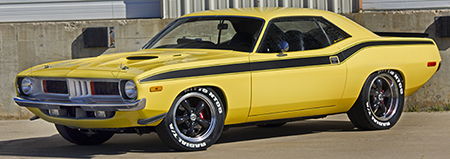
I've just chosen to live with it and check-up the brakes after reasonable turns. It's habit now.1972 Plymouth 'Cuda - Not LS-swapped, 5.7L Hemi [MS3 Gold Box], T56 Magnum 6-speed - 'Cuda Build Page
1976 Dodge D100 - Warlock
2016 Subaru WRX - E30 Tune

 Reply With Quote


