


Results 21 to 32 of 32
Thread: Oil Accumulator question....
-
05-15-2010 #21

 Registered User
- Join Date
- Sep 2006
- Location
- Henderson,NV
- Posts
- 2,870

You're still overthinking this whole deal. You leave the valve closed and fill your oil pan to capacity, THEN you add oil to fill the accumlator. Add 2.72-3qts, start the engine, pressurize the accumulator and close the valve. Your oil level should be perfect on the dipstick. You don't need it on the street unless you have a really crappy oil pan.
Todd
-
05-15-2010 #22
 Registered User
- Join Date
- Jan 2010
- Location
- Delaware
- Posts
- 689
Perhaps I am. I'll still verify it myself. I'd like to know how much it holds at idle, and also at full oil pump pressure.
There are 2 things an accumulator is used for. Oil starvation under race conditions and to reduce friction on start up. I'm going to use it for both. While I dont expect to need it on the street frequently Pontiacs are known for oil starvation on hard right cornering due to placement of the oil pickup. I do occasionally push my cars through the windy back roads.
Researching it has not given me a good reason to shut it off while running unless you have one?1973 Trans Am 455 SR block, ported 6x-8 heads, solid cam, Victor intake, 830 CSU carb, aluminum rods, 77mm Garrett turbo and methanol injection. 1064hp at the flywheel@5500 rpm

-
05-17-2010 #23
 Registered User
- Join Date
- Aug 2005
- Location
- Patterson, NY
- Posts
- 784
FWIW, if you wanted to prelube the engine before it's first startup you would start with no air pressure in the accumulator, and just fill it with oil. Then add air pressure to it to force the oil into the engine.
After doing that you'd have to set the pressure according to instructions.Jason Scheer
-
05-17-2010 #24
Registered User
- Join Date
- Jan 2010
- Location
- Delaware
- Posts
- 689
Thanks Jason, good point. Will consider doing that. And thanks to everyone for contributing their thoughts. Here was my last 2 posts in another forum on the same subject for anyone reading later to have the full story from my perspective.
69GTO - I just bought a used one for my car, but I have done some research and I don't know if I agree with you about the full 3 qts being in the accumulator at anything over 6 psi. Basically the accumulator has a piston in it. Initially you drive the piston all the way down with 100 psi with the valve open, shut the valve and then bleed off the remaining air leaving 6 psi. Then open the valve while running to allow oil into it.
When the engine is running oil pressure will force the piston back (being higher pressure) and oil will begin to fill the accumulator. The air pressure behind the piston though will also increase as the piston is forced back by the oil. How much that piston can be forced back by 15-20 pounds of oil pressure at idle is my big question.
Essentially it will take X pounds of oil pressure to force the piston back all the way and allow 3 qts to be inside the accumulator....but at this point without knowing the size of the air chamber as well as width and stroke of the piston I cannot calculate how much oil will be in it at any specific oil pressure.
If you could manually pressure feed 3 qts of oil into it you could just look at the air gauge on the unit(it has one right on it). Whatever the gauge said would be the oil pressure required to force 3 qts into it. You could try the same with 2 qts, etc. Can't think offhand what I could use to manually feed the 3 qts into it under pressure as a test.
I did determine that at idle I'm usually running around 20 psi oil pressure....not the 15 I originally thought. My hope is that 20 psi is enough to force the majority of the extra 3 qts into accumulator.
Only way I can think of to find out would be to idle it, shut the accumulator off, shut the engine down, disconnect the accumulator and see what it held at idle. Might not be a bad idea to do this........in fact would probably make sense to test exactly how much it holds at 70 psi just to verify it really took in 3 qts and didnt leave an extra 1/2 qt in the pan.
69GTO -
Interesting that you had yours 2/3 full......assuming that was left over from an idle situation when you closed it. Truthfully that has been my hope/guesstimate of what might be in there at idle with say 20 psi from the oil pump. That would mean an extra quart of oil in the pan at an idle, but thats not the same as having excess oil in the pan at 5500 rpm while the crank is spinning fast.
I could calculate it all if I knew the air chamber size. Piston diameter and stroke could give me an idea how quickly it fills and empties. I'd have to use a guesstimate on friction of the system due to viscosity of the oil, but I could get close. Would be nice to know how long it takes to squirt half its volume out into the motor at startup (assuming at that point it probably has 2 qts from an idle pressure in it). Obviously the more full the accumulator is the quicker it will squirt (initially, until air pressure drops)
I'm going to guess on about 3 seconds for a quart.......open accumulator, pump gas pedal twice, hit starter. Hopefully if I watch the oil pressure gauge the needle will be flickering just as I hit the starter.
In the end I think I'd use the oil to protect the engine on startup instead of the turbo on shutdown. I know I can bring the oil in the turbo down to a certain temperature range by idling before shutdown, but I have no other way to get oil pressure up in the motor before startup. The $ in the lower end of the motor, and the time it would take to pull it and rebuild are my biggest investments.
Probably paranoid anyway, but it only cost me $96 shipped for my VERY nice 3 qt Moroso accumulator with brackets, and to be honest its real use will be hard cornering someday. Pontiac put the pickup on the right rear and that leaves one vulnerable on hard right turns.1973 Trans Am 455 SR block, ported 6x-8 heads, solid cam, Victor intake, 830 CSU carb, aluminum rods, 77mm Garrett turbo and methanol injection. 1064hp at the flywheel@5500 rpm
-
05-28-2010 #25
Starting The Transformation
- Join Date
- Nov 2006
- Posts
- 264
Tell me about it. In the UK, we go round all the roundabouts clockwise. Originally Posted by aronhk_md

Most turns are right turns and oil starvation has been a big issue for me. I ended up moving the pickup to the left of the sump to limit the problem a bit. I think I'm going to have to get an accumulator though...my local track is a clockwise circuit with some real long right turns that I don't think my engine would survive. :(
Why are pontiacs so bad with oil surge? My car suspension has hardly been modified and the oil pressure drops off on fast road use. :(
I noticed, none of the engine's I've had have been rebuilt (by previous owners/builders) with the windage tray reinstalled.
Are these windage trays supposed to be part of the oil control on pontiacs...not just to stop windage?'79 Trans Am W72 400/4spd Y84 S/E with WS6 T-Tops LSD AC OK?
Remember, big engines are for those trying to compensate for something.
-
05-28-2010 #26
Registered User
- Join Date
- Jan 2010
- Location
- Delaware
- Posts
- 689
I cannot address why Pontiacs are so bad with oil surge besides pickup placement, but I know that they are. I cannot compare the other brands due to limited experience there.
The windage tray is only for windage. It does nothing to control lateral movement of the oil in the sump. I really dont know why previous rebuilders often left them off.
I have yet to experiment with my accumulator as it is not installed yet. One of the planned experiments is to see how long it takes with the engine shut off and oil hot for the accumulator to dump all 3 quarts into the engine as read by the gauge.
That will give me the MAX # of seconds I have once entering a corner where the oil pickup is uncovered. Most likely in reality it will be less. I have no data to support this but my guess is maybe 5-6 seconds.
Another option I plan to add later is a Canton style road race pan. It has baffles that slow oil travel. To go beyond this I think would require a dry sump system, and now we are talking serious money. I doubt it will be necessary for my needs.
1973 Trans Am 455 SR block, ported 6x-8 heads, solid cam, Victor intake, 830 CSU carb, aluminum rods, 77mm Garrett turbo and methanol injection. 1064hp at the flywheel@5500 rpm
-
06-07-2010 #27
Starting The Transformation
- Join Date
- Nov 2006
- Posts
- 264
Originally Posted by aronhk_md
The canton road race sump is gated too - not just baffled.
It's not just lateral movement of the oil that's the problem though...I think it moves up the side of the block and into the path of the crank and pistons. The windage tray will obviously stop the crank from picking it up when it travels up the side of the block...I wondered if it blocked it's path up there too?
I'll certainly buy one and fit it this time - I'll let you know what I find on the rebuild too.'79 Trans Am W72 400/4spd Y84 S/E with WS6 T-Tops LSD AC OK?
Remember, big engines are for those trying to compensate for something.
06-08-2010 #28 Registered User
- Join Date
- Aug 2004
- Location
- Rustburg, Virginia
- Posts
- 3,436
Correct, my Canton pan is baffled and has gates that swing only in one direction. Originally Posted by 79PonchoUK
1970 RS/SS350 139K on the clock:
89 TPI motor w/ 1pc rear seal coupled to a Viper T56 via Mcleod's modular bellhousing w/ hydraulic T/O bearing from the Viper, 12 bolt rear w/ 3.73 gearing, SC&C upper control arms, factory lowers with Delalums, C5 brakes at all four corners, Front Wheels 17x8's with Sumi 255/40/17 and Rear Wheels 17x9's with Sumi 275/40/17.
Brief description of the work done so far can be found here: http://www.nastyz28.com/forum/showthread.php?t=112454

06-08-2010 #29
Registered User
- Join Date
- Jan 2010
- Location
- Delaware
- Posts
- 689
Good info guys.....I have yet to see the inside of one of those pans. If you get one and have time post a pic or two?
Thanks1973 Trans Am 455 SR block, ported 6x-8 heads, solid cam, Victor intake, 830 CSU carb, aluminum rods, 77mm Garrett turbo and methanol injection. 1064hp at the flywheel@5500 rpm
06-08-2010 #30
Registered User
- Join Date
- Aug 2004
- Location
- Rustburg, Virginia
- Posts
- 3,436
This isn't anything like my pan...just a pic off the net of the one-way trap doors(gates) that we were discussing.
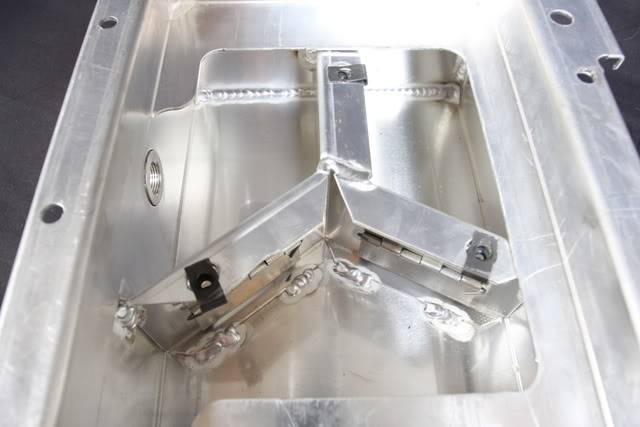
if you look closely, you can see the piano style hinge at the top of the trap doors.
The pan that I'm using came with these notes:
This Canton SBC late Corvette road race pan is for 1986 and newer blocks with one piece seal. It is designed for 1984-96 Corvettes, but will fit in early Corvettes as well. It has a 7" deep, 13-3/4" wide, 12" long sump, with a 7 quart system capacity. Will work with stock starter. This pan requires one of Canton's pickups.
The Pan Features:
Five Trap Door Baffles
Crank Scraper
Built In Screen Windage Tray
1/2" NPT Temperature Bung
Provision For Our Pan Mounted Dipstick
Magnetic Drain Plug
Includes a 20MM fitting For A Low Oil
Warning Sender (Purchase Canton p/n 22-405 Plug if not using sender)Last edited by John Wright; 06-08-2010 at 11:47 AM. Reason: added comments
1970 RS/SS350 139K on the clock:
89 TPI motor w/ 1pc rear seal coupled to a Viper T56 via Mcleod's modular bellhousing w/ hydraulic T/O bearing from the Viper, 12 bolt rear w/ 3.73 gearing, SC&C upper control arms, factory lowers with Delalums, C5 brakes at all four corners, Front Wheels 17x8's with Sumi 255/40/17 and Rear Wheels 17x9's with Sumi 275/40/17.
Brief description of the work done so far can be found here: http://www.nastyz28.com/forum/showthread.php?t=112454
06-09-2010 #31
Starting The Transformation
- Join Date
- Nov 2006
- Posts
- 264
That's very interesting. Originally Posted by John Wright
I've only ever seen trap door pans have the trap doors in line or perpendiular to the sump....
I made my trap door sump from the original pan using door hinges...it looks remarkably similar to the picture above with the trap doors in a V-formation.... I though it worked around the pump and the pickup better than doing them the other way.
It made a huge improvement over stock with my engine - as I say...when I really push it I still get surge but I suspect that's down to two things...
Windage and the huge size of the pickup making it easy to be uncovered. I welded a plate over my pickup with a smaller hole in it so it was harder to uncover but kept the same screen size inside..not sure why that wasn't done from the factory.'79 Trans Am W72 400/4spd Y84 S/E with WS6 T-Tops LSD AC OK?
Remember, big engines are for those trying to compensate for something.
06-09-2010 #32
Registered User
- Join Date
- Aug 2004
- Location
- Rustburg, Virginia
- Posts
- 3,436
I think it actually forms a diamond shape...you can only see one half of it in the pic. Originally Posted by 79PonchoUK
1970 RS/SS350 139K on the clock:
89 TPI motor w/ 1pc rear seal coupled to a Viper T56 via Mcleod's modular bellhousing w/ hydraulic T/O bearing from the Viper, 12 bolt rear w/ 3.73 gearing, SC&C upper control arms, factory lowers with Delalums, C5 brakes at all four corners, Front Wheels 17x8's with Sumi 255/40/17 and Rear Wheels 17x9's with Sumi 275/40/17.
Brief description of the work done so far can be found here: http://www.nastyz28.com/forum/showthread.php?t=112454

 Reply With Quote



