


Results 21 to 37 of 37
Thread: Hydraulic Clutch Smarties Needed
-
01-10-2010 #21

 -Moderator/Sponsor-
- Join Date
- Apr 2001
- Location
- The City of Fountains
- Posts
- 16,117

How did you go about determining the spacing of the bearing in relationship to the clutch fingers?
I don't like the loose fit over the bearing retainer snout. That doesn't seem right.
Andrew1970 GTO Version 3.0
1967 Cougar build
GM High-Tech Performance feature
My YouTube Channel Please Subscribe!
Instagram @dr__efi
I deliver what EFI promises.
Remote Holley EFI tuning.
Please get in touch if I can be of service.
"You were the gun, your voice was the trigger, your bravery was the barrel, your eyes were the bullets." ~ Her
-
01-11-2010 #22
 Registered User
- Join Date
- Aug 2006
- Location
- San Francisco, CA
- Posts
- 808
Hi Andrew: Originally Posted by andrewb70

The distance from my fingers to the mating surface of the bellhousing (with the tranny) is 3.2"
Mcleod says to thread the bearing onto the collar for 0.1-0.3" clearance between the bearing and the fingers when the bearing is fully compressed. I set my height from the tranny mating surface to the bearing as 3.05" Therefore my clearance is 3.2-3.05=0.15"
As a followup from McLeod, Fred has told me (via their forums here http://www.mcleodind.com/forum/showt...=3966#post3966 ):
At least they're on the record saying that the wiggle in the threads doesn't matter. As I stated above, I removed the weights so I think the source of my problems are over. I still have a disengagement issue but I think it's from improper bleeding. I checked for a throwout bearing leak like this (picture below), and it doesn't leak a bit! so I'm pretty sure the bearing is OK when everything is well aligned:First rule is Not to use a CenterForce pressure plate with our Hyd Bearing. The reason is two parts,
1) If the counter weights are working as they claim they are,then the counter weight would flex the levers of the pressure plate back toward the transmission causing the bearing to be pushed back into the bore. Now remember that bearing will always move the same distance every time you push the clutch pedal. IF the bearing needs to move .450" to release the clutch, and your bearing moves .500" when the clutch pedal is depressed, you will have good release. BUT.. if the bearing is pushed back into the bore by.125" and now you push the pedal and the bearing moves .500". You will be short of disengagement by .075" of bearing travel, because the first .125" of bearing travel will only get you back to the fingers of the pressure plate, which will only leave you .375 of bearing travel after the bearing reaches the fingers. NOT ENOUGH.
2) As you press the finger of the CenterForce pressure plate down, the couter weights come closer together and sometimes they will pinch the side of the bearing and jam the release.
The wiggle of the adjusting screw is not that important, because as the bearing is applying pressure to the pressure plate, it is also applying pressure to the adjusting screw and the wiggle is gone. Just remember to adjust the bearing to the correct distance from the Pressure plate fingers when installing.
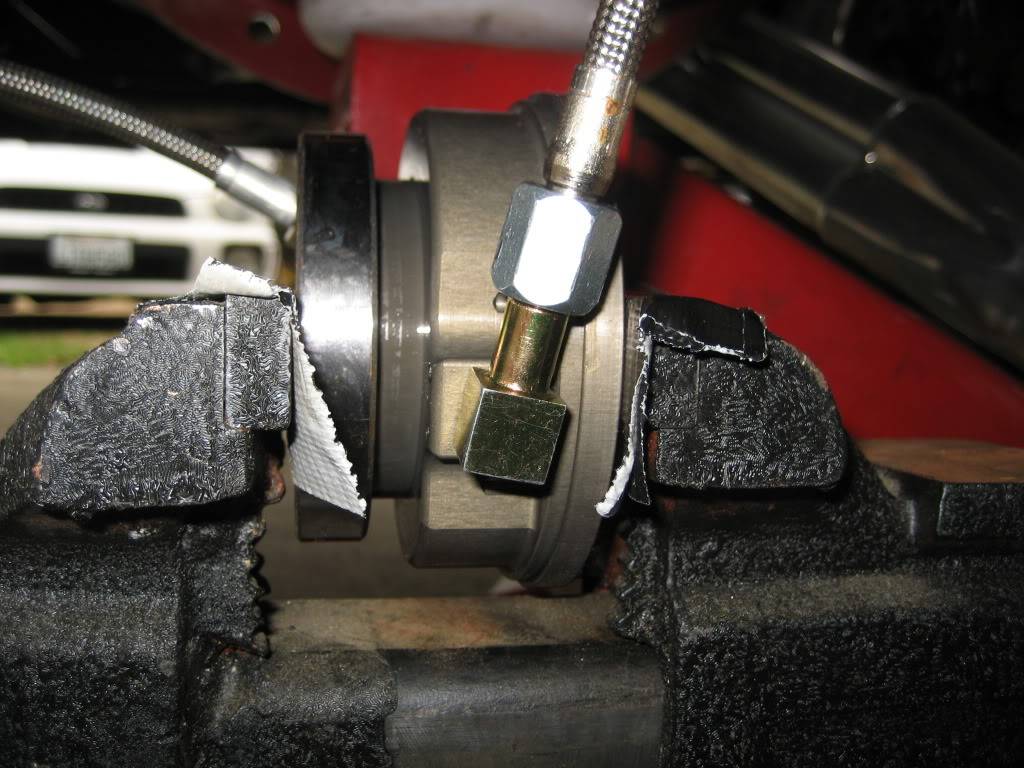
I'll check back in when I re-bleed and let everyone know how it turned out.
Thanks, StevenLast edited by sik68; 01-11-2010 at 09:07 AM. Reason: had more to say
-
01-11-2010 #23
 Registered User
- Join Date
- Apr 2005
- Location
- Cartersville, GA
- Posts
- 1,299
This may not be the case, but I did find a car once with a hydraulic clutch that was doing the exact same thing...it went from shifting fine, to only going into a couple of gears. After searching everything else and drawing a blank, I realized that the threaded holes in the aluminum bellhousing were slightly wallowed out, and as a result a few of the bolts were loosening just slightly. I helicoiled every bolt hole, put it back together, and it solved the problem.
Joe Hinds
-
01-16-2010 #24
Registered User
- Join Date
- Aug 2006
- Location
- San Francisco, CA
- Posts
- 808
OK, I have an update. I think the problem is not with my clutch, which seems to work perfectly as I drove the car for 20+ minutes today. However, toward the end of the drive, the shifting acted up again and I limped the car home using 3rd gear the whole time and never shifting. The problem seems to me to be in the transmission. I know a couple of you have already guessed this with the shift rails, but I am pretty clueless on the inner workings of a TKO so perhaps someone can help with more detail.
Here's a video describing my problems. Basically, the car won't let me select another gear while it's on. I did buy the transmission used, so hopefully something isn't TOO seriously wrong with it. Kiesler, Classic Chevy, or anyone else with ideas? I did dial indicate my bellhousing to within 0.005". And the transmission does shift OK when it's not warmed up. I used GM Syncrhomesh fluid.
Video:
Video showing that the clutch/throwout bearing is working
Thanks!
Steven
-
01-16-2010 #25
Registered User
- Join Date
- Aug 2007
- Posts
- 271
Well, I've only had mechanical clutches but the issue of the shifter not going into gear sounds similar to when I've had my clutch adjustment out of whack and the clutch was simply not fully disengaging. If the trans is still slightly engaged with the engine, it can't slow down enough for the steeper gear (1st) and definitely not reverse, or it will grind.
Is there anyway to tell if the clutch is completely disengaging? I'll bet the clutch engages right off the floor when you take off.
Easy fix for mechanical but no idea with hydraulic...anyone else?Tom Koontz
-
01-17-2010 #26
 Registered User
- Join Date
- Apr 2001
- Location
- Rockford Illinois
- Posts
- 3,949
It really just sounds like the shifter to me. Have you had it out to look at the movements for slop? When it is cold it may have enough friction to keep it stable and when it warms up it starts to float where it wants causing problems.
If the clutch is starting to grab right off of the floor then you might be able to adjust it .050 or so and change it sgnificantly but I really doubt it is the clutch.
To be able to start out in 3rd is somewhat proof that the clutch is working like it should or you would have killed the motor or gone nowhere fast.
Check with Keisler about it to be sure about what to do, used trannies can be crapshoot like any other used part.
Good thing is that it will be like new if you send it to them and they go over it for you and do what is needed.
I know it is not what you want to hear and I can attest to the pain you are going through. The good thing is that you are making progress whether you see it or not.
I will keep hoping that you can just fix it with a shifter tune up. maybe buying a faster throw shifter is possible and you could get it to work and get faster shifts?
I'll keep positive thoughts for you.May The Horsepower Be With You !!!
-
01-17-2010 #27
Registered User
- Join Date
- Aug 2006
- Location
- San Francisco, CA
- Posts
- 808
Thank you very much Tom and Jim. Tom, the throwout bearing is adjustable because it can be turned on threaded collar that slides onto the input shaft.
Jim, my shifter is a Pro5.0 aftermarket shifter. I wonder though if there is something up with it. The clutch does feel fine to me although some people are guessing that it's not fully diesngaging. I'm not so sure if I agree with that because I could sit at a light with the clutch depressed and it wouldn't move, even when I would rev it. I am eager to hear what Kiesler or Classic Chevy have to say. Thanks for hanging in there with me.
-
01-17-2010 #28
Registered User
- Join Date
- Aug 2006
- Location
- San Francisco, CA
- Posts
- 808
For more exposure in the transmission section, I have started a thread there. I will still keep tabs on this thread as well. Here is the link: https://www.pro-touring.com/forum/sh...ad.php?t=64259
Thanks everyone. Again I am the guinea pig on this forum. It will all be worth it once it's solved and everyone gets smarter or at least entertained for a while.
-
01-18-2010 #29
-Moderator/Sponsor-
- Join Date
- Apr 2001
- Location
- The City of Fountains
- Posts
- 16,117
I would repeat this test again with someone putting twist on the driveshaft while the trans is in gear. This will tell you if the clutch is being fully disengaged. You can also be over-traveling the spring fingers, at which point the clutch will start to engage again. The bearing is certainly moving quite a bit. The question is how much of the movement is taking up the air gap and how much is going towards releasing the clutch. The test I mentioned will shed a lot of light on things. Originally Posted by sik68
Andrew1970 GTO Version 3.0
1967 Cougar build
GM High-Tech Performance feature
My YouTube Channel Please Subscribe!
Instagram @dr__efi
I deliver what EFI promises.
Remote Holley EFI tuning.
Please get in touch if I can be of service.
"You were the gun, your voice was the trigger, your bravery was the barrel, your eyes were the bullets." ~ Her
-
01-18-2010 #30
Registered User
- Join Date
- Aug 2006
- Location
- San Francisco, CA
- Posts
- 808
Andrew thank you very much that is a perfect idea trying to turn the driveshaft. I am not familiar with the pressure plate geometry...does the pressure plate really begin to change direction and head back towards the clutch if depressed too far? Originally Posted by andrewb70
With the air gap, if you look closely the video shows that the bearing is always in contact with the fingers even when the clutch is not depressed. The throwout bearing is always partially extended, filling the would-be air gap. This is confirmed by Mcleod as the way they designed it...they have said that bearing life is OK because there should be very little to no load between the fingers and the bearing. I set the gap to 0.15", which Mcleod recommends between 0.100 and 0.300 to allow for expansion and clutch wear.
-
01-19-2010 #31
 Registered User
- Join Date
- Aug 2004
- Location
- Rustburg, Virginia
- Posts
- 3,436
Maybe I'm not seeing it correctly, but to me it looks like the T/O bearing is bottoming out on something. It appears to come to an abrupt stop at the end of the clutch pedal travel. I'm wondering if you have it travelling too far for the pressure plate fingers, like others have stated already.
1970 RS/SS350 139K on the clock:
89 TPI motor w/ 1pc rear seal coupled to a Viper T56 via Mcleod's modular bellhousing w/ hydraulic T/O bearing from the Viper, 12 bolt rear w/ 3.73 gearing, SC&C upper control arms, factory lowers with Delalums, C5 brakes at all four corners, Front Wheels 17x8's with Sumi 255/40/17 and Rear Wheels 17x9's with Sumi 275/40/17.
Brief description of the work done so far can be found here: http://www.nastyz28.com/forum/showthread.php?t=112454
-
01-19-2010 #32
 Registered User
- Join Date
- Jun 2006
- Location
- NW burbs IL
- Posts
- 1,732
When the clutch is working, does the car shift smoothly? I had an issue last year and when the revs were up I could not get into gear. Getting it into gear with the engine off does not tell you much. The fact it will not go into gear while running shows us the clutch is not releasing like it should. I chased a problem last year and it ended up being a bad master cylinder that would bypass internally and / or pull air into the system. Sometimes it worked fine, but then put some miles and heat on it and it was harder than hell to shift the car. Then take it out for another drive and it seemed fine.
I believe the video of the cluth throw-out bearing shows it working correctly. I doubt that is how it is acting when the problem rears its ugly head. Testing the master is a tricky one, I could never get the defective one to show a problem. When bleeding the system it would get rock hard and then seem to loose it. The master can suck air into the system as well as the throw-out bearing. Testing for pressure leaks is one thing, but the system has to stay sealed under " vaccum " also. Bleed the system with a mityvac to draw all air out of the system. I like to pull 10" - 15" or so and let it sit to check for leaks. You can also lightly tap all components to help dislodge any trapped air.
P.S. The faulty master tested perfect under pressure when capped off.
Matt
Current project: " Chain Reaction "
A.K.A. " BIG " by wife, biatch in garage.
1969 RS Camaro L92 T56 Quadra-link, CW sub, Ford 9" a progressive build.
Ex track car: 1995 Camaro LS1 T56
-
01-19-2010 #33
Registered User
- Join Date
- Aug 2006
- Location
- San Francisco, CA
- Posts
- 808
Thanks John. That would be awesome if it is just a matter of not pushing the pedal down so far to disengage. I already have a pedal stop ready, but I haven't installed it because these problems were happening, so I could diagnose. I really can't tell why it bottoms out so abruptly. It could be the pressure plate, or maybe the master cylinder bottoming. The allowable travel on the wilwood 3/4" master is 1.4" if I remember right, so when I stroke the pedal I will measure how much travel I'm getting.
Yes, when it's working, it is a bit notchy but there's no sensation that it's resisting me, going from gate to gate. Just an easy "click-click". Almost as easy as in the video with the car off. Originally Posted by Bow Tie 67
For bleeding, I do have a positive pressure bleeder that pressurizes at the cap. Pumping it up to 10-15psi, you think this would let me check for bleed-down like you're talking about?
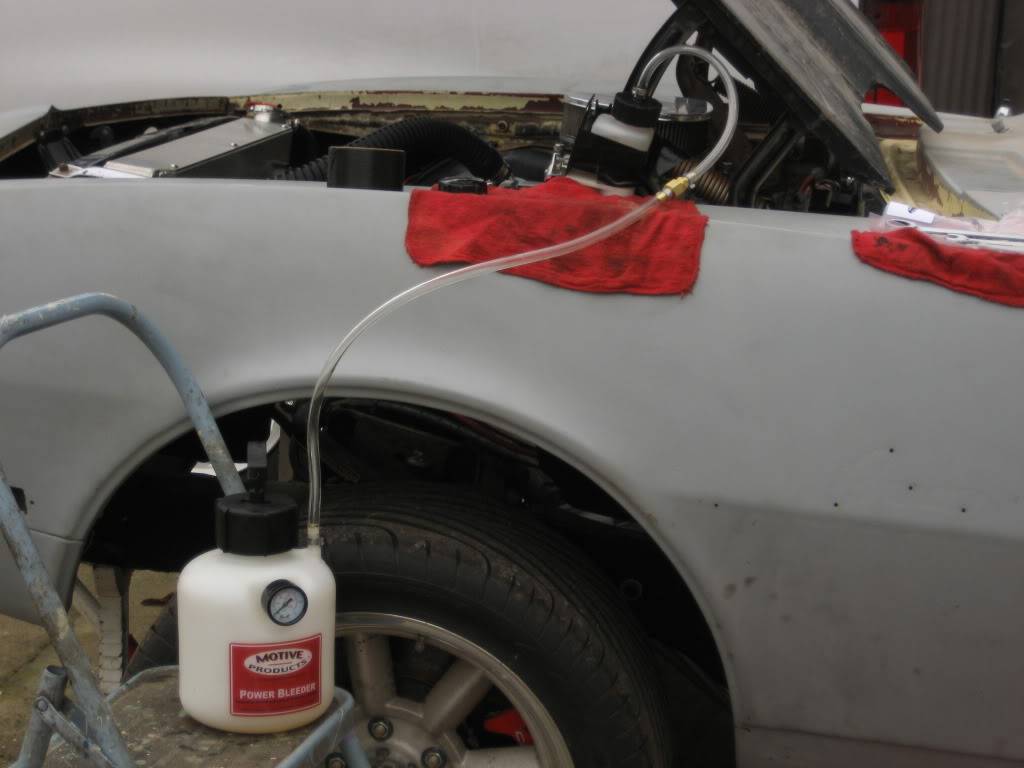
Thanks,
Steven
01-19-2010 #34
Registered User
- Join Date
- Jun 2006
- Location
- NW burbs IL
- Posts
- 1,732
Although that is a nice system, its not the same as using vacuum to pull out air and check for air leaks.
Matt
Current project: " Chain Reaction "
A.K.A. " BIG " by wife, biatch in garage.
1969 RS Camaro L92 T56 Quadra-link, CW sub, Ford 9" a progressive build.
Ex track car: 1995 Camaro LS1 T56
01-19-2010 #35
Registered User
- Join Date
- Apr 2001
- Location
- Rockford Illinois
- Posts
- 3,949
I too think vacuum is better and faster but it requires 2 people with such a small reseviour. Originally Posted by Bow Tie 67
I have a mighty vac but chose to gravity bleed both times I had to do mine by myself. I filled the reseviour almost full and slowly pumped the pedal 2 times and let it flow keeping it full. After I had 3 times as much fluid in the catch container than was needed I watched for air bubbles and when they were gone I watch the reseviour get to the point it should be at and closed the bleeder.
I had no problems both times I had to do it. I have a Howe but I would think it would work the same for a McCleod.
I am pulling for you to get this figured out sooner than later as I totally understand the frustration you are going thru.May The Horsepower Be With You !!!
01-20-2010 #36
Registered User
- Join Date
- Jun 2006
- Location
- NW burbs IL
- Posts
- 1,732
Jim and Steven,
When I say use vacuum, I'm referring to using it at the reservoir.
I start by bleeding it in a conventional manner. Then I attach a tapered adapter to the mightvac hose and insert it into the clutch reservoir outlet. Make sure the fluid level in the master reservoir is over the tapered adapter and hose union, then apply your vacuum. I have done this numerous times by my self and end up with a rock solid pedal.
MattMatt
Current project: " Chain Reaction "
A.K.A. " BIG " by wife, biatch in garage.
1969 RS Camaro L92 T56 Quadra-link, CW sub, Ford 9" a progressive build.
Ex track car: 1995 Camaro LS1 T56
01-20-2010 #37
-Moderator/Sponsor-
- Join Date
- Apr 2001
- Location
- The City of Fountains
- Posts
- 16,117
Did you do the test? If the bearing is traveling too far it will start to push the whole pressure plate assembly back towards the flywheel and the air gap between the disk and pressure plate will start to close. This is also very hard on the thrust bearing in the engine. Speaking of which, have you checked that? If you have access yiu can simply check the air gap between the disk and flywheel to confirm that the clutch is being fully released. Use a feeler gauge. Confirm with centerforce, but you probably want a gap between .060" and .090". Originally Posted by sik68
Andrew1970 GTO Version 3.0
1967 Cougar build
GM High-Tech Performance feature
My YouTube Channel Please Subscribe!
Instagram @dr__efi
I deliver what EFI promises.
Remote Holley EFI tuning.
Please get in touch if I can be of service.
"You were the gun, your voice was the trigger, your bravery was the barrel, your eyes were the bullets." ~ Her

 Reply With Quote