


Results 41 to 53 of 53
Thread: global west vs. sc&c
-
10-03-2009 #41
 Pro-Touring Veteran
- Join Date
- Aug 2004
- Location
- NY
- Posts
- 1,070
I am sure Marcus will chime in but as per SPC SC&C part numbers are different for 1st gen then regular SPC arms. I had a set and the part numbers were not as indicated in catalog and SPC said they were SC&C only. I did notice that there were some changes from an earlier set I had bought years ago. The mtg arms from the crossbar to arms is now bent.
If you are looking to bolt them on and forget them go Global, DSE, or the many others. If you want adjustability go with SC&C. Actually SC&C are the only set up that allows you to make the adjustments that you want with added header clearance.
-
10-03-2009 #42
 Registered User
- Join Date
- Sep 2002
- Location
- San Jose, CA
- Posts
- 1,793
I have also heard that Mark customizes the a-arms.
1971 Camaro, 383 stroker ~500HP,M21 Trans with lightened flywheel. All Sorts of Auto-x Goodness in the Suspension. 12" Brakes ->SOLD
But ask me about my 2004 STi Auto-x car...
Just call me Brett
-
10-03-2009 #43
 Registered User
- Join Date
- Nov 2008
- Location
- So. Cal.
- Posts
- 1,240
 Hi Brian. A dealer commonly places his own part numbers on the parts he is distributing. It makes good for his own internal paperwork. All distributors do it. Go to summit, jegs, or whoever. They all sell SPC arms and arm components. They apply their own numbers for the exact same part. You can buy anything from the SPC catalog from summit.
 Originally Posted by BRIAN

But lemme tell you, you wont get nearly the price break and customer service that you will get from SCC.. Really, give Mark a call one day at SCC.. LOL I loved it. The dude is a car guy just like me.. And he really knows something about suspension geometry, but wont speak engineer talk to you. He will talk with you and come up with some decent ideas. And Mark can deal in anything in the SPC catalog. The folks at summit may not be all that savy, they have a huge line of products to deal with. Oh yeah, call SPC too, great folks!! I was on the horn with them also. They know their products, even the first level phone folks, surprising in this day and age. JR
-
10-03-2009 #44
 Registered User
- Join Date
- Jan 2009
- Posts
- 111
if you're considering the SPC UCAs I highly recommend the alum links. The standard round links makes it difficult to adjust by hand. I found my hand slipping and wished I could adjust it with a crescent wrench as would have been possible with the alum links.
wish i could return and switch mine!car blog... updated sporadically. http://regans66.blogspot.com/
-
10-03-2009 #45
Registered User
- Join Date
- Nov 2008
- Location
- So. Cal.
- Posts
- 1,240
Umm.. Read my post before. I use a combo of shims and adjustable arms. And arm length DOES change the camber curve dramatically, even small changes. And I didnt even go into bump steer and roll center changes. Just camber gain changes. A small amount of arm length does have a large effect on camber gain and roll center position. Originally Posted by Norm Peterson
I had the luxury to be able to try many, oh so many combos of shims and arm lengths. I have air bags. So I could run my arms all through the motions. I set it up with the wheels degreed in movement and measured the changes in camber and caster with varying arm lengths and shims. I wrote down every combo.
And I just ran through all types of changes.. After about four pages of numbers I came up with a decent setting for me. And I learned alot. I saw the effects of camber and caster. How alot of caster actually gives you some major camber in a turn. Saw the link between the two adjustments.
So after mapping out ALL the camber and caster changes that I could possibly do. Thats with changing arm lengths, un-equal arm lengths, shims, un-equal shim packs and every possible combination I mapped out a profile on paper. Its actually kinda cool. I can look at all the settings I made, see what adjustments I made and documented so I can go back, and see where the perfect combination of shims and arm length is.. I LOVE IT!!!! Its all down on paper. So I can dial in that combo at any time.
And this is just for my car,wont work with any other cars. But I have my map. And now I have the numbers. If I want a certain amount of camber gain, Ill just dial it in. If the caster is too much but I dont want to mess with the camber gain I have that number too. Change a shim here, adjust a arm there, DONE..
And Im always setting the static camber at around .5 degrees. Toe at almost straight up, just a lil in, maybe a 1/16". I always kept those two numbers the same. They had to stay there IMO.
And it all depends on what car we are talking about. But the change in arm length is still just as dramatic on all the cars. For the most part we cant set our upper arms, the frame attaching point low enough. Show me a production car that it is too low and Ill be happy, plenty of room for improvement. But usually they are too high, sometimes WAY too high. Ideally you want to be in the 3 O-clock position when the lowers are also at 3. But crazy as it sounds some production cars have the upper arms at below 3. So as the upper arm is coming up on bump its actually pushing the top of the spindle OUT. Bad camber change. Where on bump it should be be pulling the top of the spindle in (camber gain). Then if its really bad it transitions over past 3 O-clock, and abruptly goes from pushing the spindle top to pulling it in. WHOA is the feeling you normally feel. All of a sudden in the turn, specially if its got some bumps, the tire grabs cause it gets more contact patch and it pulls in.
Most drivers can handle the sub 3 O-clock (4 to 3) movement. But if you have a car that transitions over that point it makes for a grabby ride. It goes from pushing the upper over to pulling it in. Weak contact patch on the tire to all of a sudden grabbing because the tire lays down and gets a full contact patch. And when the transition is too fast because of a short arm it gets hairy. The outside tire grabs fast and causes some dramatic oversteer when you may not want it when you were fast in a corner in plow mode (understeer). Thats when the rear comes around and says I wanna be in front...
So the better approach is to stay at just above 3 O-clock at ride height. Then in the turns its always pulling the top of the spindle in, camber gain.
I dont know. I may be taking it too far for the average guy that wants to drive his car. And thats all I want from my car, just drive it. I wont race it, never will. Im retired so I have to spend my time f-in around with something. My car and shop is my retirement present. I love it all.
And yeah, I may have some OCD issues LOL Not nearly as bad as some of the guys that want nuthing but aircraft fasteners in their cars though. Now those guys are really OCD Kidding bolt fanatics JR
-
10-08-2009 #46
Full Blown G-Machiner
- Join Date
- Sep 2004
- Location
- PA.
- Posts
- 935
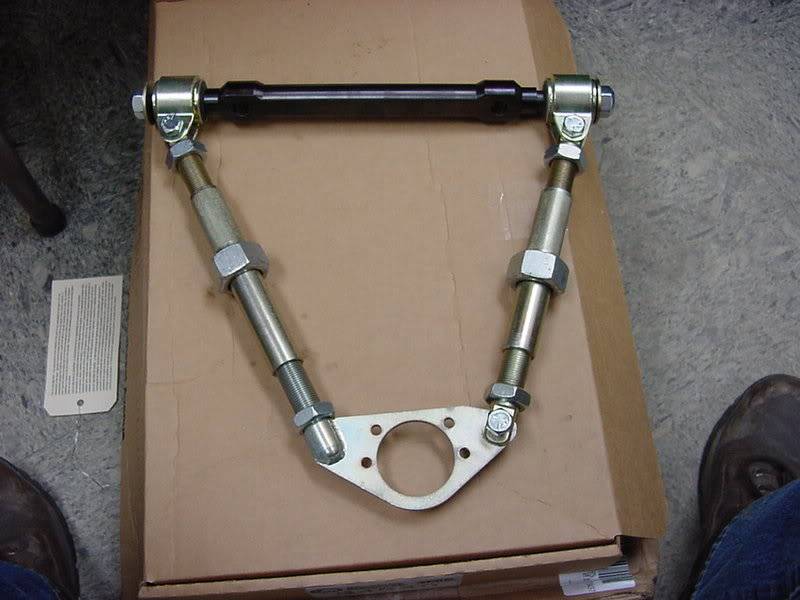
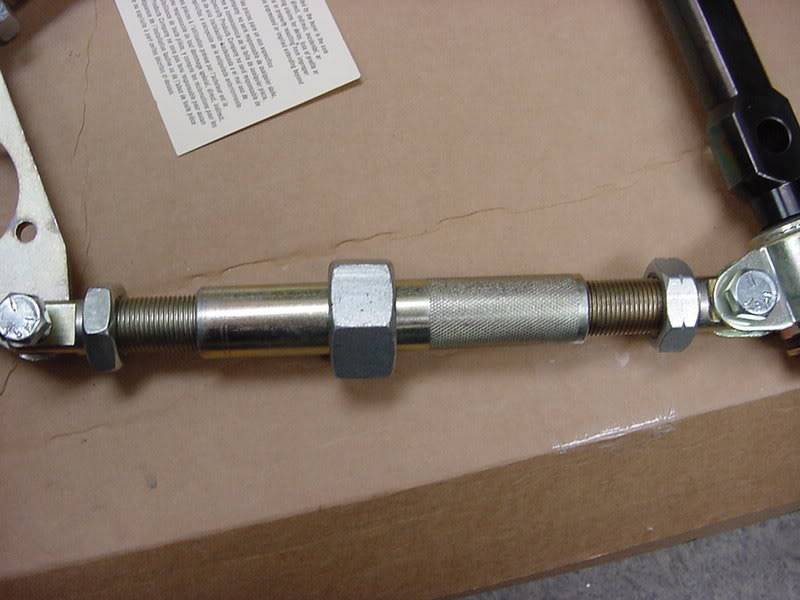
Hey guys, sorry I`m late to the party! For a little clarification, SPC makes SPC arms, but we have them assemble many arm configurations for our packages that are not otherwise cataloged. Probably 75% of the arms we sell fall into this catagory. The bottom line is that once we change improve the geometry of the front end we almost always have to reconfigure the arms length, offset and even ball joint plate mounting angle for proper fit and function. One of things we like about these adj. arms is that while any change in alignment, arm offset via shims or change in arm length naturally changes the camber curves etc., changing the length of the arms makes less of a change than shimming the same amount. Using a shim on a fixed arm moves all 3 of an arms pickup points to new locations, adj. arms move only a single point (the ball joint) so it`s easy to see what there is less disturbance to the camber curves, RC location etc. Since very few of these cars are exactly bilaterally symetrical that lets us achieve very minimal variation side to side. It`s also cool that we can make use of both the adj. arms AND shims for various purposes. For example setting the performance street alignment with the arms and the auto X alignment with the shims. That makes it a 5 minute deal to go from street to race settings at the track and you don`t even have to get under the car.
Mark SC&C
10-08-2009 #47 Registered User
- Join Date
- Aug 2004
- Location
- Rustburg, Virginia
- Posts
- 3,436
I added some weight to the arm, but mine is now adjustable by wrench.....LOL Originally Posted by RYU
 1970 RS/SS350 139K on the clock:
89 TPI motor w/ 1pc rear seal coupled to a Viper T56 via Mcleod's modular bellhousing w/ hydraulic T/O bearing from the Viper, 12 bolt rear w/ 3.73 gearing, SC&C upper control arms, factory lowers with Delalums, C5 brakes at all four corners, Front Wheels 17x8's with Sumi 255/40/17 and Rear Wheels 17x9's with Sumi 275/40/17.
Brief description of the work done so far can be found here: http://www.nastyz28.com/forum/showthread.php?t=112454
10-08-2009 #48 Registered User
- Join Date
- Apr 2009
- Location
- san jose,ca
- Posts
- 180
Thanks for all the good info. I will be getting the stage 2 kit which I think will pair nice Originally Posted by Marcus SC&C
With my i-roc steering box

10-08-2009 #49 Registered User
- Join Date
- Nov 2002
- Location
- state of confusion
- Posts
- 1,499
Let's start by agreeing on some definition of "small changes". Originally Posted by JRouche
I suspect that if you shorten the UCAs by half an inch without relocating the chassis-side pivot outward by a similar amount (so as to essentially retain the static camber setting) that things will change more significantly than if you're working with ±1/8" here and ±1° there. But that wouldn't be relevant to a daily-driveable set of alignment specs (1/2" inward relocation of the UBJ ==> more than a -3° change in static camber).
I can throw all this stuff at a spreadsheet that plots camber and camber gain curves as well as a few other things.
Norm'08 GT coupe, 5M, suspension unstockish (the occasional track toy)
'19 WRX, Turbo-H4/6M (the family sedan . . . seriously)
Gone but not forgotten dep't:
'01 Maxima 20AE 5M, '10 LGT 6M, '95 626, V6/5M; '79 Malibu, V8/4M-5M; '87 Maxima, V6/5M; '72 Pinto, I4/4M; '64 Dodge V8/3A
10-08-2009 #50
Registered User
- Join Date
- Nov 2008
- Location
- So. Cal.
- Posts
- 1,240
Ok, first off, we will agree, no doubt. Ill agree with you in a second. I have nuthing but respect Norm. Originally Posted by Norm Peterson
I was just trying to show what I noticed, on my car. I have the springs removed and all the other components installed and aligned, steering and all. I was just playing around, trying to get a grasp on how the system worked together. And it was nice to have the springs out and some time.
So I mapped out a degree pattern on the floor. I have turn plates but I was working with the wheel up. And THATS the main issue why my setup isint correct. I may talk about that later.
So anyway. I ran through all the combos. Short arms, thick spacers. In between, semi thick spacers, longer arms. I did this through no spacers and the longest arm I could get from the SPC arms. To max spacers and the arms as short as they will go. In 1/16th inch increments. I ran the suspension through its entire travel with all the combos. Documenting all the numbers the entire time, with every change.
And that was straight up with both arms equal and using the vertical plate for caster which gives me about 2 degrees of caster with the arms equal. I also did it with varying amounts of arm offsets to change the caster.
I was always looking for an 1/8" on toe in and a 1/2 degree on static camber. I wanted to keep those two numbers constant no matter what.
So being its a system you change one thing you have to go back and check and prolly change the other settings. Toe and camber. Like I said, I had some time.
I chased the numbers all around the place. What I was shooting for was a degree of camber change for each inch of wheel travel.
I thought I wanted the max amount of caster. Just about 6 degrees for my car. Well, Im re-thinking that now. I wasnt shooting for 6*. I was looking at 5.5* But after thinking about that number it might be too heavy on the steering for me. Im throttling back to 3* of caster.
A good amount of caster can work with you and kill you at the same time. You will get some additional camber gain with more caster. And it will work out some bumpsteer issues. It almost sounds like a fixall. But when they say heavy steering they mean it. It will be like a truck without power steering. It will snap back and be not much fun to drive on the streets. Highway speeds!!! Yer gonna be using the steering wheel more than you might like to. Great for the track. But for the street car it will be a fight.
So I backed off the caster to a reasonable amount. Was still able to get the camber gain to a decent number. It trails off as the compression cycle goes up. Starts out at close to 1* for an inch of travel. Then to .81* for the next inch then to .80* for the next inch. Till it bottoms and goes to .75*.
And I only checked it for compression, the loaded outside tire, the one thats gonna take all the abuse on a turn. The inside tire?? Well?? She is gonna be treated like a red headed step child, she gets to go for the ride but doesnt get much say so for the trip. LOL
I have pages upon pages mapping out all the configurations from arm length and spacers. I like it so now I can go back and look at all the numbers and get the exact setup that looks good. Ill be able to dial in what looked good during the playing around.
Idealy Id love to be able to sink the upper arm frame mounts an inch or more down. And the frame has the room, and the arms would clear. But that would mean removing the engine and I really need to stop working on this pig and just drive it. So thats not gonna happen.. Maybe the next project car
JR
10-08-2009 #51 New to Pro-Touring
- Join Date
- Jul 2009
- Location
- canada
- Posts
- 78
Do you also check how much camber gain you get in proportion to the wheels being turned also? Doesn't caster add some camber proportionate to the amount the wheels are turned? And depending on the car and weight distribution. The amount of anti-dive changes the caster from static to variable during bump/rebound?
Most of the information that is on race cars says that the anti-dive be as minimal to keep the caster as constant if possible. That is mostly do to their low center of gravity though. But most OEM cars have fixed control arm locations that limit messing with the anti- dive. And since most have lowered, altered weight distribution and so on on their respective vehicles. Would this not need be thought about especially for a performance based application?81 Malibu- work in progress.
350 sbc, T56, 8.5" Auburn posi 3.42, 4wdb, GW suspension
and now with unknown seats.
10-09-2009 #52
Registered User
- Join Date
- Nov 2005
- Posts
- 257
This thread is very interesting, I was just thinking about custom A arms. Thanks for posting.
Killer Comet
10-09-2009 #53
Registered User
- Join Date
- Apr 2009
- Location
- san jose,ca
- Posts
- 180
Ya no prob I've got so much great info. Originally Posted by streetrod77

 Reply With Quote