


Results 1 to 20 of 25
Thread: pull/pushrod suspension
-
03-14-2008 #1
 Registered User
- Join Date
- Feb 2008
- Posts
- 148
pull/pushrod suspension
im considering changing the design of my truck's rear suspension from a 'conventional' 3link with coilovers, to a 3link with bellcrank suspension due to packaging and cost issues (i can machine small parts easily, but a full crossmember i cant)
has anyone on this forum done anything of this sort with a solid rear axle?
any major issues to be looked at?
tips? etc?
also, i know most F1 teams use pushrods now, but has anyone found anything backing up which is actually superior over the other (push/pull) yet?
i believe F1 uses push due to packaging
-
03-16-2008 #2 Registered User
- Join Date
- Sep 2006
- Location
- New York, NY
- Posts
- 458

less unsprung weight
03-16-2008 #3 -Moderator-
- Join Date
- Apr 2001
- Location
- Central CA USA
- Posts
- 6,114
Yes, packaging is the reason for it's use in F1. Keeping the shocks out of the airstream and reducing the width of the chassis. Originally Posted by greencactus3
I don't believe there is any unsprung weight lowering from using pushrod or pullrod suspension, the shocks still move and transmit their inertia to the suspension.
I'd stay away from this type suspension if at all possible. If you are considering it only because you lack the skills to make the conventional parts, either pay someone to do it, or trade for the work. I'm sure someone with fab skills would like to have some parts machined.
DavidDavid Pozzi http://www.pozziracing.com67 Camaro RS that will be faster than anything Mary owns.
03-16-2008 #4
Registered User
- Join Date
- Feb 2008
- Posts
- 148
unsprung weight is definilty lower with this setup, because only half the connecting rod is going to be unsprung. the forces are transmitted to the shock, but the mass is still sprung.
any particular reason behind staying away from this type?
i can build most small parts to precision.
(i am building an SAE formula car now anyways)
only reason i can't do larger parts is because i cant weld, and asking a teammate to weld small parts is one thing, but having him weld a full crossmember with various bracketry is too much.
im pretty confident that if i do end up going with this method, id be able to pull it off, but i was just hoping for some input based on experience whether actually doing it, or any solid reasoning not to.
im also considering this due to basic packaging reasons as well
03-16-2008 #5
-Moderator-
- Join Date
- Apr 2001
- Location
- Central CA USA
- Posts
- 6,114
I disagree, half the shock and spring moves with the wheel, so half the shock and spring is unsprung, the bellcrank moves too, so it's the rod, bellcrank and half the spring/shock. There is a motion ratio for it relative to the wheel, so it wouldn't be 1 to 1 with it.unsprung weight is definilty lower with this setup, because only half the connecting rod is going to be unsprung. the forces are transmitted to the shock, but the mass is still sprung.
Most of the bellcrank suspensions are used on ground effects cars that are VERY stiffly sprung, and the rocker assy can provide a rising rate geometry which is common.
No reason you can't make one work, but I prefer a more simple system if possible, - less to go wrong, less complicated, probably more reliable. The rocker pivots are not going to last forever on a street driven truck unless they are greaseable with some kind of good bearings or large bushings inside, and the push rods or pull rods would have to be very heavy duty to carry the loads that might be placed on them. What's the load capacity of your truck? There will be a lot of work in the mounting of the shocks and pivots, much more work than simply making a crossmember to mount coil overs.
I've seen Heim joints used on Autocross cars that flat wore out in 8 months of street use. They work fine for a race or autocross car, but the potholes and bumps of normal street use did them in. It's that durability I'd worry about in any linkage you would use. I'm not as concerned about fitting the setup under the truck.
DavidLast edited by David Pozzi; 03-16-2008 at 07:18 PM.
David Pozzi http://www.pozziracing.com67 Camaro RS that will be faster than anything Mary owns.
03-16-2008 #6
Registered User
- Join Date
- Feb 2008
- Posts
- 148
yea, i have wondered about the durability issues.
no worries about load capacity tho. i will design it for an unloaded bed, and unless i have confidence in the capacity, it will stay that way.
im already working on making it a progressive rate, and as for the 'conventional' method of slapping on the coilovers, they just wont fit under the stock bedfloor, without limiting the sus travel more than i want. (dont want to mount the shocks on the link bars)
as you said, i will try to use greasable bearings on each joint. i do not plan on using bushings if at all possible.
lastly, this is just too much fun! and if i do pull it off, thats one more thing to brag about. i doubt anyone has done a pushrod suspension setup on a streetable s-series yet
03-17-2008 #7
Registered User
- Join Date
- Aug 2003
- Location
- Southern Louisiana
- Posts
- 377
You may want to rethink making it a progressive rate. As David stated, ground effect cars do that. In short, at speed, a ground effect cars suspension "thinks" the car weighs more than it really does. The spring rate needs to be higher. When the car is going slower, the spring rate needs to be lower, because now the suspension "thinks" the car weighs less. Overall, the car will always have the correct spring rate for the amount of travel being used. Keep in mind that we're not talking about more than a couple inch's of bump travel here anyways.
If you set up the rear of your truck with a progressive rate, what's fine at the first 1" of travel will be way too stiff at 2". The weight at the rear of your truck doesn't change, but the spring rate will. Not a good idea.
Kevin
03-17-2008 #8
Registered User
- Join Date
- Feb 2008
- Posts
- 148
hmmm...
i was thinking leaving it progressive would be better than, say having it linear, and have a progressive bumpstop on the end.
i am aiming for max 4in of compression and maybe about 2in of extension from ride height (just numbers pulled out of nowhere)
and i can probably play with the geometry until it is almost linear (heh, a standard mounting method isnt totally linear anyways :P) for the first 2 in of compression, and then step up the rate for the other 2 inches.
if i can accomplish that, i think i might be okay on that matter? maybe?
03-17-2008 #9
Registered User
- Join Date
- Feb 2008
- Posts
- 148
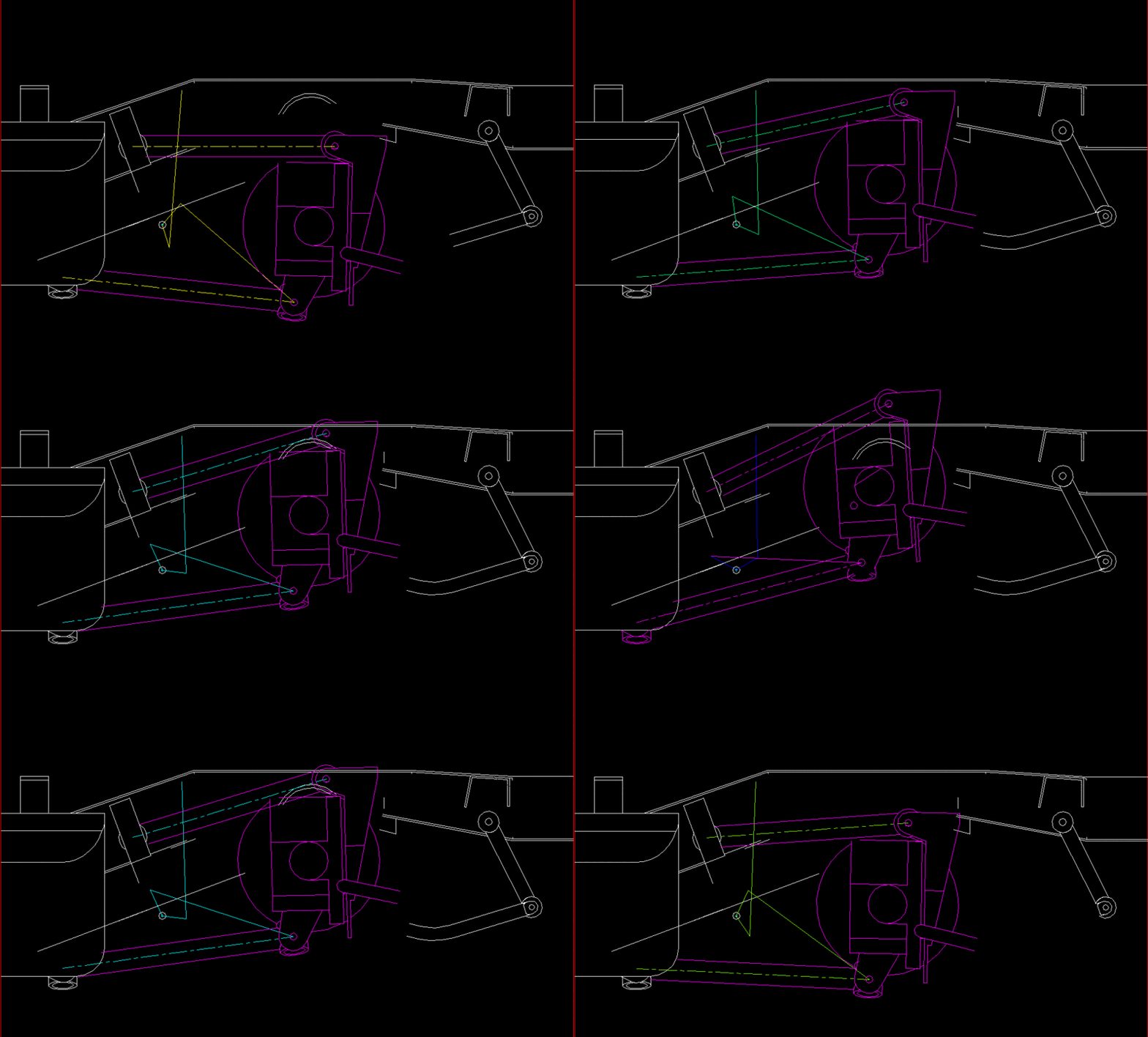
definitly not a final design or geometry or close to it, but this is where im at now.
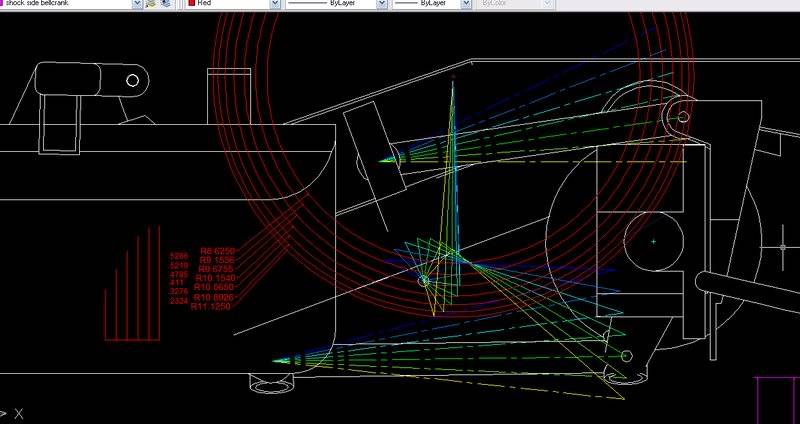
with crappy animated .gif
03-18-2008 #10
-Moderator-
- Join Date
- Apr 2001
- Location
- Central CA USA
- Posts
- 6,114
It looks like you will lose a huge amount of spring rate due to the low pushrod angle. Gaining it back, or choosing a good shock rate and spring rate will be a challenge. I'd give a hard look at what is the stock spring rate at the wheels, and try to achieve that or slightly lower since you say it won't be loaded that heavily. I've seen street rod pickups that had 150 lb/in coil springs used on them and were still pretty stiff.
It's hard to tell where you have it now, but at normal ride height, set the rod to bellcrank arm angles at 90 degrees.David Pozzi http://www.pozziracing.com67 Camaro RS that will be faster than anything Mary owns.
03-19-2008 #11 Registered User
- Join Date
- Aug 2002
- Location
- Sweden
- Posts
- 910

Mount the coil over in a horisontal position instead of a vertical and adjust the rocker arm (or whatever it's called in english...).
Here's an example of positioning the coil overs;

Don't do the modification to gain unsprung weight... If you want to chase weight, start with swithcing the rear axle for something lighter...
03-19-2008 #12
Registered User
- Join Date
- Aug 2002
- Location
- Sweden
- Posts
- 910
6" travel is way too much. You'll get trouble with the rocker arm geometry, unless you're planning some serious off road driving...
1" droop and 3" bump of wheel movement (which means even less damper movement. Depends on what ratio you're going for on the rocker) would be more than enough...
03-19-2008 #13
Registered User
- Join Date
- Feb 2008
- Posts
- 148
as of that sketch i had the rod to bellcrank angle at 90 degrees at full droop. any reason to have it 90 at ride height other than the 'efficiency' of it being at 90? Originally Posted by David Pozzi
how much total bellcrank angle movement do you suggest i aim for?
as of now it is 102.5 degrees of total movement of the bellcrank across 6in of travel at the wheel.
for 3" of bump and 1" of droop, 67.3 degrees.
i dont see the reason why i should position them horizontal. the main reason for this is due to packaging issues trying to fit it under the bed floor. also, im not famliar with ferraris, but from that picture it seems to just be a cantilevered uca? rather than pushrods? Originally Posted by Ripper
that is the numbers ive heard too, but i figured daily driving in michigan roads calls for the need for more than the 'standard'. Originally Posted by Ripper
even if the shock never sees full extension or full compression, i would much rather know that the shock is not destroying itself.
as far as i can tell with that current sketch, the rocker arm geometry seems to work fine throughout the full travel.
03-19-2008 #14
Registered User
- Join Date
- Sep 2006
- Location
- New York, NY
- Posts
- 458
how much lower than stock are you planning? How big is your frame notch? It looks like just a small 2 inch notch. Theres definitely room to mount coilovers conventionally. Design the axle mount to put them 5 or 6 inches below axle centerline, crossmember at top of frame just below bed, and if necessary you can angle the coilovers in.
Jerome
03-19-2008 #15
Registered User
- Join Date
- Feb 2008
- Posts
- 148
im aiming for a 6" ground clearance to the frame, so that would be about a 4 to 5" drop from stock i believe. Originally Posted by jerome
it is a 2.25" notch
i am also running som pretty short tires (24.7") and seeing the massive craters of potholes we have around here, i dont want to have anything hang down that low.
but if all else fails with the bellcrank idea, that method will work.
04-03-2008 #16
Registered User
- Join Date
- Feb 2008
- Posts
- 148
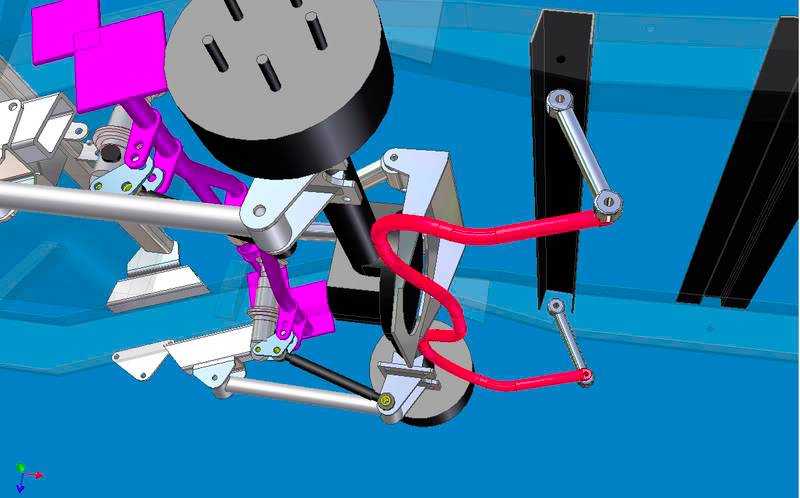
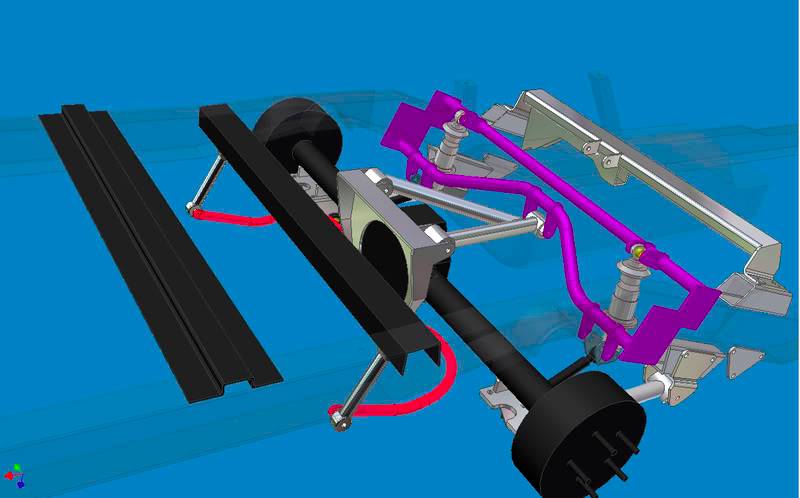
these screen shots should help you guys visualize what im going for
04-05-2008 #17
Starting The Transformation
- Join Date
- Aug 2004
- Posts
- 194
Why are you directing so much spring force rearward instead of downward?
04-05-2008 #18 Rat Pack Member

- Join Date
- Nov 2004
- Location
- LYNCHBURG,OHIO
- Posts
- 512
I have been working on a coilover design for the cyclone/typhoon for the last few months and I have figured out that I can mount a coilover stock frame mount on top.The lower link plate I have designed,has a mount for the lower coilover.I can post pics of my plate I had fabricated. From where you are mounting your coil over at,by the stock fuel tank cross member,I cant see you being able to run a very long coilover. You stated you wanted extra room for MI roads. My design gives you 4.5" to the ground from the frame. I designed my "kit" from a cyclone that was lowered 3" more than a factory cyclone. There for I dont see your 4-5" drop being a problem. I designed my "kit" to be a bolt on deal, that way if they decided to return there trucks back to stock they could with out a hassle. Hope this helps.
Greg Tholen
GT Motorsports
Dealer for Wilwood,Baer,Viking,Moser,BMR,Earl's
(937)763-7272


04-05-2008 #19
Registered User
- Join Date
- Aug 2003
- Location
- Southern Louisiana
- Posts
- 377
Two thoughts.
That rocker arm link is going to have a hard time holding up the rear end at that angle. I'd say you need to have it at a minimum of 45* in side view.
Did you leave out the watts or panhard bar in your drawing? That upper link will not hold the rearend laterally all by itself.
Ok, make it three thoughts.
Are both shock mounts, rockerarm mount, and pushrod axle mounts all in the same plane, looking at it in plan view? Or does everything skew in towards the vehicle C/L in plan view?
If I may just throw an idea out. Crap, I looked a the drawings again and realized the crossmember (s) are for the shocks/rockerarms AND the top link. I'll just say it anyway.
If you were to move the crossmember for the rockerarms back and down , you could get the angle if the pushrod more straight up and down (which it needs to be). You would also be able to lay the shock down to keep it from intruding into the bed(which the shock doesn't care what orientation it's in). Basically the rockerarm would be directly over the pushrod(good thing), the rockerarm would mount on top of the crossmember(where you have the shock mounted now), and the shock would mount on the rockerarm where you have the crossmember mounting now. Like I said, the shock doesn't care if it's layed down, but the pushrod does.
Hope this makes sense. By the way, I really like the out of the box thinking.
Kevin
04-05-2008 #20
Registered User
- Join Date
- Feb 2008
- Posts
- 148
Beige,
i also have thought about that, but from the pictures of the F1 cars i have looked at, it would seem that they (although they do use much better materials than i will be) have pushrod angles that would seem non ideal. the forces on the pushrod/bellcrank just get higher with a bad angle correct?
796spdbu,
i would love to see what you have done! one thing that bugs me. its syclone. not cyclone lol
gt1guy,
im not quite sure what you mean by the 45*, can you explain that part again? do you mean the 'vertical'ness of the pushrod should be 45* from horizontal?
im pretty sure the wishbone upper link would locate the rearend laterally by itself. i have no worry about that part.
but why do you say it wouldnt?
the pushrod is skewed inwards at the bellcrank, but the shock mounts are both in the same plane.
i like the idea of laying the shock down to get a longer stroke out of the shock, but i cant move the bellcrank closer to the axle by much because im still trying to get the full stroke of 4" bump and 2" rebound at the wheel.
i could make the bellcrank larger to shorten the angular stroke of the bellcrank, but that accentuates the play i have in any component.
and thanks!! i appreciate the comments
(also picked up don alexander's high-performance handling book today. hopefully this will help a lot more)

 Reply With Quote