


Results 21 to 40 of 43
-
09-06-2013 #21

 Registered User
- Join Date
- Sep 2006
- Location
- New York, NY
- Posts
- 458

I am considering making an offset upper link as an acceleration link (collapsible, but not extendable) and a centered upper link as a brake link (extendable, but not collapsible) to decouple braking and acceleration geometry. The acceleration link will run downhill from rearend to chassis (high anti-squat under acceleration) and the brake link will be flatter (high SVSA length under braking). The centered upper link takes care of any asymmetry under braking.
A couple questions:
1. Acceleration and brake links will travel along different arcs.
Chassis pickup point heights are different (to create high anti-squat and high SVSA length)
Chassis pickup points are slightly different longitudinally (packaging)
Rearend pickup point heights are slightly different (packaging)
Rearend pickup points are slightly different longitudinally (packaging)
I have not run through a simulation yet to determine whether there will be kinematic bind. Anybody have guesses on whether this arrangement works? The commercially available acceleration and brake links do not seem to have more than 0.5" of travel in the collapse/extension non-load directions.
2. Any other issues with this concept?
-
09-06-2013 #22 Registered User
- Join Date
- Apr 2006
- Location
- Yankton, SD
- Posts
- 240
 Originally Posted by Ron Sutton

Since I don't have an accurate CG for my car yet, I had to make some assumptions and build in some adjustability. If my CG estimate is close, my AS for anything but drag racing is right at 50%. If I go to the drag strip, I can drop the rear of my lower control arms into a lower hole and get a little bit more than 100% AS.
09-06-2013 #23
Registered User
- Join Date
- Nov 2012
- Location
- Sacramento, CA
- Posts
- 1,918
If you're running poly bushings, they have to be replaced on a regular basis, or they crack, break & come out. This varies with durometer rating, load, & number of cycles. When they break & fall out, the suspension links have monster excessive travel, which makes the car unstable on braking & acceleration. Originally Posted by jerome
09-06-2013 #24 -Moderator-
- Join Date
- Apr 2001
- Location
- Central CA USA
- Posts
- 6,114
Bad Penny & the One Lap Camaro have the Lateral Dynamics 3 link. I've driven them both & never experienced brake hop, even when rear brake bias was excessive. I always read warnings about it, but I think if the links are reasonably long, it isn't going to be a problem.
David Pozzi http://www.pozziracing.com67 Camaro RS that will be faster than anything Mary owns.
09-06-2013 #25
Registered User
- Join Date
- Nov 2012
- Location
- Sacramento, CA
- Posts
- 1,918
Hi Shawn,
Again, you should make your rear suspension adjustable, so you can tune it for optimum performance. You may find 50% AS makes the car loose on corner entry under hard braking ... depending on the rest of your suspension set-up. You may not. It simply needs adjustment range to be dialed in for your car, your set-up & your driving activities. Originally Posted by feeble
Make sense?
Last edited by Ron Sutton; 09-06-2013 at 07:55 AM.
09-06-2013 #26
Registered User
- Join Date
- Apr 2006
- Location
- Yankton, SD
- Posts
- 240
Ron: Thanks for your input. I assumed a CG height of 20" and have built in some adjustability. All of it bolts together as well, so I can redo some or all the parts if the optimum falls outside of the adjustment ranges. I am well versed in redoing things several times until I get them right. ;-)
09-06-2013 #27
Registered User
- Join Date
- Nov 2012
- Location
- Sacramento, CA
- Posts
- 1,918
LOL. Take care ! Originally Posted by feeble
09-10-2013 #28
Registered User
- Join Date
- Sep 2006
- Location
- New York, NY
- Posts
- 458
Originally Posted by Ron Sutton
I have figured out a way to get enough travel in these collapsible/extendable decoupled braking and acceleration links to allow the suspension to cycle through full travel. This will allow me to have a link active only during braking and a link active only during acceleration.
Under acceleration:
Acceleration link is offset to passenger side and will help offset driveshaft torque, in addition to providing anti-squat that can be adjusted to any value without affecting any braking characteristics.
Under braking:
Braking link is centered laterally on the rearend and will not have any assymetrical effects. Under braking, rearend will try to forward (pinion downwards) and so the brake link will be loaded in compression. I am trying to figure out what the brake link angle should be when optimizing only braking characteristics (as it does not affect anti-squat).
- Uphill towards chassis: pushes up on chassis and down on the rearend during braking. Weight transfer forwards acts through the third link instead of just unloading the springs, making the rearend push the chassis upwards, which makes the rear of the car rise more.
- Flat: no upward or downward forces acting during braking.
- Downhill towards chassis: pushes down on the chassis and up on the rearend during braking. Weight transfer forwards acts through the third link instead of just unloading the springs, making the rearend push itself up into the chassis, which makes the rear of the car rise less.
I think theoretically #3 would be best because it keeps the CG height down for less weight transfer to the front wheels. Would you generally want to design with #3 in mind and keep increasing the downhill angle towards the chassis (reducing SVSA length) and stop when you experience brake hop?
Jerome
09-10-2013 #29
Registered User
- Join Date
- Apr 2006
- Location
- Yankton, SD
- Posts
- 240
Just throwing this out there without a lot of thought, but wouldn't you want AS to be as close to zero as possible on the braking link?
09-10-2013 #30
Registered User
- Join Date
- Nov 2012
- Location
- Sacramento, CA
- Posts
- 1,918
So, what are you using to take up the slack & compress when needed? Poly bushing? Spring? Something else?
09-10-2013 #31 Registered User
- Join Date
- Sep 2008
- Location
- Jacksonville, Florida
- Posts
- 634
Have you looked at circle track pull bars? Lots of travel. I modified one to use as my upper link used under braking (torque arm for accel). You need to preload each with some type of bushing as Ron stated.
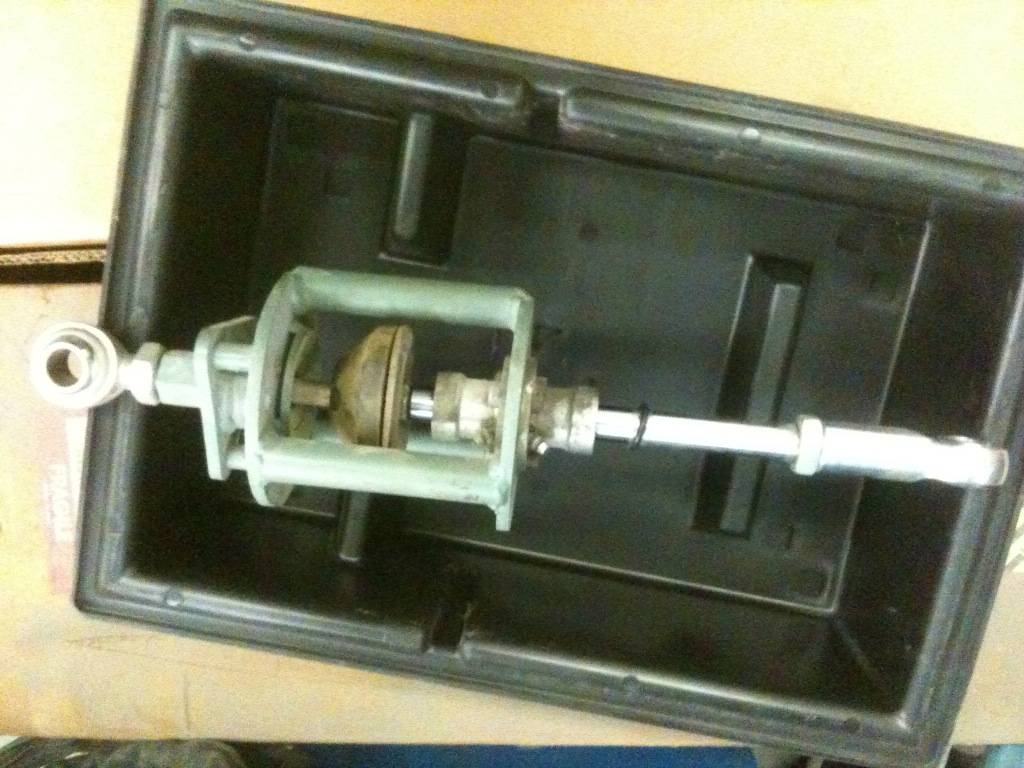
This is my modified pull bar that I now refer to as a "push bar". As you can see, the bushing "cage" can be extended to allow more or less travel.Craig Scholl
CJD Automotive, LLC
Jacksonville, Florida
904-400-1802
www.cjdautomotive.com
"I own a Mopar, I already know it won't be in stock, won't ship tomorrow, and won't fit without modification."
09-10-2013 #32
Registered User
- Join Date
- Sep 2006
- Location
- New York, NY
- Posts
- 458
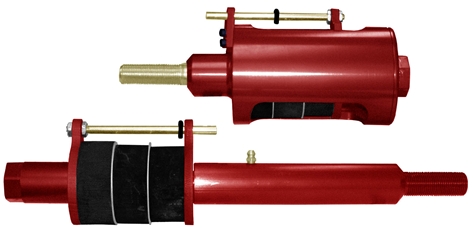
lower link from the below picture for the braking link: Originally Posted by Ron Sutton
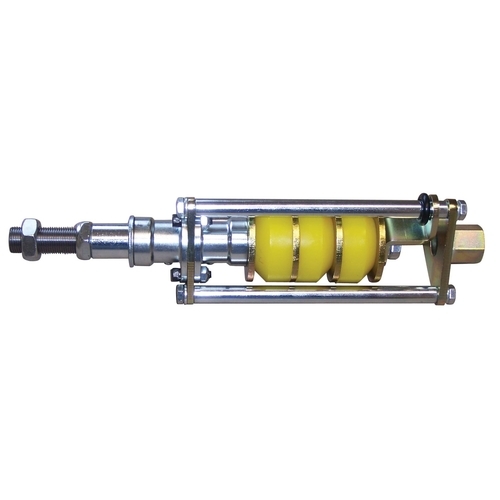
acceleration link (run only one of the biscuits):
09-10-2013 #33
Registered User
- Join Date
- Nov 2012
- Location
- Sacramento, CA
- Posts
- 1,918
The red Coleman unit uses rubber bushings. The unit with the 3 yellow bushings, uses poly bushings.
Both of these work fine, but with use (cycles of compression & release) crack & split. You'll want to replace them annually. Think of them as a wear item like brake pads.
.
09-10-2013 #34
Registered User
- Join Date
- Nov 2012
- Location
- Sacramento, CA
- Posts
- 1,918
Jerome,
Are you clear that this type of suspension linkage has to compress the lower bushing to compress the rear suspension? The rubber bushing is hard & doesn't compress easily, so it acts like an additional stiff spring in the rear suspension.
These work well in racing applications. And it will do what you're looking to achieve performance wise. But, it will make the rear suspension ride rougher. Because if you hit a bump or dip with both rear tires, your spring rate is substantially stiffer than just the two rear springs. Plus the rubber bushing is a progressive spring, meaning its spring rate gets stiffer as it compresses. So it will not compress far, it will just bounce the rear end up.
When you hit bumps with either individual tire, the suspension on that side doesn't simply compress like in a normal suspension. It rocks the rear suspension and rear of the car's body ... compressing one side & extending the other side. So it "shakes" the car from the rear.
That's when the links are "in line" with each other. If you mount them apart from each other, you will get an interesting "diagonal rocking" situation over bumps. It will rock & shake the rear of the car more over bumps one direction versus the other.
I'm not trying to talk you out of this type of suspension. I have a LOT of experience with this type of suspension linkage and other variations of this in racing applications. If tuned correctly, they add performance for track days. But there are cons for street applications. I just want you to hear it from someone with experience, so you know what you're getting into.
.Last edited by Ron Sutton; 09-12-2013 at 04:03 PM.
09-10-2013 #35
Registered User
- Join Date
- Sep 2006
- Location
- New York, NY
- Posts
- 458
I spent some time drawing and thinking it through - you're right. I was thinking about it too simply and did not realize that in bump, the acceleration link would need to get longer (which it can't) or the deceleration link would need to get shorter (which it can't). In rebound, there would be no bind, the acceleration link could get shorter and the brake link could get longer. The rearend would be free to flop between pulling on the acceleration link and pulling on the brake link depending on what the tires are doing. Originally Posted by Ron Sutton
09-10-2013 #36
Registered User
- Join Date
- Nov 2012
- Location
- Sacramento, CA
- Posts
- 1,918
Like I said, I have ran this type and other designs quite a bit. They work well in racing applications. But they do make the rear end spring rate much harder and more likely to rock than to compress.
Spreading the links apart would create a unique, amplified rocking situation.
09-10-2013 #37
Registered User
- Join Date
- Sep 2008
- Location
- Jacksonville, Florida
- Posts
- 634
Is this going to be present in any decoupled 3 link type suspension? I think I see what your saying, but not sure why the spring rate would increase, but do see how it would "rock" between bushings on the upper and lower links (accel/decel links). Wouldn't a bump just cause the rear to rock to the accel stop bushing and then the rear springs start controlling compression? Originally Posted by Ron Sutton
Craig Scholl
CJD Automotive, LLC
Jacksonville, Florida
904-400-1802
www.cjdautomotive.com
"I own a Mopar, I already know it won't be in stock, won't ship tomorrow, and won't fit without modification."
09-10-2013 #38
Registered User
- Join Date
- Sep 2006
- Location
- New York, NY
- Posts
- 458
At ride height, imagine the two links in side view where they originate from the same point on the rearend. The brake link is parallel to the ground and the acceleration link points downwards towards the chassis. You now have a triangle where the top link is free to extend and the acceleration link is free to collapse. The problem in bump is that if the brake link stays at its shortest and pivots upwards to follow the rearend, the acceleration link needs to get longer (which it cannot). If the acceleration link stays at its longest, the brake link would need to compress (which it cannot). The stop bushings end up adding spring rate until they are no longer elastic and then you have a bind situation. Originally Posted by sccacuda
09-10-2013 #39
Registered User
- Join Date
- Nov 2012
- Location
- Sacramento, CA
- Posts
- 1,918
Originally Posted by sccacuda
Good question Craig,
Your question implies there is a gap before the bushing engages. For these double-link top link systems to work properly, there can be no gap.
When the car is at rest, at ride height, both the bushing on the decel link and the bushing on the accel link have some load on them. I've had cars with springs in front of the axle, and that set-up causes more load on accel link bushing. I've had cars with the springs behind the axle, and that set-up causes more load on decel link bushing.
If you were to run a double-link top link system with gap in the bushings, the rear end would "flop" back& forth under slight acceleration or deceleration. Plus gap defeats the purpose and function of a double-link top link system. Frankly, when you really dial in a double-link top link system for optimum performance, you will end up with several rounds of preload on the bushings in most cases.
You know that energy takes the path of least resistance. So when you have a double-link top link system ... with the bushings touching or preloaded to a degree ... and you hit a bump on the right rear tire ... the energy goes three places. Some of it compresses the right rear spring, some it compresses the link bushing and some of it rocks the body on the car by extending the left rear spring ... lifting the body on that side.
This is easiest to see with GoPro digital video cameras under the car pointed at the suspension. We typically run two. But I have ran three, so I can watch the affects on pinion angle during all the different motions of double-link top link system.
09-16-2014 #40
Registered User
- Join Date
- Dec 2009
- Posts
- 261

Bringing this one back up to add, maybe you could birdcage the rear brakes? A birdcage is basically a bearing that goes over the axle tube, so that the rear brake would attach to a big sleeve over the axle, which would then have a seperate link to the suspension. That way you could add all the anti-squat you'd like, and have the brake links set to a more preferable angle.
Tags for this Thread

 Reply With Quote





