Results 1 to 20 of 23
Thread: How much do shims change camber.
-
10-12-2010 #1

 Registered User
- Join Date
- Aug 2004
- Posts
- 567
How much do shims change camber.
If i wanted to increase the camber from -.7 to -2.0 with a few shims, anyone know the sizes without doing an alignment.
Nathan Shaw
71 Nova, 1000+whp 5.3, 8 second autoXer.
-
10-12-2010 #2
 Registered User
- Join Date
- May 2002
- Location
- Northern California
- Posts
- 10,716

thats almost impossible to predict due to frame and mounting differences.
MrQuick ΜΟΛ'ΩΝ ΛΑΒ'Ε
-
10-12-2010 #3
 Registered User
- Join Date
- Sep 2006
- Location
- Henderson,NV
- Posts
- 2,870
Google..... I'd guess about 3/16-1/4.
Todd
-
10-13-2010 #4
 Registered User
- Join Date
- Nov 2002
- Location
- state of confusion
- Posts
- 1,499
Approximately,
sin(1.3°) x ([UpperBallJoint height] - [LowerBallJoint height])
For a 9" difference in ball joint heights, Vegas' numbers (above) are certainly in the ballpark. 9 * sin(1.3°) = 0.204"
Norm'08 GT coupe, 5M, suspension unstockish (the occasional track toy)
'19 WRX, Turbo-H4/6M (the family sedan . . . seriously)
Gone but not forgotten dep't:
'01 Maxima 20AE 5M, '10 LGT 6M, '95 626, V6/5M; '79 Malibu, V8/4M-5M; '87 Maxima, V6/5M; '72 Pinto, I4/4M; '64 Dodge V8/3A
-
10-13-2010 #5
Registered User
- Join Date
- Aug 2004
- Posts
- 567
Thanks
Nathan Shaw
71 Nova, 1000+whp 5.3, 8 second autoXer.
-
10-13-2010 #6
 Registered User
- Join Date
- Jan 2008
- Location
- Long Beach, Ca
- Posts
- 1,564
But, by adding more camber, you will also be increasing Toe-in.... Food for though.
-
10-13-2010 #7
 Registered User
- Join Date
- Sep 2002
- Location
- San Jose, CA
- Posts
- 1,793
Alignment is more complicated than this...
1971 Camaro, 383 stroker ~500HP,M21 Trans with lightened flywheel. All Sorts of Auto-x Goodness in the Suspension. 12" Brakes ->SOLD
But ask me about my 2004 STi Auto-x car...
Just call me Brett
-
10-13-2010 #8
Registered User
- Join Date
- Nov 2002
- Location
- state of confusion
- Posts
- 1,499
It sounds like a temporary swap from a moderate performance street alignment to something a bit more aggressive for, say, autocrossing.
Yes, it might also help to tweak toe, but that's kind of a separate question in this particular scenario.
Norm'08 GT coupe, 5M, suspension unstockish (the occasional track toy)
'19 WRX, Turbo-H4/6M (the family sedan . . . seriously)
Gone but not forgotten dep't:
'01 Maxima 20AE 5M, '10 LGT 6M, '95 626, V6/5M; '79 Malibu, V8/4M-5M; '87 Maxima, V6/5M; '72 Pinto, I4/4M; '64 Dodge V8/3A
-
10-13-2010 #9
 Registered User
- Join Date
- Mar 2009
- Location
- SoCal
- Posts
- 1,240
-2.0 degrees is pretty aggressive for street use. If your car sees more street miles than track miles, I hope you take it back to -0.7 when not on the track. That or flip your tires before you wear out the inner shoulders.
Brett H.
1979 Pontiac Firebird Trans Am
1991 Mazda Miata
2005 Ford Mustang GT
1987 Ford Mustang GT - Sold 06-29-2014
1988 Oldsmobile Cutlass Ciera - RIP 9-17-2011
1992 Chevrolet Corvette - Sold 10-12-2017
-
10-13-2010 #10
 Registered User
- Join Date
- Jun 2006
- Location
- Katy,TX
- Posts
- 1,678
Actually most factory GM shop manuals, at least for second gens, have a very detailed chart for if your settings are "this" how many shims to add and where to get "there". So I guess GM thought it was that simple.
-
10-13-2010 #11
Registered User
- Join Date
- Aug 2004
- Posts
- 567
I have it aligned on a "street" setup with 5.5 caster and -.7 camber. Ill be autocrossing this weekend and would like to throw some shims in to get it to -2.0. Ill adjust the toe too. Any recommendations on that? Toe out right?
Nathan Shaw
71 Nova, 1000+whp 5.3, 8 second autoXer.
-
10-13-2010 #12 Full Blown G-Machiner
- Join Date
- Sep 2005
- Location
- East, Tennessee
- Posts
- 574
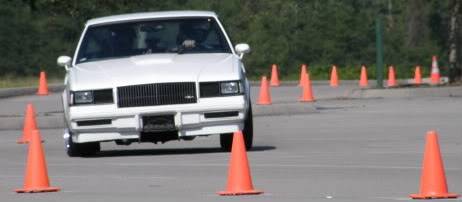
I don't know much about the Nova settings and where they should be but I run -1.2 camber on the street on my Buick G-Body and have no issues what so ever with inner wear on the front tires! Originally Posted by LS1NOVA

DSE sells their "Track shim kit" just for this reason, so you can add shims at the track and change Camber!
Here are my settings:
Camber: -1.2*
Caster: -6.15*
Toe: 3/32"1986 Buick T-Type
RideTech, DSE, BAER Brakes, Forgeline Wheels, LED lighting, More!
* Get your Top of the line GPS Theft recovery devices Here!
www.GNSperformance.com
10-13-2010 #13 Registered User
- Join Date
- Jun 2005
- Location
- Greenwood, SC
- Posts
- 2,314
Originally Posted by Norm Peterson
Norm, where'd you pull this equation? Not doubting, just want to get my hands on the source as it seems like it may be valuable to have locked away somewhere.
10-13-2010 #14
Registered User
- Join Date
- May 2002
- Location
- Northern California
- Posts
- 10,716
I agree but it should actually be measured to get an accurate degree. Originally Posted by xxxturbo6
We had measured shim packs pre set at the shop for track swaps.
All in all most of our cars like -.7 to -1.3 degrees
VinceMrQuick ΜΟΛ'ΩΝ ΛΑΒ'Ε
10-14-2010 #15
Registered User
- Join Date
- Nov 2002
- Location
- state of confusion
- Posts
- 1,499
I'm not that familiar with your chassis, but if it's a "front steer" arrangement, the toe will move towards (and probably into) toe-out as you shim the upper control arm inward and you might not have to even touch it. A rear steer car will go toward more toe-in. Originally Posted by LS1NOVA
For starters, try 1/8" (toe-out). Make paint marks and count turns. If you know the thread pitch and the steering arm length, you can estimate how many turns would be necessary to change the individual toes per 1/16" or whatever unit degree change you'd choose to use. Don't forget that one turn of the adjuster equals two threads adjustment distance.
Norm'08 GT coupe, 5M, suspension unstockish (the occasional track toy)
'19 WRX, Turbo-H4/6M (the family sedan . . . seriously)
Gone but not forgotten dep't:
'01 Maxima 20AE 5M, '10 LGT 6M, '95 626, V6/5M; '79 Malibu, V8/4M-5M; '87 Maxima, V6/5M; '72 Pinto, I4/4M; '64 Dodge V8/3A
10-14-2010 #16
Registered User
- Join Date
- Nov 2002
- Location
- state of confusion
- Posts
- 1,499
My own mental picture of what's happening to the upper ball joint location as you adjust camber by moving the UCA inward, with a little triangle geometry math. Think front view. Originally Posted by formula
Keep in mind that it's only an approximation - it would never pass muster as a true geometric construction. But it's good enough for the intended purpose here, particularly when your thinnest shim is probably 1/64" (0.0156"), which gives you camber adjustment steps of about 0.1°. IOW, in this case, the magnitude of any error from the math approximation isn't worth either worrying about or the time it would take to develop a closer approximation that would be harder to use.
Norm'08 GT coupe, 5M, suspension unstockish (the occasional track toy)
'19 WRX, Turbo-H4/6M (the family sedan . . . seriously)
Gone but not forgotten dep't:
'01 Maxima 20AE 5M, '10 LGT 6M, '95 626, V6/5M; '79 Malibu, V8/4M-5M; '87 Maxima, V6/5M; '72 Pinto, I4/4M; '64 Dodge V8/3A
10-14-2010 #17
Registered User
- Join Date
- Nov 2002
- Location
- state of confusion
- Posts
- 1,499
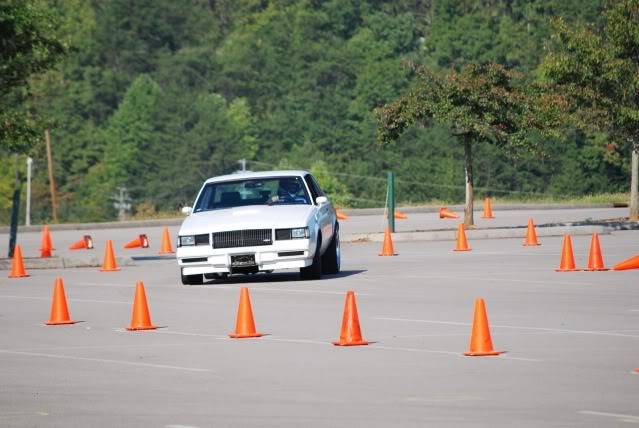
Does your DSE suspension alter any of the G-body's geometry, as in taller knuckles (aka "spindles"), taller ball joints, or relocated chassis side pivot points? Is it stiffer than OE? The reason I ask is because at autocross -1.2° wouldn't be nearly enough. Here's a near head-on shot of my Malibu, showing 1° or so of positive camber in a turn. Static autocross setting was something like -2.7° . . . Originally Posted by xxxturbo6
I'm expecting OP's car to lose camber about half as fast as the car rolls, so a -2° setting will "cover for" up to about 4° of roll. That does assume that the front roll center is slightly above the ground, which may or may not be the case. If it's below the ground, camber will actually "gain" the wrong way over at least part of the suspension bump travel and you'd need to set it still further negative. In any event -1.2°-ish settings are unlikely to be enough for serious autocrossing even though it's fairly aggressive for most street driving.
Norm'08 GT coupe, 5M, suspension unstockish (the occasional track toy)
'19 WRX, Turbo-H4/6M (the family sedan . . . seriously)
Gone but not forgotten dep't:
'01 Maxima 20AE 5M, '10 LGT 6M, '95 626, V6/5M; '79 Malibu, V8/4M-5M; '87 Maxima, V6/5M; '72 Pinto, I4/4M; '64 Dodge V8/3A
10-14-2010 #18
Full Blown G-Machiner
- Join Date
- Sep 2005
- Location
- East, Tennessee
- Posts
- 574
With the DSE front Upper & Lower A-arms the suspension geometry is improved over stock by increasing camber gain and improving roll camber. Originally Posted by Norm Peterson
Yes the car is more stiff than OE..
The -1.2 was the setting we put it at for every day driving and when at the track for an Auto-x event we will bump it up a bit by throwing in a 1/4" shim for better results.
Below is a pic kind of similar to yours and the Camber was at -1.2 in this picture.
 1986 Buick T-Type
RideTech, DSE, BAER Brakes, Forgeline Wheels, LED lighting, More!
* Get your Top of the line GPS Theft recovery devices Here!
www.GNSperformance.com
10-14-2010 #19
Registered User
- Join Date
- Nov 2002
- Location
- state of confusion
- Posts
- 1,499
Have to wait until I get home to see the picture, as I expect it to be another useful data point.
@&%$#@#!()*& corporate internet filtering
Norm'08 GT coupe, 5M, suspension unstockish (the occasional track toy)
'19 WRX, Turbo-H4/6M (the family sedan . . . seriously)
Gone but not forgotten dep't:
'01 Maxima 20AE 5M, '10 LGT 6M, '95 626, V6/5M; '79 Malibu, V8/4M-5M; '87 Maxima, V6/5M; '72 Pinto, I4/4M; '64 Dodge V8/3A
10-14-2010 #20 Registered User
- Join Date
- Aug 2004
- Location
- Rustburg, Virginia
- Posts
- 3,436
Norm,
Will this pic work for you?1970 RS/SS350 139K on the clock:
89 TPI motor w/ 1pc rear seal coupled to a Viper T56 via Mcleod's modular bellhousing w/ hydraulic T/O bearing from the Viper, 12 bolt rear w/ 3.73 gearing, SC&C upper control arms, factory lowers with Delalums, C5 brakes at all four corners, Front Wheels 17x8's with Sumi 255/40/17 and Rear Wheels 17x9's with Sumi 275/40/17.
Brief description of the work done so far can be found here: http://www.nastyz28.com/forum/showthread.php?t=112454

 Reply With Quote