


Results 1 to 19 of 19
Thread: Curious
-
09-18-2010 #1
 Banned
- Join Date
- Dec 2009
- Posts
- 256
Curious
Hi
I have finally got my 68 Charger in the country. I plan on turning it into a pro-touring car with a 528ci Hemi.
The non-important curiosity I have is...
If I baught a 1977 Trans-Am... would it be able to handle better than a 68 Charger if all is done on both of them (Coil overs, limit body roll, poly/aluminum bushings etc)
If money is thrown at both of them would they pretty much handle the same?
I ask because I love that trans-am also and would not mind having one. Then I could just leave the charger original and do up the trans-am if it would handle better, if it wouldnt if money was thrown at both then I will continue with the charger.
I think the TA has a 108" wheel base vs the 117 on the charger. Anyone know how heavy the TA is?
Which one could be made lighter with aluminum parts and leaving the body steel (no vcarbon fibre exterior body)
Thanks!
-
09-19-2010 #2
 Registered User
- Join Date
- Nov 2005
- Posts
- 827
If it was simply a matter of sliding a Morrison chassis with coil overs and identical components under each one, it would probably be a close call other than the T/A's smaller dimensions and the weight of the Hemi up front in the Charger. The size of course will help the T/A on a road course and especially an autocross and the weight on the nose of the Charger will promote understeer but comparing them as is, I can definitely tell you that you'll be throwing money and mods at the Charger before it's anywhere near the T/A's baseline which can also be dramatically improved with TONS of aftermarket support to make it better and better with only basic bolt-ons.
Before the Hemi, the two are probably really close in weight but when you start removing door braces and big bumper bracing, the T/A will lose weight fast. If it isn't a T-Top car, you'll be ahead of the game with weight savings and torsional rigidity and the roof is definitely not where you want to be adding weight.Jason
-
09-19-2010 #3
 Registered User
- Join Date
- Dec 2005
- Location
- Birmingham, AL
- Posts
- 3,355

Maybe you can get both Bill Howell and Mary Pozzi to reply. Bill has a later model Charger ('72 I think) and has done extensive mods and has driven it hard. Mary has a well setup second gen Camaro with mostly bolt on parts and drives it hard as well. I would think it would take a lot more time and money to get the Charger handling like the TA.
Stephen
-
09-19-2010 #4
Registered User
- Join Date
- Sep 2007
- Posts
- 459
I can definitely tell you that you'll be throwing money and mods at the Charger before it's anywhere near the T/A's baseline which can also be dramatically improved with TONS of aftermarket support to make it better and better with only basic bolt-ons.
I wouldn't be so sure about that. I think the T/A has some advantages but I don't think the gap is huge.
The Charger has a stiffer unibody. It's probably still a bit stiffer even after you put solid bushings into the T/A's subframe. The Charger also has better factory suspension geometry. It lacks caster from the stock UCAs and it's aligned & sprung for bias-ply tires, but all that stuff is pretty cheaply correctible. The rear end is a good setup on the Charger too. The stiff staggered leaf springs aren't great for handling but the basic layout back there responds easily to upgrades.
As for the hemi, if it's got aluminum heads & intake then its weight is gonna be about what a stock all-iron 440 weighs. It's kinda nose-heavy but nothing off the charts. The T/A has a lighter motor, but I dare say it probably has more redundant mass in the front end of the body/chassis/suspension than the Charger does.
I more or less agree about the curb weight. They are literally about the same 3800 pounds as it is, but the T/A is gonna lose a couple hundred pounds more easily than the Charger will.
.
-
09-19-2010 #5
 Registered User
- Join Date
- Mar 2005
- Location
- Loganville, GA
- Posts
- 931
Curious on what brought you to these conclusions? I haven't seen/read anything that would agree with them myself. So I am curious about this. Originally Posted by mikedc
 2018 Cruze LT Hatchback
2003 Suburban 2500 8.1L
1975 MGB Roadster
2003 GSX750F Katana
-
09-19-2010 #6
 Registered User
- Join Date
- Jul 2010
- Location
- Sacramento, CA
- Posts
- 1,214
The second gen is VERY well setup from the factory, and much better than the charger for an inexpensive/easy build. There is tons of aftermarket support for the second gens, and they are VERY capable cars when prepped.
That said, I think pro-touring chargers are cooler, but I kinda have a charger fetish. If you have the $60,000 for parts and hundreds of hours to fab, id build a charger.

-
09-19-2010 #7
Banned
- Join Date
- Dec 2009
- Posts
- 256
I dont have the $$$ for what I am thinking but I was thinking like 60 000 just for the suspension (whether its a 77 TA or 68 Charger) aluminum Hemi block and heads etc, making it weigh about as much as a 383ci motor. I know thats about 25000 for the motor. A 6 speed manual in an aluminum casing, another $12000. So basically 100k = gearbox, suspension/wheels/tires and engine.
Changing all iron bits in engine bay over to aluminum for weight saving I can see the charger going down to 3300 lbs or less which is now about as heavy as a ferarri is.
If that kinda $ was thrown at both cars, I was wondering which would out do which, or its so close that it would be the driver not the car if 2 cars were done and 2 F1 race car drivers were to race eachother neither car would be the one flying ahead...
I know this is a very Big If and Maybe and But and Unlikely and Theory etc but just wanted to know what cause if its identical at the end of the day if the $$$ are spent... I would probbably stick to the charger till it handles like a Ferrarri rather than having a TA that handles like a ferrari. If both can handle that good, then id rather the look of the 68 Charger. I was just wondering whether the charger had some physical restrictions where it cant handle.
I dont care to autocross where the 9" difference in the wheel base will matter. I like circuit racing, few S bends, long straight, etc.
The place I will be using it at is Eastern Creek raceway in sydney (if you want to see how the track looks, google it). Handling in that context not left/right/left/right in tight spots like Autocross. If i wanted that I would get a Mini Morris (the original ones)
-
09-20-2010 #8
Registered User
- Join Date
- Sep 2007
- Posts
- 459
XV Motorsports did a bunch of expensive 4-post rig testing on the B/E-body Mopars. I don't know about the specific data, but the end result is that they were amazed at how stiff the stock Mopar chassis was. They said it was decent even for a modern car. And that was before they added the basic stuff like subframe connectors & torque box plating, etc.Curious on what brought you to these conclusions? I haven't seen/read anything that would agree with them myself. So I am curious about this.
I doubt the 2nd-gen F-body is that stiff. It's hard to know exactly, because the F-body's rubber isolated subframe wrecks the ability to sense it unless the car has been retrofitted with solid bushings. But the stock 1982-92 car is not known for having such great stiffness for its time. And I would expect it to be at least as good as the 2nd-gen if not better.
For the purposes of this discussion I'm not sure it matters a whole lot though. Either car can be made very stiff with a good cage. I just think the F-body's handling advantage out of the gate is not so huge over a Charger. It's a smaller car, but as the factory built it the F-body is also overweight & not as stiff in relation to its proportions.
.
09-20-2010 #9
New to Pro-Touring
- Join Date
- Sep 2010
- Location
- Texas
- Posts
- 4
Ta
I can confirm what has been said about the second gen. F-body cars. I am proud of the performance of my '79 WS6 TA, but I must admit that it has been on the track and even with lots of modifications it's still a pig at handling compared to modern cars. It can run away from a race prepped WRX on the straits, but the corners bring the WRX right back on the bumper. I think that both cars would need lots of weight savings and a cage to stiffen them up. My reference for this opinion is my 2000 Corvette and the six years that I have raced the Trans Am in open road races. The road is very different from the track. At the track the TA pushes from too much weight and not enough tire that will fit under the fenders. The TA kicks the Corvettes butt on the open road with better down force and lots more power. The Trans Am has QA1 single adjustable coil overs, subframe connectors, solid subframe mounts, Delrin control arm bushings, 9 inch wide wheels with 275 - 40 x 18 tires and a 6 point roll bar. It needs an X member to help control unibody twist. Good luck with either, but I think you'll spend a lot less for the same performance with the Pontiac.
09-20-2010 #10 Registered User
- Join Date
- May 2005
- Location
- Northern CA
- Posts
- 417
Here's the deal with the second generation Charger's. They're big and they're very heavy, I know as I've done two of them. I've also raced them both. One big key to these cars is to really stiffen the crap out of them. XV Motorsports chassis stiffening kit is a must. Use the sub-frame, inner fender well connectors, rad support and engine brace and that will greatly help you out.
As for suspension, believe it or not but you can actually do quite a bit the old torsion bar set-up. I would go with Hotchkis 1 1/8 bar up front with a nice size bar in the rear. Hellwig or Addco units work just fine. Also, bump up your T-bars to a minimum of .96 and get some good shocks. The bilsteins that Hotchkis offers are good as are the Edelebrock IAS performers.
I run both my '68 Charger and my '69 Daytona clone on the track all the time they both do just fine. Remember though, these are BIG cars... 18 feet long and while great on a big course nice sweepers, they can get a bit cumbersome in the tight stuff.
The '77 Trans Am was a great handler when it came out way back when, plus there is BUTTLOAD of aftermarket stuff out there for it that will cost you half of the price of the Mopar stuff.
Just my two cents...Never trust a pretty girl... or a lonely midget.
09-20-2010 #11
Full Blown G-Machiner
- Join Date
- Oct 2008
- Location
- Santa Fe Springs, CA
- Posts
- 625
It would be interesting to see what unlimited funds would do. People are correct that the Trans Am will be a cheaper project. The Mopar is going to turn more heads, and it sounds like you might be drawn to the Charger already. Any project is better the more you like the car itself. Originally Posted by G-man
That said, they did road race those cars in the 60s, so it's not impossible to make one turn corners.
Have you ever spoken to Dan with the 68 RoadRunner? He's doing amazingly well with torsion bars and leaf springs.
 Hotchkis Sport SuspensionToll Free: 877-466-7655
09-20-2010 #12
Registered User
- Join Date
- Mar 2005
- Location
- Loganville, GA
- Posts
- 931
Having owned 3 2nd gens and a low mile 3rd gen (all hardtops, no t-tops), the 3rd gen isn't stiffer than the 2nd, probably a little worse. Too big of holes in the 3rd gen unibody, especially with the hatch. 4th gens were an improvement. 2nd gens weak point is the subframe to body connection no doubt. Basically both cars can benefit from stiffening the chassis. Originally Posted by mikedc
On a road course they both could do well. Tighter stuff like autocross will favor the smaller car, as I know all too well. I've run big cars (El Camino and Dakota ext cab) and small (third gen, Mustangs, FWD cars) on autocross. All things equal but size, the smaller car will be quicker.2018 Cruze LT Hatchback
2003 Suburban 2500 8.1L
1975 MGB Roadster
2003 GSX750F Katana
09-20-2010 #13
Banned
- Join Date
- Dec 2009
- Posts
- 256
Thanks for the responses guys even if it was an intelectual challenge so to speak considering there is no funds for either at this present moment in time and may not be for a few good years. I appreciate the comments very much at least to understand what can be done with what I have when I have to do what needs doing.
Considering all the above, I must say the 68 charger is the kind of look I like, mean, sinister, etc.
My charger currently is a 383 column auto car all original and is QQ1 blue. I plan to change that to a custom orange, a nice dark brown stripe and shiny brown (like brown chrome) wheel faces with a number on the door to make it more touring looking (also in brown). I think it will look really good on track that way.
I guess if both can do it, I would have to stick to the charger cause nothing else would feel right. I mean, Hemi = my dream engine. I would never put one of them in a pontiac... so going with pontiac I would have to give up my dream motor and a car I loved since I was 6 years old (dukes of hazzard).
Once again thanks very much and at least I have some direction in my mind as to what I can do with this car.
You guys are great and No I have not spoken to the roadrunner guy... wouldnt even know who or what name he is under... maybe you can get him to post or message me?
Thanks
George
09-21-2010 #14
Registered User
- Join Date
- Sep 2007
- Posts
- 459
Just another suggestion - skip the 426-based Hemi in the Charger. Those things are great for what they are, but what they are is not really suited to a handling oriented car at all. A lighter weight motor will make for a much more balanced car. Just the stock 383 you've got is already a boat anchor of a motor in the big picture. (I love those motors too but it's true.) There's a major difference in the feel of the car just going to a 340/360 type LA smallblock with aluminum heads & intake.
When it comes to sub-3500-pound street performance cars, the gen-II Hemi has limited application. It's for people who wanna go REALLY stupid-fast in a straight line (not dissing it, just saying) and people who wanna pop the hood and show it off. If your priorities are anything else, then there is a better motor to be had elsewhere. Look at aluminum gen-III Hemis, various versions of the SB and BB wedge motors, etc. (If you really wanna get heretical then look at GM LS2 crate motors. Big inches and light weight.)
.
09-21-2010 #15
Registered User
- Join Date
- Apr 2005
- Location
- Colorado Springs
- Posts
- 761
If we're talking $100k build ups, then the only real difference between the two will be size of the wheelbase and make of the engine and body. At this point they will both be on pretty equal in terms of weight, horsepower, and grip.
If we are talking the stock based vehicles modified in the ways most of us build cars, then the situation changes.
Side by side, the two uni-bodies are comparable in rigidity and both can be improved significantly with a minimal amount of work. For any performance application, bracing is a must do and that includes eliminating the rubber bushings under the TA subframe. No real advantage to either one here, although there are probably more selection and lower priced choices for the TA.
The two front suspension are close as well in that they have decent geometry, but are certainly not optimal while they do use different means to achieve the results. Two limits the Charger will have compared to the TA; caster adjustment and t-bars. Caster can be overcome with aftermarket control arms, so that's no big deal. However, t-bars are another story. The absolute biggest torsion bar you put under a stock Charger is 1.22. This is the equivilent of a 800# coil spring that you can put in the TA. Similarly, there are only 5 sizes of t-bars readily available, all softer in rate than the 1.22. Unlike the F body coil spring which can be found in 50# increments from 300 to 1200 pounds. Knod to the TA for being able to more precisely control front spring rates and having greater aftermarket support.
TA is front steer, Mopar is rear steer. To a profesional driver, they would be able to feel the difference in response, but the most of us probably won't. TA may be better here, but it debatable.
Out back, the Mopar leafs are quite a bit better at controlling wrap up and lateral loads than the TA. Both would require some custom rates to get the ideal set up, but mopar leafs are used as extensively as F body leafs in oval track applications so these wouldn't be hard to find. The TA may require a Cal Trac set up to get the same performace that you'll see in a stock mopar set up. it also is mucho easier to fit large rubber under the massive mopar rear flanks with a minimum amount of changes. Mopar gets this one.
Body wise, there are probably as many fiberglass parts available for the Charger as the TA, however they will tend to be more expensive and you certainly won't find more exotic materials like carbon fiber that you may come across for the TA. One for the TA if price is a consideration. Charger if you want a sexier looking belly button.
Engine wise, it is hard to beat the looks and all outperformance of the 2G Hemi. It is bad to the bone anyway you slice it. Get it in aluminum and you have the ultimate high rpm track motor. I'll give it to the Mopar over the Pontiac using era correct powerplants. Back off to wedge power and it gets a bit closer, but I'd still lean towards the Mopar for its ability to withstand large revs and high power compared to the Poncho. For a pure street driver, the massive torque of the Pontiac makes it a choice of personal preference.
The 3G Hemi is a modern design and capable of power comparable to any LS series engine, but the price tag is gonna get ya. Yes they are coming down in price and the proliferation of them in so many new vehicles that mopar is slapping them into means they will continue to drop, but GM has decades worth of construction already out in the field, so it will never totally catch up in price. LS pieces are easily picked up and can make big power like falling out of bed. Again, I think this will be a personal preference point for power, but the GM motor definetely has it in price and ease of aquiring parts, whcih may be a consideration for our overseas friends.TonyC@HP2
09-21-2010 #16
Registered User
- Join Date
- Aug 2004
- Location
- Rockford, MN
- Posts
- 278
I would add that the aftermarket is also finally catching up to the Pontiac motors, with aluminum blocks, and a variety of heads, including Hemi style heads available. With that said, most guys would opt for a big cube LSx, and that is something I would seriously consider if the primary purpose is road racing. If it's 90% or more street, it's hard to beat the Poncho's torque as mentioned above. It's not hard to make 650+ hp naturally aspirated with the Pontiac, but like the Hemi, it won't be cheap. $20K is a safe assumption, more with EFI.
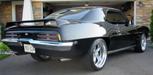
1969 Firebird, Black, Parchment Arizen interior, Poncho 383 (4" crank), Kauffman heads, TKO600, Moser 12 bolt, Wilwoods, DSE, Speed Tech, Koni, Hotchkis, GW, 18" TTI's, VA Gen IV, etc.
09-22-2010 #17
Banned
- Join Date
- Dec 2009
- Posts
- 256
Well for me its my dream car that I like to cruise in on the weekends or special occasions or just for some fun with my younger cousins (age 13 and 16). So its a street car (just like a lamborgini to me would be a street car) but at the same time, something I can take to the track and drive it the way you would a lambo at the track.
This means putting it in comparrible terms, 650 horsepower.
Now Mike has mentioned higher reving gen 3 etc Hemis.
Why would I want a high reving engine making 650hp when I can make 650hp reving half as much by adding more cubic inches?
Like why on a circuit would I want 650hp @ 7000rpm vs 650hp @ 4000rpm???
650 is 650 no?
Last I remember hearing was a viper out doing a ferrari because it was 8.2 litres in size in the engine vs the 3.0 litre ferrari. Both had the same power but due to the low RPM power of the 8.2 litre motor the fuel consumption was only a 3rd of the ferrari thats screaming his head off to do what the viper did pretty much in its sleep.
For me if its a hemi its gotta be a 500ci + Hemi. Aluminum block, heads etc so it weighs like a small block.
I also dont care for EFI. I like the feel and responsivness of a double pumper carburettor back by a manual gearbox... everythings just on tap... very much does what you do + I love the way carbies look when all polished nice. I want a stock so to speak look "Muscle car look" But have coil-overs under the car, 3 or 4 link rear whatever will help with its handling etc.
I also wonder what size tires up front, 10" wide or what? I know I want 12" out back with 335' or 345's. I understand that means modifications of the wheel well and probbably modifying the front a little to fit a 10" wheel in the front. But since im talking handling, do lambos run 10's etc in the front or only 8" up front?
Thats about it I think
09-23-2010 #18
Registered User
- Join Date
- Sep 2007
- Posts
- 459
For me if its a hemi its gotta be a 500ci + Hemi. Aluminum block, heads etc so it weighs like a small block.
I know what you're saying. But if you're a true handling nut then you realize "weighs like a small block" is still heavier than you want it. Never mind when the small block is iron.
Look at the 2011 Mustangs. The motor options are all aluminum. It's sacreligious for a musclecar guy to say this, but IMHO the V6 is probably becoming a better all-around sports car than the V8 model. The current V6s are as powerful as most people would expect a V8 Mustang to feel like, and the extra couple hundred pounds removed from the car's nose really make a difference in the feel of it.
As for the displacement thing I agree with you. 10 liters @ 5000 RPM is a better motor than 5 liters @ 10,000 RPM. Simpler, cheaper, more reliable, and a flatter power curve.
But cubic inches means cubic pounds of engine material. We're back to the displacement versus motor weight debate again. And more torque means you need a heavier drivetrain. Tranny, rear diff/axle, chassis stiffness, etc. The curb weight just keeps on climbing.
Where you draw the line and make the compromises is up to you. This is just some stuff to think about.
.
09-25-2010 #19
Banned
- Join Date
- Dec 2009
- Posts
- 256
So in a general sense the idea is... Originally Posted by mikedc
A: Get car as light as possible
B: Make it as close to 50-50 static weight front/rear for ideal centre gravity.
If the car can be reduced to 3200lbs with a huge hemi and get 60/40 front/rear weight... then that should be fine... reason why the lighter engine... its more realistic to achieve the ideal.
Is that pretty much right in a nut shell?
Btw- Going with all the stiffening kits etc, doesnt that all add up more weight to the car?
Howmuch extra lbs would the charger get in stock form by adding XV2 stiffening kit all around (fenders etc) and can that be overcome another way (as in, get around having to use the kit, either by welding bits together or whatever for firmness), considering the front and rear is turned over to coil overs and whatever else custom built?

 Reply With Quote



