


Results 1 to 12 of 12
-
04-26-2010 #1
 Registered User
- Join Date
- Oct 2004
- Location
- St Louis, MO
- Posts
- 373
Why is a 3-link better for corners and a 4-link for track?
Can someon explain why you want a 3-link for handling and a 4-link for the track? I figured a 4-link would be better b/c it can keep the rear at the right pinion angle a lot better.
-
04-26-2010 #2
 Registered User
- Join Date
- Nov 2005
- Location
- Auburn, WA
- Posts
- 1,360
Contrary to popular internet wisdom, some four-link/bar suspensions can work just as well as a 3-link. 3-links, in theory, have less bind with body roll, allowing the roll stiffness to be better controlled by springs and ARBs.
Matt Jones
Mechanical Engineer
Art Morrison Enterprises
-
04-26-2010 #3
 Registered User
- Join Date
- Apr 2005
- Location
- Fife, WA
- Posts
- 887
 Originally Posted by brrymnvette

Are you talking about a drag-race style four link? If so, they are better, because there is a lot of adjustment to set the instant center of the suspension and maximize how hard the tire plants on the launch.
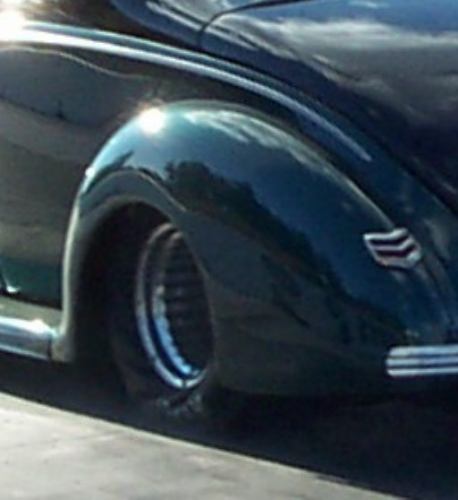
this is on my 40 Ford with Hoosier "street" tires. The four link gave me the adjustment to plant the tire like this.
-
04-26-2010 #4
Registered User
- Join Date
- Oct 2004
- Location
- St Louis, MO
- Posts
- 373
I'm talking about for a street/road car. I figured 4-link would be better.
-
04-26-2010 #5 Registered User
- Join Date
- Oct 2004
- Location
- Orlando, Fl
- Posts
- 1,229
 Originally Posted by brrymnvette
Depends on its intended purpose... But look at it this way. The minimum amount of points needed to securely locate anything in space is 3... Using a proper locating device (Watts or Panhard) along with a well designed 3 link will net a highly tunable suspension that has no bind characteristics.
That being said, a well designed triangulated 4 link can also work very well. And the triangulated 4 link eliminates the need for a locating device. The question you have asked is really much bigger than you are trying to make it out to be... Multi faceted to say the least.Nick DiPrenda
04-26-2010 #6 Registered User
- Join Date
- Aug 2004
- Location
- Rustburg, Virginia
- Posts
- 3,436
Good thing you had the bead screws, I expect that would have spun inside the rim without them. Originally Posted by CraigMorrison
1970 RS/SS350 139K on the clock:
89 TPI motor w/ 1pc rear seal coupled to a Viper T56 via Mcleod's modular bellhousing w/ hydraulic T/O bearing from the Viper, 12 bolt rear w/ 3.73 gearing, SC&C upper control arms, factory lowers with Delalums, C5 brakes at all four corners, Front Wheels 17x8's with Sumi 255/40/17 and Rear Wheels 17x9's with Sumi 275/40/17.
Brief description of the work done so far can be found here: http://www.nastyz28.com/forum/showthread.php?t=112454
04-26-2010 #7 Registered User
- Join Date
- May 2002
- Location
- Northern California
- Posts
- 10,716
I would go 4 link, there are many existing full kits out there. Originally Posted by brrymnvette
VinceMrQuick ΜΟΛ'ΩΝ ΛΑΒ'Ε
04-26-2010 #8
Registered User
- Join Date
- Nov 2005
- Location
- Auburn, WA
- Posts
- 1,360
Me too, the packaging is much better. Originally Posted by MrQuick
Matt Jones
Mechanical Engineer
Art Morrison Enterprises
04-26-2010 #9 Registered User
- Join Date
- May 2007
- Location
- Orlando, FL
- Posts
- 215
We know that oscillatory loading of a friction surface is undesirable. (For instance, wheel hop during braking always increases stopping distance.) We also know that a tire pair, whether in traction or cornering, achieves maximum performance with equal loading. Unfortunately, the driveshaft torque tends to unload the right rear tire of a RWD beam rear axle car during forward acceleration. So, for a dragstrip application of a RWD beam rear axle car, we would want 100% antisquat (no oscillatory loading) and a suspension which would provide equal rear tire loading regardless of driveshaft torque magnitude. Once this has been achieved, there would be no rational excuse for adjustment. This can be achieved starting with virtually any one of the many rear suspension design concepts, ranging from torque tube to torque arm to truck arm to 3link to 4bar to competition 4link to triangulated 4link. Here are spreadsheets for them all: http://www.racetec.cc/shope
04-27-2010 #10
Registered User
- Join Date
- Oct 2004
- Location
- St Louis, MO
- Posts
- 373
Thanks Billy, that actually helps explain somewhat. I'll be on the site you posted for a while it looks like.
04-27-2010 #11
Registered User
- Join Date
- Mar 2010
- Location
- AZ
- Posts
- 801
I will say one thing for very sure, a triangulated four link has much better packaging possibilities than a three link with locating device, such as watts or panhard. There are the options of a offset three link, as discussed here previously, but still, the arms on a three link are *generally* inherently longer than a four link, especially one designed for as neutral handling as possible. Neutral handling being a very vague and far reaching term.
Also keep in mind that the rear suspension alone is less than half the equation, your best bet, if starting with a fixed front suspension, is to work that to the bone towards a general goal, then use the rear suspension to either keep towards that goal, or possible correct limitations of the front suspension.
I've traditionally been taught that a three link has overall better flexibility and tune-ability for cornering and high speed stability over virtually any four link design, but the more I study the more I find that it's not entirely true, though I have found it easier to virtually tune a three link design over a four link, both seem equally possible.
One of the major benefits of a three link with lateral locating device that I've found is the ability to fix a RC around the PHB or Watts as the center of said link will be the RC. With a four link the RC will migrate both vertically and horizontally as the suspension deflects either from road conditions or body roll. The RC location in and of itself is a generally manufactured number, however the distance from the Center of Gravity to the Roll Center is significant in that it essentially tells you the arm on which the weight of the car will move.
Also, the vertical angle between the front and rear roll centers will help predict if the vehicle has a tendency toward oversteering or understeering, which are misnomers in themselves, but are generally appreciable as forced or excess yaw of the vehicle through a turn.
I think I've gone just about far enough off path now to make little to no sense outside of my own brain, but maybe it can be of some help with a little deciphering.
04-27-2010 #12
Registered User
- Join Date
- Oct 2004
- Location
- St Louis, MO
- Posts
- 373
Yes, that helps. Thanks!

 Reply With Quote