


Results 1 to 6 of 6
-
06-11-2012 #1

 Registered User
- Join Date
- Nov 2011
- Location
- College Station, TX
- Posts
- 204

Fabricated Control Arms, Material Sizing
Howdy,
Back to work on "Improving GM's Suspension" on my '64 Riviera. Since nothing is catelog beyond stock parts, I'm doing it old school way of fabricating pretty much everything sorrounding some OEM major parts. While I toyed with the idea of using Coleman Racing's build your own spindles since they would keep my stock wheel bolt patern and bears I decided that in the end it would be cheaper and simpler to use a pair of C5/6 uprights for more product support and more wheel options.
I've been staring at various aftermarket manufacturers adjustable A-arms. This formulated the basic design of using my stock upper control arm bushings (the cross shaft is way more complex than the A/F/X/B-body cross shaft with a bend to clear the upper spring pocket) and weld on tabs to pick up clevis type rod ends for the adjustable piece of the A-arm and have a similar plate welded to a Spindle Taper with one free and one fixed clevis on the other end. Now the big difference I noted between the Speedway and Coleman racing parts was the standard shank diameter for the Speedway stuff was 5/8in fine while the Coleman stuff was 3/4in fine. Which is recommended for my ~4000lb Riviera? Is aluminum hex strong enough for an upper control arm? Will 3/8in thick tabs/plate be strong enough?
Thanks,
Central TEXAS Sleeper
Experimental Physicist
'64 Riviera T-type: 4.1L Buick Turbo6, 4L80E, L67 OBDII SEFI swap
ROA# 9790
-
06-11-2012 #2 Registered User
- Join Date
- Nov 2009
- Location
- the dirty mitten
- Posts
- 1,217
c5/6 knuckles are very good pieces to work with. You can get bolt on steering arms if the stock location will not work with you and the scrub radius ends up being very good with a large tire and a positive offset wheel.
6061 Aluminums strength is 45,000psi, 40,000 tensile. Either the 5/8 or 3/4 will be more than strong enough. As for the 3/8, you mentioned using clevis ends to attach this, just use whatever thickness will fit inside the clevis. 1018 steel has a strength of 63,000psi, 53,000psi tensile strength. I would not be afraid to use 1/4 in that application
I built my upper arms from mostly 1/8 steel. The ball joint area is 3 pieces of 1/4. I prefer laminating various pieces of steel together rather than using 1 solid 3/4 thick piece
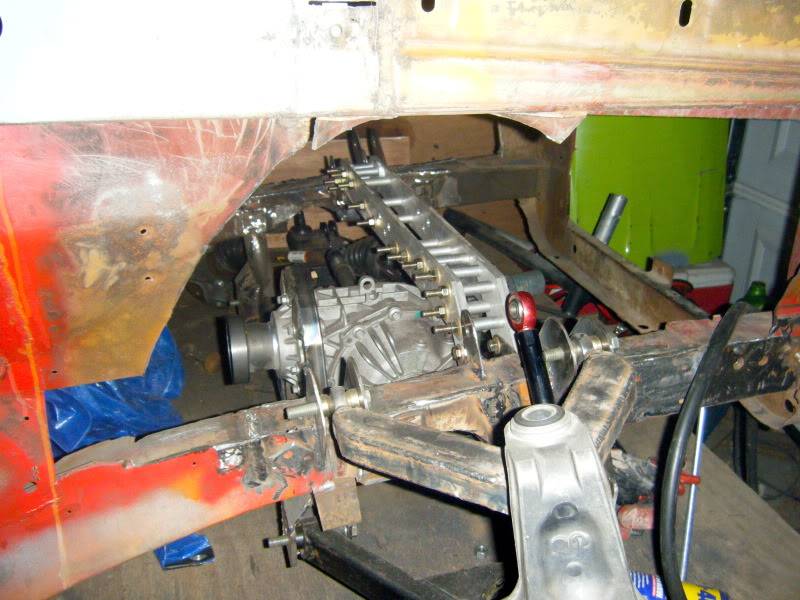
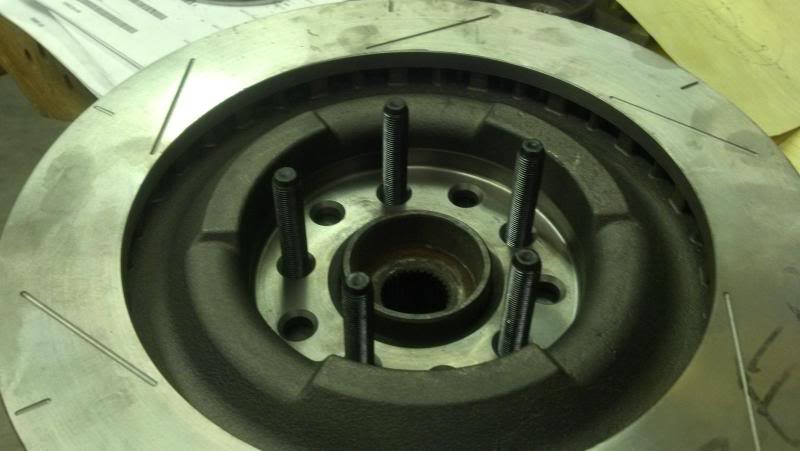
Also do not worry about your bolt pattern. You can have the brake rotors and hubs redrilled for whatever pattern you need. I just had mine done in 5x4.5, a local machinist took care of this for me (btw the brake rotor is on backwards in this picture)
 Steve
1968 Dodge Charger All Wheel Drive project Red Bull<script type="text/javascript" src="safari-extension://com.ebay.safari.myebaymanager-QYHMMGCMJR/5cce6da5/background/helpers/prefilterHelper.js"></script><script type="text/javascript" src="safari-extension://com.ebay.safari.myebaymanager-QYHMMGCMJR/85dc54c0/background/helpers/prefilterHelper.js"></script><script type="text/javascript" src="safari-extension://com.ebay.safari.myebaymanager-QYHMMGCMJR/85dc54c0/background/helpers/prefilterHelper.js"></script>
06-12-2012 #3 Registered User
- Join Date
- Oct 2009
- Location
- New Derry, PA
- Posts
- 1,265
I agree with Steve that the aluminum is strong enough in theory (that's all I use on my supermodifieds); but you may encounter problems with the threads deforming over time, due to the inherent "weak spots" where the threads are closest to the hex flats. We get away with a lot of stuff on race cars because the maintenance is constant (or should be).
Remember, the closer the hub is to being centered between the ball joints, the more evenly camber and braking loads are distributed between the upper and lower arms... I'd definitely go with 3/4' shanks on the lower arm. 5/8 would typically be OK for the upper, but again it depends a lot on spindle design.
Glad to see you making progress on the Riv!
Ray Kaufman - Wyotech Chassis Fab and High Performance Instructor. Words of Wisdom from an old master... at Asylum Custom Interiors website
06-12-2012 #4
Registered User
- Join Date
- Nov 2011
- Location
- College Station, TX
- Posts
- 204
Thanks for the comments and pictures guys. I'll admit to only to starting work on the upper control arms since the lowers are a single arm with a strut/brake reaction rod. I was basically coping the visual aspects of the SPC adjustable uppers as seen on SC&C. I'm not adverse to using steel since the car is heavy and I do value long term durability over 10/10ths weight reduction. Since I'm looking at the the C5/6 upright with it's inverted upper ball joint, I miss out on lots of the oval track parts since they are designed for a conventional upper and have to build it myself. The AFCO 5/8in shank clevis I found on Speedway has a 3/8in center gap and 3/8in bolt hole. I didn't look too hard for 3/4in clevis parts but wouldn't be surprised if they were also 3/8in shank.
As for the bolt pattern, I don't think there is enough room on the C5/6 hub for a 5x5in bolt pattern and the wheel choices definately go down, especially in high positive offset.Central TEXAS Sleeper
Experimental Physicist
'64 Riviera T-type: 4.1L Buick Turbo6, 4L80E, L67 OBDII SEFI swap
ROA# 9790
07-04-2012 #5
Registered User
- Join Date
- Nov 2011
- Location
- College Station, TX
- Posts
- 204
Ok, started making parts lists for purchase over time. Right now the major parts cost for raw materials is the clevis rod ends. I've looked through who I consider the major vendors (Coleman Racing, Jegs, Summit, and Speedway) and 3/8in is the largest gap. I called SPC since they are semi local to me here in Colorado and asked them for the sizes of parts in thier arms. They are using 3/4in shank and 7/16in pin clevises. Looking up the shear strength of bolts, a 3/8UNF bolt only has ~2x the weight of the car in shear. Most but not all of the clevises I've found have 3/8in pins to start with though the HD ones generally say they can be drilled out.
With the C5/6 uprights the spindle is at around the lower 25% mark. I would guess this pushes the load more on the lower arm?
Not opposed to spending the money on the right parts, but I'm not in the budgetary possition to spend more than I have to on more strength than I need.
Thanks,Central TEXAS Sleeper
Experimental Physicist
'64 Riviera T-type: 4.1L Buick Turbo6, 4L80E, L67 OBDII SEFI swap
ROA# 9790
07-06-2012 #6
Registered User
- Join Date
- Nov 2011
- Location
- College Station, TX
- Posts
- 204
Is a 3/8in bolt in the rod end clevis enough for a 4000lb car?
Thanks,Central TEXAS Sleeper
Experimental Physicist
'64 Riviera T-type: 4.1L Buick Turbo6, 4L80E, L67 OBDII SEFI swap
ROA# 9790

 Reply With Quote



