


Results 1 to 20 of 39
Thread: Anothing question
-
11-06-2008 #1

 Registered User
- Join Date
- May 2007
- Posts
- 249
Anothing question
So I'm pretty set on running a satchell, but
I've done a search and have read a few prints, but can't seem to confirm a solid answer for this. Does the placement of the link tabs on the axle matter, in example say the uppers, (being the parallel) are spaced 36" apart (just an example) and the lowers were 40" apart center to center. Would that have any adverse effects? Or do they need to be one on top of the other. TIANick Schiffer
2001 Silverado
Currently Fabricating Full Tube Chassis
Special Thanks to:
Air Ride Technologies - Wilwood Engineering
...back in the day

-
11-06-2008 #2 Registered User
- Join Date
- Sep 2007
- Location
- Edmonton, Alberta
- Posts
- 291
I see where you are going with this. You are trying to create the longest lower links possible. As far as I can see, the only possible negative effect would be an increased risk of binding. But, if you are using some good heim joints, and well placed brackets there shouldn't be any issues. Be sure to think of the forces acting on the brackets (link tabs as you call them). This is pretty important on the lowers, because the brackets will see forces in the x,y,and z axis.
Let me know how your satchel turns out. I have a design pretty close to implementation, just waiting to find a shop that I can work in haha.
Cheers, Ryer.
11-06-2008 #3
Registered User
- Join Date
- May 2007
- Posts
- 249
yea I was wondering about binding, would binding be increased being the lowers were further apart? I'm wondering only because my uppers will hit the frame if they are any wider.
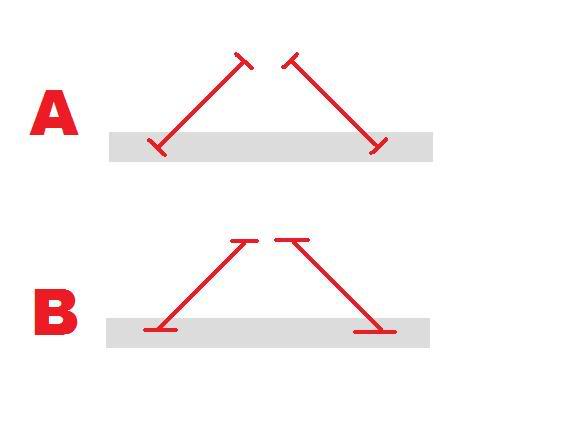
What if I ran my bushings parallel to the axle instead of on the angle of the bar, or fig a instead of fig b?
excuse my paint skills, I did it quick
 Nick Schiffer
2001 Silverado
Currently Fabricating Full Tube Chassis
Special Thanks to:
Air Ride Technologies - Wilwood Engineering
...back in the day
11-06-2008 #4
Registered User
- Join Date
- Sep 2007
- Location
- Edmonton, Alberta
- Posts
- 291
Drawing A by far. And binding will not be an issue with some good heim joints. I would suggest as a mock up get a piece of 3" square tubing or something to act as an axle, and tack your brackets onto it the same way you plan to run. Get your links tacked up with your heim's and move the tubing up and down and through some roll. This will identify any binding before you weld up your rear end, and it's lighter to move around
 . But like i said, you most likely will not find any binding within any reasonable suspension travel.
Cheers, Ryer.
11-06-2008 #5
Registered User
- Join Date
- May 2007
- Posts
- 249
due to air Ill be around 9.5" of total travel, riding at 5.5" however I was really hoping to run poly bushing, only because of it being a daily driver. but I could for sure check binding first with some tubing.
Nick Schiffer
2001 Silverado
Currently Fabricating Full Tube Chassis
Special Thanks to:
Air Ride Technologies - Wilwood Engineering
...back in the day
11-06-2008 #6
Registered User
- Join Date
- Sep 2007
- Location
- Edmonton, Alberta
- Posts
- 291
That's a ton of travel. Don't know what brand of poly you are looking at but I don't think poly will give you enough room for movement. Just for consideration check out johnny joints. They are still steel on steel, but will give you a ton of movement, especially for when you go to lay the thing out.
11-06-2008 #7
Registered User
- Join Date
- May 2007
- Posts
- 249
I was considering those actually, so I will for sure look more into those, thanks man!
Nick Schiffer
2001 Silverado
Currently Fabricating Full Tube Chassis
Special Thanks to:
Air Ride Technologies - Wilwood Engineering
...back in the day
11-06-2008 #8 Registered User
- Join Date
- Dec 2007
- Location
- Carlsbad, Ca
- Posts
- 1,213

the closer they are, the less they will move and therefore there is a less chance of binding. say one tire moves 2" upward and the other stays stationary. the center of the rear end will move 1" and the other tire wont raise. so if you have the uca brackets on the extreme ends of the rear axle tubes there will be a 2" difference. if you put the uca's right next to each other to where they were touching, there would be almost no difference (almost like a 3 link). the example is hard to follow, but maybe youll see what im getting at.
i just built a parallel 4 link with a watts and i used jj's for the links and heims for the watts. the jjs offer tons of movement prior to binding. way more than our cars would ever need.
also, keep your brackets like in "A". you may get away with it if you didnt, but you wont have any problems with your first example.
TimTim
The WidowMaker: Garage Built 70 Chevelle
Special Thanks To: Rushforth Wheels, MuscleRodz, Kore3 & SC&C
Build Thread Link
11-07-2008 #9
Registered User
- Join Date
- May 2007
- Posts
- 249
Packaging is my issues, I don't have the room for parallel with watts, Triangulated is basically my only option, and satchell will be superior in that aspect.
and I'm not sure what you're trying to say in the first part... are you talking about having the upper axle link ends and the lower axle link ends different widths apart will cause...huh?Nick Schiffer
2001 Silverado
Currently Fabricating Full Tube Chassis
Special Thanks to:
Air Ride Technologies - Wilwood Engineering
...back in the day
11-07-2008 #10
Registered User
- Join Date
- Dec 2007
- Location
- Carlsbad, Ca
- Posts
- 1,213
what im saying is that binding when both sides of the axle are doing the same thing (bounce or rebound) will not likely happen. when it happens the most is when the arms are being twisted, and that usually only happens when the rear axle is at a different angle than the frame (body roll). so imagine the body staying level in a turn (its easier for me to picture this way), but the axle rotates on its roll axis. one side will get closer to the frame and one will get further away. the exact center of the axle will not move and the further you move away from the center, the more movement you will get.
so, what all this leads to is this; the narrower you can place the upper control arms,the less binding you will have because they will move and rotate less. theres actually a lot more to it than that because they move on multiple planes, but ill start with whats above.
maybe someone else can better explain..... it would only take a minute in person, but typing makes things more difficult sometimes.
TimTim
The WidowMaker: Garage Built 70 Chevelle
Special Thanks To: Rushforth Wheels, MuscleRodz, Kore3 & SC&C
Build Thread Link
11-07-2008 #11
Registered User
- Join Date
- May 2007
- Posts
- 249
no I know exactly what you're explaining now. Makes complete sense, however the angle between the two lower bars are supposed to be about 40+* from what I'm told. I can figure all that kind of stuff out, this was more so geared to whether both the uppers and lowers had to be the same distance horizontally apart on the axle side. Thanks again for the reply
Nick Schiffer
2001 Silverado
Currently Fabricating Full Tube Chassis
Special Thanks to:
Air Ride Technologies - Wilwood Engineering
...back in the day
11-07-2008 #12
Registered User
- Join Date
- Sep 2007
- Location
- Edmonton, Alberta
- Posts
- 291
Where did you hear 40*? I wouldn't mind reading up on that and the reason for that figure. I found an article by Mr. Satchel himself where he outlined a 45* from the axle to the arm. But he disclosed that limited testing was done with different angles.
Oh ya, and post pictures of your build!!!
Cheers, Ryer
11-07-2008 #13
Registered User
- Join Date
- May 2007
- Posts
- 249
I remember reading about it somewhere, not sure where, but it uses more of the bar to keep that axle center, rather that the bushing. I guess if you picture it this way, 45* when it tries to shift it push straight on the bar thus pushing straight on the bushing, the less of an angle the more crocked the bushing will deflect leading to premature bushing failure.
Here is my build...
https://www.pro-touring.com/forum/sh...ghlight=schevyNick Schiffer
2001 Silverado
Currently Fabricating Full Tube Chassis
Special Thanks to:
Air Ride Technologies - Wilwood Engineering
...back in the day
11-07-2008 #14
Registered User
- Join Date
- Dec 2007
- Location
- Carlsbad, Ca
- Posts
- 1,213
i guess i answered your question the long way. you dont need to worry about putting the uppers and lowers in the same place horizontally.
TimTim
The WidowMaker: Garage Built 70 Chevelle
Special Thanks To: Rushforth Wheels, MuscleRodz, Kore3 & SC&C
Build Thread Link
11-07-2008 #15
Registered User
- Join Date
- Sep 2007
- Location
- Edmonton, Alberta
- Posts
- 291
Very cool build. What wheels do you have on in the first pic?
As far as the 40* thing goes, I've re-read some of the info I have on the subject, and with that shallow of an angle you are actualy more succeptable to bushing or heim failure. Considering your high intended horse power and relativly high weight, under acceleration you are going to be putting a ton of stress on all four links. The lower links will see compression on acceleration and try to collapse flat, but will see a high bending stress because of their fixivity. The 40* angle you are looking at will increase the bending stress on the links when compared to 45*, which could lead to the link failing. But on the other hand the shallow angle will lend itself to a possible increased ressistance to lateral movement.
Aswell, I think the 40* will decrease the overall length of the links. This could lead to an increase in roll center migration. But that depends on how long the links end up being. Also, longer links will reduce the likelyhood of binding, which you already know cuz you asked the initial question hahaha.
But, if you run the 40* angle just be sure to use larger/stronger tube. And build some wicked brackets.
I don't mean to be a douche and knock your design, just in my opinion that 40* might lead to compnent failure. Which no one wants to see. But if someone see's a flaw in my logic I'd love to hear it!
Cheers, Ryer.
11-07-2008 #16
Registered User
- Join Date
- May 2007
- Posts
- 249
Im going to go for 45* I was just saying at LEAST 40* thanks for the input, I do really appreicate it. the old wheels are American Racing RT-S. Plus my bars are quite beefy and going to try to set up around 30" bars. We will see keep an eye on my thread for updates
Nick Schiffer
2001 Silverado
Currently Fabricating Full Tube Chassis
Special Thanks to:
Air Ride Technologies - Wilwood Engineering
...back in the day
11-08-2008 #17
Registered User
- Join Date
- May 2007
- Posts
- 249
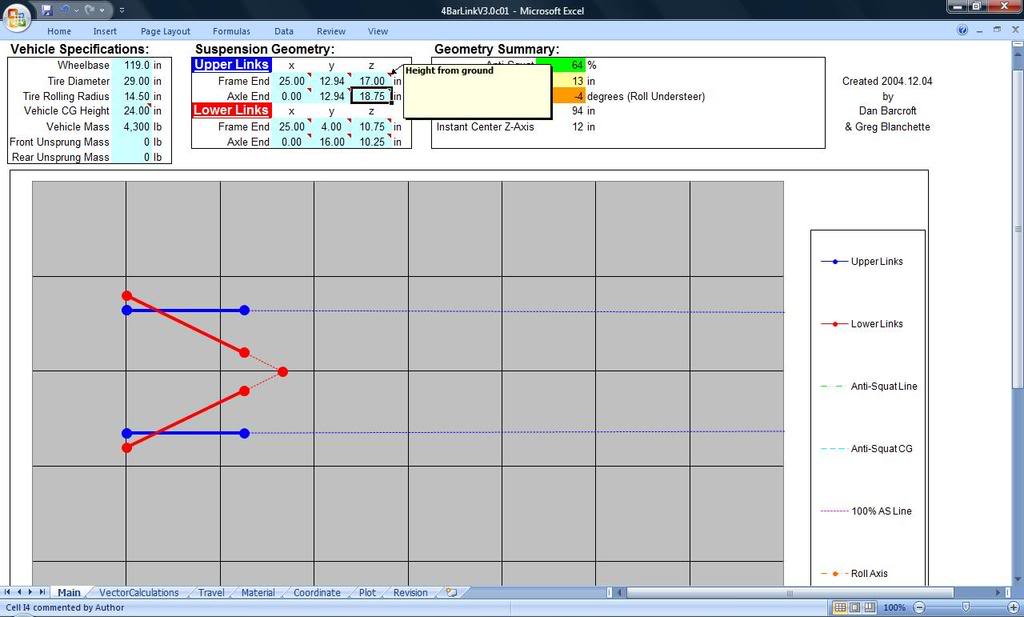
So I spent some time in a 4link calculator, and came up with some numbers but wanted to see what you guys thought, I was trying to equal the over/under steer out but I couldn't do that without coming up with <10 AS
 Nick Schiffer
2001 Silverado
Currently Fabricating Full Tube Chassis
Special Thanks to:
Air Ride Technologies - Wilwood Engineering
...back in the day
11-08-2008 #18
Registered User
- Join Date
- May 2007
- Posts
- 249
I plan to have it adjustable also, to increase AS for the strip days
Nick Schiffer
2001 Silverado
Currently Fabricating Full Tube Chassis
Special Thanks to:
Air Ride Technologies - Wilwood Engineering
...back in the day
11-09-2008 #19
Registered User
- Join Date
- Dec 2007
- Location
- Carlsbad, Ca
- Posts
- 1,213
slight roll understeer is a good thing. from what i have read, roll oversteer doesnt upset the balance, but it does give a weird sense of handling.
you can also download performance trends suspension analyzer and run your numbers through that program. it will give you an idea of the balance btwn the front and rear.
timTim
The WidowMaker: Garage Built 70 Chevelle
Special Thanks To: Rushforth Wheels, MuscleRodz, Kore3 & SC&C
Build Thread Link
11-09-2008 #20
Registered User
- Join Date
- May 2007
- Posts
- 249
yea i downloaded that program but everytime I open it, it says error with license I don't know why.
btw I didnt notice that I covered the text up but my RC height is 13" -4 understeer, and the other is the IC of links. Is 70% a good number for handling on the street for AS, and then Ill kick it up to 100% at the track. Also what is too much understeer?Nick Schiffer
2001 Silverado
Currently Fabricating Full Tube Chassis
Special Thanks to:
Air Ride Technologies - Wilwood Engineering
...back in the day

 Reply With Quote



