


Results 1 to 3 of 3
Thread: Critical damping?
-
09-13-2008 #1
 New to Pro-Touring
- Join Date
- Feb 2008
- Location
- Mooresville, NC
- Posts
- 71
Critical damping?
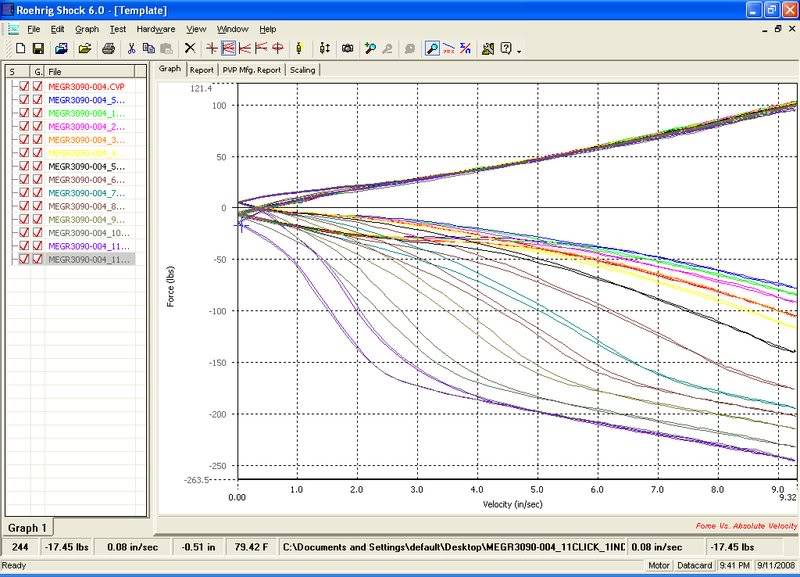
I had the opportunity to run one of my shocks on a Roehrig Shock Dnyo a few days ago and was wondering if somebody could explain what critical dampening is exactly?
I also have my test graph with overlays of each run. I started at full soft then increased one click at a time. Which run is critical daming taking place and which run is dampening just before critical damping taking place?
-
09-13-2008 #2 Registered User
- Join Date
- May 2002
- Location
- Northern California
- Posts
- 10,716

I can't but this is from John Grindall:
I think you'd get a rough idea about the different sorts of damping if you think about the suspension on a car.
Underdamping is when the suspension is really bouncy and if you go over a bump you bounce a lot afterwards.
Overdamping is when the suspension is too tight, and can't move. So when you go over a bump you get a jolt and possibly a bruised behind.
Critical damping is the one where you don't feel a thing, (vorsprung durch technik probably)you go over a bump and when the car lands it cushions you perfectly, and the suspension just relaxes back to where it started.
You can see these patterns if you look at the graphs of the solutions of your differential equations. the bouncy one has lots of sinusoidal motion for a long time.
Overdamping is too sudden, the curve decays really fast to zero without any bounce at all.
Critical & overdamped systems both decay to equilibrium without oscillation, but critically damped systems do so as rapidly as possible (i.e. quicker than overdamped systems) - any less damping and the system starts to oscillate.
MrQuick ΜΟΛ'ΩΝ ΛΑΒ'Ε
09-14-2008 #3 Registered User
- Join Date
- Nov 2002
- Location
- state of confusion
- Posts
- 1,499
What you have are shock force plots, which don't directly provide critical damping data.
The fraction of 'critical damping' that you have depends on the mass and spring constants in the system, and this fraction could exceed 1.0 if the shocks were valved for a sufficiently heavier vehicle with enough stiffer springs.
Critical damping Cc = 2 * SQRT( K * W / g ) . . . where K is some kind of spring rate (lb/in) and W is the weight (lb) of the mass that's "vibrating". g is the acceleration due to gravity (386.4 in/sec^2)
Cc is a force per unit velocity (think lbs per in/sec - you may see this rewritten as "lb-sec/in"). You can extract what your shock is providing as critical damping from the slopes of those curves at whatever point you're interested in and compare it to the above to get the "% critical damping" at that particular condition. I think you could use the sprung portion of corner weight and the wheel rate and correct that result by the overall shock motion ratio to see what Cc = 1.0 needs along the shock axis.
Briefly, the % critical damping is relatively high for the blue traces on what I assume is the rebound side between 1.0 and 2.0 in/sec, good for control of body motions. Those same traces give up a lot of the % critical damping as the rebound velocity goes past 2.5 in/sec or so (good for reducing harshness in the higher velocities). And there is little change in the bump damping regardless of the setting or applied velocity.
Norm'08 GT coupe, 5M, suspension unstockish (the occasional track toy)
'19 WRX, Turbo-H4/6M (the family sedan . . . seriously)
Gone but not forgotten dep't:
'01 Maxima 20AE 5M, '10 LGT 6M, '95 626, V6/5M; '79 Malibu, V8/4M-5M; '87 Maxima, V6/5M; '72 Pinto, I4/4M; '64 Dodge V8/3A

 Reply With Quote