


Results 1 to 16 of 16
-
1 Week Ago #1
 Registered User
- Join Date
- Jul 2026
- Posts
- 4
Model A Chassis and Suspension Design
My wife inherited a 1930 Model A coupe. I am in the planning stages of the build. Her requirements were that it be a sleeper, no big loud V8, and that it handle and ride nice. My neighbor has a Thunderbird Turbo Coupe sitting in the yard he said he'd sell me the engine out of so the sleeper part is handled. The stock style Model A suspension does not handle or ride nice so IFS and IRS it is. As we like driving to car shows around the country I want components that I can buy parts for anywhere and easily replace in a parking lot. After much research I found ridetech's Fox Mustang SLA conversion and IRS which meet the bill. The Fox Mustang is pretty similar in wheelbase and track width to the Model A believe it or not. The Mustang is 100.5"-56.6"/57" and the Model A is 103.5"-56".
Plugging stuff into ChatGPT I getParameter Front Rear Notes Track width 57.0" 57.0" Ride height (frame) 4.5–5.0" 5.0–5.5" Roll center 1.5–2.0" 2.5–3.0" Roll axis Rising toward rear — Static camber -1.0° street / -2.0° track -0.8° to -1.5° Camber gain 0.8–1.0°/in 0.6–0.8°/in Caster 7–8° — Toe 1/16" total out 1/16" total in Anti-dive 8–12% — Anti-squat — 25–35% Ackermann 70–90% — Scrub radius 0–0.5" positive — Bump steer <0.020"/in Minimal
Chassis balance
For your target weight of 1700–1800 lb, I'd aim for:
- Front weight: 48–49%
- Rear weight: 51–52%
With the turbo four mounted completely behind the front axle, that's a realistic goal and should produce a very neutral, confidence-inspiring chassis.
Tires
My current recommendation would be:
- Front: 225/45R17
- Rear: 245/40R17
or, if you want a slightly more aggressive appearance without sacrificing balance:
- Front: 235/40R17
- Rear: 255/40R17
At only 250 hp, I don't think anything wider is necessary. A lighter tire and wheel package will improve steering feel, ride quality, and acceleration.
Springs (starting point)
Because the ridetech suspension is intended for a heavier Mustang, I'd expect to tune it substantially softer:
- Front: 275–325 lb/in
- Rear: 225–275 lb/in
The exact rates will depend on the suspension's motion ratios and the final corner weights, but this range should be much closer to what a 1700–1800 lb car wants.
I've been turning wrenches and modifying cars for 25 years but suspension design is new to me so I have some questions.
First, how do these numbers look? Is ChatGPT way off?
Second, is the Ridetech stuff a viable option for this build?
My current plan is to start with a new, bare Model A chassis and adapt this Fox suspension to it.
Would I be better off using CAD to design a custom chassis with the Ridetech pickup point integrated into the overall design? I have done some CAD but currently am not skilled enough to use it to design a chassis.
I would love to hear this group's thought and advice on this project.
-
1 Week Ago #2
 Administrator
- Join Date
- Jan 2000
- Location
- Thousand Oaks California
- Posts
- 10,198

Following. My wife has a 1930 as well.
Larry Callahan
Founder/Administrator of Pro-Touring.com, G-Machines.com and HostMyJunk.com
To advertise on Pro-Touring.com click here
1 Week Ago #3 Registered User
- Join Date
- Nov 2006
- Location
- Mountain Springs, Texas
- Posts
- 4,848
I painted and got running a 1930 model A for my farrier years ago. It was the most crude car I have worked on. The body flex was incredible, it was all I could do to keep the doors from popping open going over a bump. Plan on some serious chassis stiffening or better yet a whole new chassis.
I’m sure Donny can offer some great advice.1969 Camaro - LSA 6L90E AME sub/IRS
1957 Buick Estate Wagon
1959 El Camino - Ironworks frame
1956 Cameo - full C5 suspension/drivetrain
1959 Apache Fleetside
1 Week Ago #4
Registered User
- Join Date
- Jul 2026
- Posts
- 4
Yes I plan on starting with an aftermarket bare chassis like one from Boling Brothers. Figured I could work from there with with suspension mounting and engine/trans mounts.
6 Days Ago #5 Registered User
- Join Date
- Sep 2010
- Location
- Beach Park IL
- Posts
- 3,042
I actually had a long reply typed up over the weekend and pushed send and got an error. Here was the most important part.
Look at your model A from the side and note where axle centerline is in relation to the radiator. Now look at the Fox suspension and note everything that is in front of the axle center line. Packaging wins everytime.
The rest of it was based on a lot of assumptions, I should just ask.
What is your skill set? Ability to fabricate and problem solve?
Got an inspiration pic of what you want this car to look like?Donny
Support your local hot rod shop!
5 Days Ago #6
Registered User
- Join Date
- Jul 2026
- Posts
- 4
The fox Mustang has more in front of the axle while the A axle is pretty much at the front of the vehicle. As for skill set, I've been a highway dept fleet mechanic for 24 years and a mechanic for 27 so I've got the the necessary skills. Originally Posted by dontlifttoshift

5 Days Ago #7
Registered User
- Join Date
- Sep 2010
- Location
- Beach Park IL
- Posts
- 3,042
So where you going to put the rack and pinion?.....and then the sway bar? There is a reason that every IFS made for the 28-34 Fords is rear steer. The upper control arm isn't going to fit under the front fender either, especially at proposed ride height.
Donny
Support your local hot rod shop!
5 Days Ago #8
Registered User
- Join Date
- Jul 2026
- Posts
- 4
The ridetech knuckles are modular and the steering arms can be mounted to the rear. There are a number 28-34 IFS options on the market, how do they fit the upper arm? I am more than open to other options or suggestions for IFS but I'd like to stick with the ridetech knuckles for their use of off the shelf Mustang parts. Would I be better off using a Helix Cornercarver or Kugel Model A IFS and adapting the Ridetech knuckle? Originally Posted by dontlifttoshift
5 Days Ago #9
Registered User
- Join Date
- Sep 2010
- Location
- Beach Park IL
- Posts
- 3,042
Forget about anything Helix or anything else that group owns. It is all garbage. Yes you would be better off looking at Kugel's IFS or TCI as another option.....I think Kugels IRS is a superior product for this application as well.
You can't just swap the steering arms to rear steer without ruining the ackerman. They fit the upper arm in 28-34 by designing a suspension that fits under the fender. TCI and Kugel both have that dialed in and it works well. Neither of them were built to win races, they were built to fit and ride nice.
The off the shelf parts thing is well reasoned but not really practical in application. Hubs and brakes are the only thing that is off the shelf and I find it highly unlikely that someone who has been a mechanic for 27 years is going to leave for a road trip with un maintained hubs or brakes. If this is a big hang up for you, let me offer some perspective. Walk into your local parts store and see if they have a valve cover gasket for your turbo coupe engine. My NAPA says tomorrow. Need a S550 front hub? That's tomorrow, too. Oddly enough they do have one rear hub in stock. If you can get past that artificial barrier, here is the way I would do it.
Start with a TCI model A IFS chassis. Tell them to keep the rear suspension and axle. Have them kick the rear frame more than standard. (assuming you want to actually be that low and are willing to pack extra light for your road trips because your rear suspension and your gas tank have to go in the trunk) Then install the Kugel IRS on your TCI chassis and chosen ride height and axle centerline. I would also spend $$$ money on very good coil overs.Donny
Support your local hot rod shop!
5 Days Ago #10 Registered User
- Join Date
- Nov 2018
- Posts
- 970

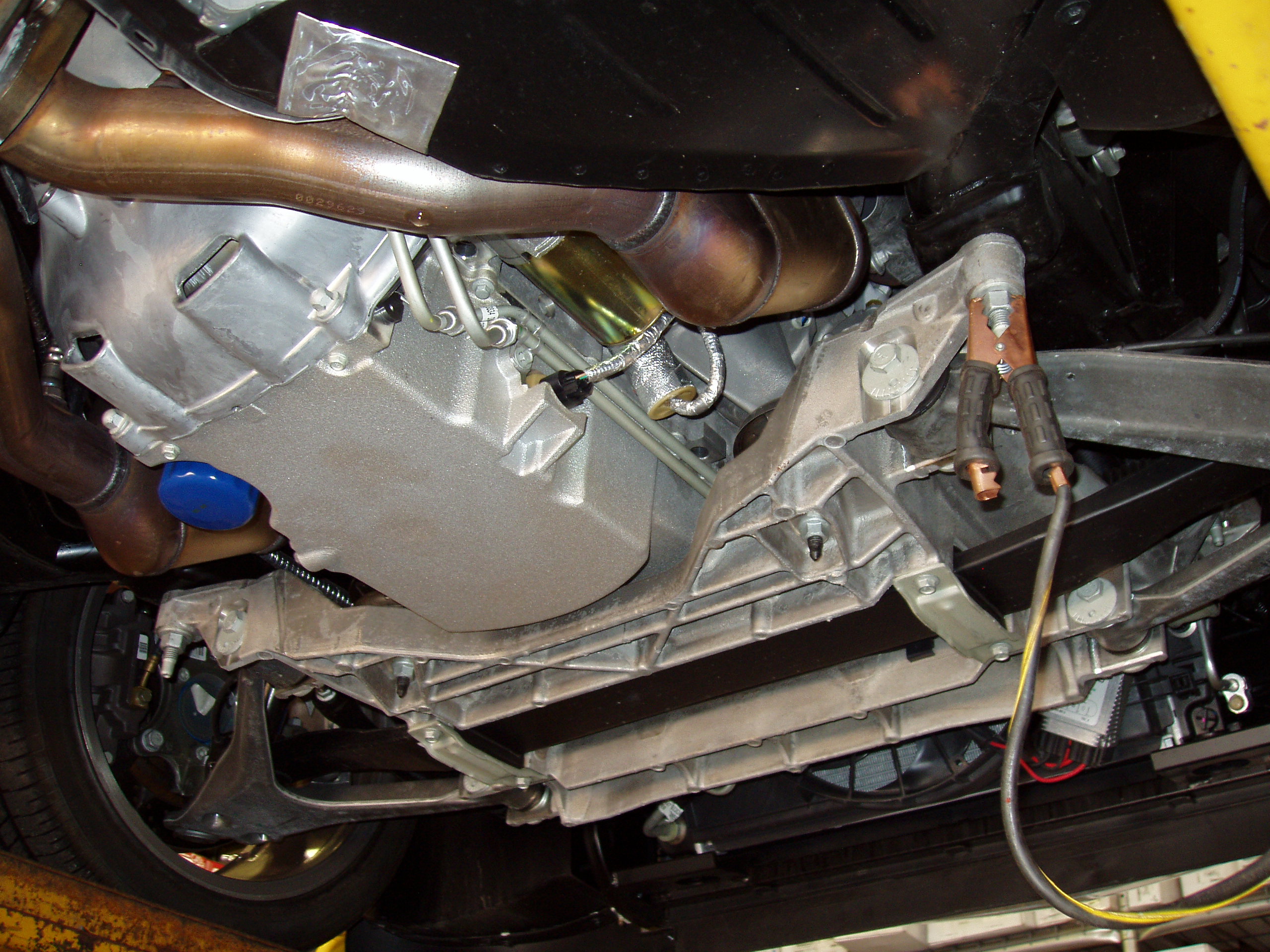
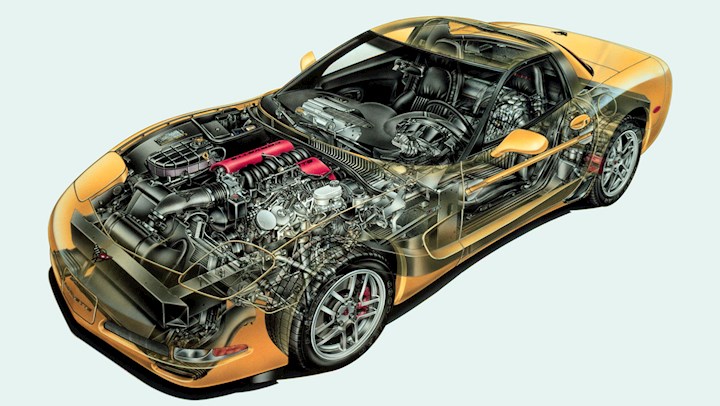
C5/6 Corvette IRS might be the way to go here. The problem I had on my build is the opposite of this one. The Corvette has the engine almost completely behind the front wheels, same as the Model A, and the cradle has the engine mounts attached. The reason I couldn't use it is the harmonic balancer was 1 inch behind the steering rack for front steering which would put the engine way too high or back inside the cab, but then my front tires are practically inside the cabin themselves. Looking at the pictures it looks like there might need to be a little body modification but it would fit fine. There is a company called Dobberton that makes adapters, but really a few tabs welded on the frame would do the trick to make the cradle work. It probably wouldn't be difficult to build engine mounts to install the Ford engine in there.
4 Days Ago #11
Registered User
- Join Date
- Sep 2010
- Location
- Beach Park IL
- Posts
- 3,042
That gif is hilarious considering how colossally wrong everything you typed is.
Donny
Support your local hot rod shop!
4 Days Ago #12
Registered User
- Join Date
- Apr 2009
- Location
- Michigan
- Posts
- 333
I have no firsthand experience building Model A's, but I will say a well sorted link type solid axle (like in the TCI chassis Donny suggested) will out perform an average IRS. 90% of it comes down to setup and tuning. The following items are more important to getting a car to "handle and ride nice" than IRS vs solid axle:
- Getting the spring rates / shock valving / bump stops dialed in, and that's assuming you have sufficient suspension travel for a comfort oriented setup
- Choosing the right tires and tire pressure for the weight and intended use of your car
- Ideally you'd run big rubber bushings to help with impact harshness / secondary ride, but this will be difficult on a Model A
- Having a reasonable amount of torsional rigidity in the chassis
- Getting wind and road noise under control
- Getting the ergonomics reasonable - seat position and padding, steering wheel position, pedal position etc.
If it's going to be a long distance driver, space for HVAC and luggage also needs to be considered, as well as fuel tank capacity.
In short, I'd recommend keeping it simple and going with a proven, off the shelf chassis and spending the time and money you save on the factors I mentioned above.
If you're dead set on IRS, I did find this in a search, but I know nothing about the company: https://shopcaliforniacustomroadster...model-a-frames- Ryan
4 Days Ago #13
Registered User
- Join Date
- Nov 2018
- Posts
- 970
Is it? Explain in detail, please. I'll be the first to say I don't know much about the 1930 Ford, but If I'm wrong then the OP should know why I'm wrong so as to not investigate my suggestion. Originally Posted by dontlifttoshift
Oh, and I'll just leave this cutaway of a Corvette, showing where the steering rack, front wheels and engine are located in relation to each other to help you explain how colossally wrong everything I typed is.
3 Days Ago #14
Registered User
- Join Date
- Sep 2010
- Location
- Beach Park IL
- Posts
- 3,042
Doubling down sure is a choice. You should have stopped here.
If you had thought, even a little, about anything I had already written you wouldn't have posted at all.I don't know much about the 1930 Ford
Axle center line is where the radiator is on a Model A. That puts the rack and sway bar out in front of it. As a bonus it is even higher up on a Corvette than on a Fox Mustang. Tie rods would have to run through the fenders.
The fenders bolt to the top of the frame on a Model A. The top of the frame is typically even or below axle centerline in side view. Go measure your corvette uprights and tell me how high the control arm is in relation. You still have the same problem with the upper control arms that won't fit under the fenders.
You have to narrow the suspension geometry somewhere around 10" to get even close to fitting the tire under the fenders. At the point you just have a crappy IFS loaded with compromise that doesn't really fit.
None of that is insurmountable for a talented fabricator willing to accept that form follows function at all costs. I don't believe that to be the situation here given the renderings.
Here is a rear view of a Kugel IFS.
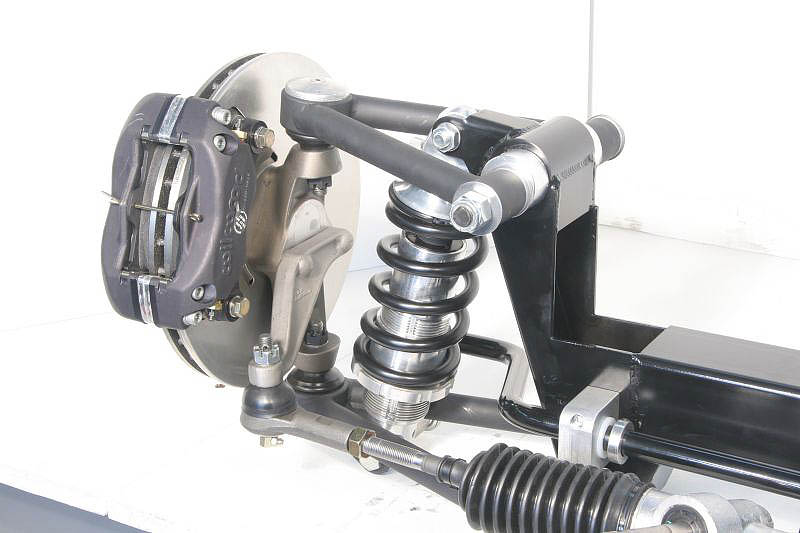
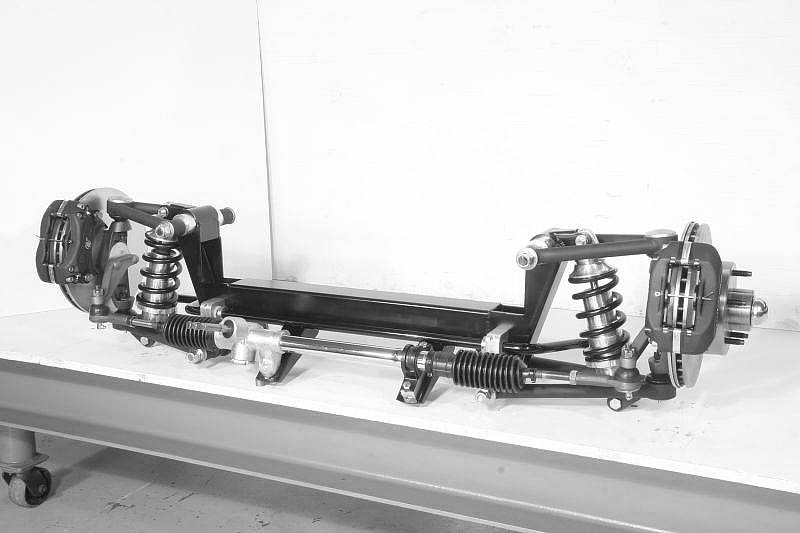
These are small cars. To package well you need a short spindle and short control arms. Upper control arm mounts outside the frame rail. Rear steer and a rear mounted sway bar to stay out of the way of the radiator and sheet metal. Note the height of the spindle pin in relation the ball joints. That's what it takes to get low and still maintain decent geometry. People been hot rodding these cars for a 100 years, it is pretty well dialed in.
****
Solid post from Stab, though and a good link, too. I forgot about them and they are using Kugel for front and rear suspension.Donny
Support your local hot rod shop!
3 Days Ago #15
Registered User
- Join Date
- Nov 2018
- Posts
- 970
See there? That was a useful post where your previous one wasn't. I don't mind being wrong when I make a suggestion, just explain why you think I'm wrong so everyone knows. "Doubling down" was not so much as pushing myself as right as it was pushing you to explain why I was wrong. Had you done that to begin with, my response would have been quite different. And with that, I'm done with the thread hijack.
OP, forget my Corvette suggestion, evidently it won't work. But I'll be watching for your solution to the problem as I'm always willing to learn.
5 Hours Ago #16
Registered User
- Join Date
- Sep 2007
- Posts
- 459
The other advice here is good.
My general thoughts on the project:
- frame stiffness is part of the battle for a smooth ride. Get an X-braced frame if it's feasible.
- Consider going down below 17" wheels. Thin tire sidewalls ride like crap and big rims get damaged easily. Half the benefit of running big wheels is to fit big brake rotors, but your 2000-lb car won't really need big brakes.
Unfortunately you are caught between some availability factors once you get below 17". There are limited choices for 16" aftermarket wheels. If you go down to 15" there are endless wheel options, but local stores don't keep enough 15" tires on the shelf.
- I also vote to spend money on good coilovers and tune them well. You have limited room for wheel travel so every inch counts. And use rubber bushings (not poly) on everything.
- Build the car for modern times. Interstate highway traffic is going 80 mph (not 65, not 70) in flat rural areas. You may not like going that fast but traffic will press you into it at times. The car needs to be able to handle it. Gear ratios, headlight brightness, body/interior parts rattling, etc.
- Is that motor's compression ratio happy with 87 octane? Premium is a poor bargain these days.

 Reply With Quote