


Results 1 to 14 of 14
-
07-30-2016 #1

 Registered User
- Join Date
- Feb 2005
- Location
- Waterloo, Ia
- Posts
- 1,408
Double adjustable shock. Does increasing compression...
I'm wondering if increasing compression on double adjustable shocks acts as an artificial increase in spring rate, allowing for a more street friendly spring for driving and essentially allowing the shock to act in place of a heavier spring on the track?
-Nick
-1967 GTO I drive and race
-Build threads:
-http://forums.maxperformanceinc.com/forums/showthread.php?t=615847&page=23
-https://www.pro-touring.com/showthre...project-thread

-
07-30-2016 #2 Registered User
- Join Date
- Aug 2012
- Location
- Peoria, AZ
- Posts
- 1,758

The spring carries the load and the shock is just a timing device that controls how fast the spring moves in each direction. By adding compression you aren't really increasing the load capacity, you are just slowing down how long it takes for the spring to compress.
I used this strategy on my car when I wanted to see what more rear spring rate would act like and I can say it does work, to a degree... What you don't want to do though is have both a bunch of compression AND rebound dialed into your shocks at the same time, they will work against one another and do neither very well. This strategy is a crutch really, not a desired tuning strategy.
I will say this, I recently went from a 250# spring in the rear to a 600# spring and the difference in ride on the street really wasn't near as bad as I though tit might be. Only the real slow, really sharp bumps are different, like the 1" hop up into my garage. On the road it's not bad at all.Lance
1985 Monte Carlo SS Street Car
07-30-2016 #3
Registered User
- Join Date
- Feb 2005
- Location
- Waterloo, Ia
- Posts
- 1,408
You have a 600 lb spring in the rear?! Originally Posted by SSLance
 -Nick
-Nick
-1967 GTO I drive and race
-Build threads:
-http://forums.maxperformanceinc.com/forums/showthread.php?t=615847&page=23
-https://www.pro-touring.com/showthre...project-thread
07-30-2016 #4 Registered User
- Join Date
- Nov 2008
- Location
- Lawrenceburg, TN
- Posts
- 4,098
no the artificial increase is done with rebound Originally Posted by Nicks67GTO
07-30-2016 #5
Registered User
- Join Date
- Aug 2012
- Location
- Peoria, AZ
- Posts
- 1,758
Originally Posted by Nicks67GTO
 Pretty recent upgrade...after MWMC.
Lance
Pretty recent upgrade...after MWMC.
Lance
1985 Monte Carlo SS Street Car
07-31-2016 #6
Registered User
- Join Date
- Feb 2005
- Location
- Waterloo, Ia
- Posts
- 1,408
Interesting. What does compression do then? I'm trying to better wrap my mind around this? Originally Posted by Rod
-Nick
-1967 GTO I drive and race
-Build threads:
-http://forums.maxperformanceinc.com/forums/showthread.php?t=615847&page=23
-https://www.pro-touring.com/showthre...project-thread
07-31-2016 #7
Registered User
- Join Date
- Feb 2005
- Location
- Waterloo, Ia
- Posts
- 1,408
Wow...what's the front rate? Originally Posted by SSLance
-Nick
-1967 GTO I drive and race
-Build threads:
-http://forums.maxperformanceinc.com/forums/showthread.php?t=615847&page=23
-https://www.pro-touring.com/showthre...project-thread
07-31-2016 #8
Registered User
- Join Date
- Nov 2008
- Location
- Lawrenceburg, TN
- Posts
- 4,098
here is a quick pic of how it works.....
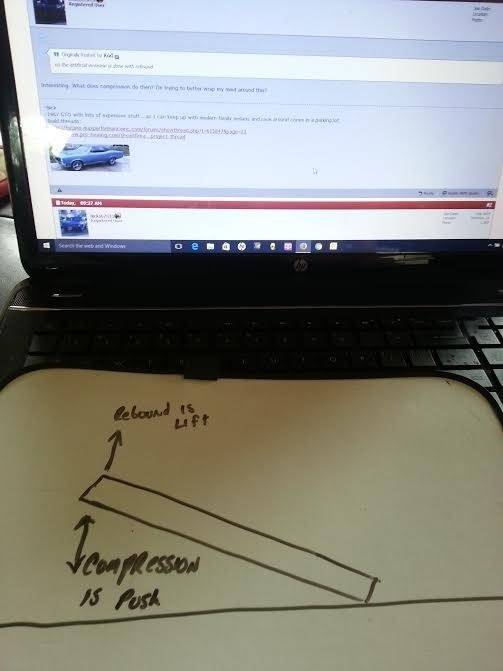
and here is how to explain it.....
its simple "your primary job as a driver is weight management" thats it....all the glory removed from racing...(bummer right)..your in that seat to control weight transfer front to back with brake and throttle then side to side with brake, throttle and steering..... simple....driver controls the speed of that transfer and the suspension settings control the balance of that weight transfer.....thats what its all about
with me so far....good...here is the basic explanation as told to me by Randy Pobst, and has always worked for me, for years...ready....
your a lumber jack....(hold on read it all) and a small tree next to you is falling....with no resistance it will just slam into the ground(to light a spring and no compression or rebound) so now you step in and try to hold it up, you are now the shock, you resist the falling weight of the tree, you are now compression damping the weight of the tree pushes down on you(got it) but there are really two of you lumberjacks there...your buddy is helping, he on the other side holding the tree back with a rope tied to the top and he is the rebound now,
hows that for a simple break down
I have heard many-many super complicated explanations and others that cant even explain it, but it just comes down to this
hope that helps
07-31-2016 #9
Registered User
- Join Date
- Aug 2012
- Location
- Peoria, AZ
- Posts
- 1,758
I'm with you 100% on your first paragraph Rodney...but you lost me on the second part. How does rebound (as you describe as lift) help pin the shock down?
I've always been taught that stiffening the rebound adjustment helps hold the shock compressed longer, not letting the spring push (extend) the shock out as fast. More rebound holds the transferred weight on the that tire for a longer time... More compression helps keep weight from transferring to that particular tire.Lance
1985 Monte Carlo SS Street Car
07-31-2016 #10
Registered User
- Join Date
- Nov 2008
- Location
- Lawrenceburg, TN
- Posts
- 4,098
I dont build them...it was explained that way to me and it has always worked...actually I take that back....I do build them....and it still has always worked for me Originally Posted by SSLance
08-01-2016 #11
Registered User
- Join Date
- Feb 2005
- Location
- Waterloo, Ia
- Posts
- 1,408
Interesting Rodney. Thanks.
I guess my presumption was that compression was the resistance to shock movement and rebound was how hard it pushed back after the initial movement was over. Almost like 2 sides of the same coin.-Nick
-1967 GTO I drive and race
-Build threads:
-http://forums.maxperformanceinc.com/forums/showthread.php?t=615847&page=23
-https://www.pro-touring.com/showthre...project-thread
08-07-2016 #12 Registered User
- Join Date
- Dec 2006
- Location
- Out of the Burbs of Detroit to SoCal, then onto my ancestral homeland, the woods of Cascadia
- Posts
- 1,753
Originally Posted by Rod
Why am I singing -
"Oh I'm a lumberjack and I'm OK, I sleep all night and I work all day..."
Sounds like if your trying to keep a tree from falling, you'll soon be squished.
But I digress...Greg Fast
(yes, the last name is spelled correctly)
1970 Camaro RS Clone
1984 el Camino
1973 MGB vintage E/Prod race car
(Soon to be an SCCA H/Prod limited prep)
08-07-2016 #13
Registered User
- Join Date
- Jul 2015
- Posts
- 101
compression dampening is the shocks resistance to getting shorter. Originally Posted by Nicks67GTO
rebound dampening is the shocks resistance to getting longer.
08-20-2016 #14 Registered User
- Join Date
- Sep 2006
- Location
- Southern Indiana
- Posts
- 4,709
If you need think of a spring as load holding piece and remember if the body is going up under acceleration the tire should be planting or bitingg surface. If it's going down the wheel is lifting off ground.
NOW a spring absorbs and releases energy. Once a spring starts going up and down it only stops when acted up on to dampen the occillation of the spring.
This is body weight, bushing resistance, and shocks.
The point of shock is to keep body in control as well as axle/tire. Keeping tires on ground.
Too soft compression let's tires lift too hard rides like ass, rebound too tight won't let suspension lift from compression fast enough, too loose lets body lift too fast then if they fully extend can lift car off track. Whst I have found, especially with ridetech, they get thing so close you then set them in middle, and adjust up or down from their.Lee Abel
AFTERMARKET PERFORMANCE
1977 Chevy Monza 2+2:Project "Cheap Trick"
1978 C10 Long bed , On air and trailer puller
2006 Buell Blast ,Just a bike to ride and for mileage
1966 Caprice 4dr Sports Roof fact.327/now 350/SOON 454???? Project "II Old,,,ZERO BUDGET OR LESS CAPRICE!"

 Reply With Quote