


Results 1 to 20 of 132
Hybrid View


-
09-02-2016 #1
 Registered User
- Join Date
- Aug 2016
- Posts
- 33
I really like your attention to detail! Tend to hyper focus on minute details, and projects take me forever because of it. I love the project. Forgive me if you've said it before, but you must be some sort of engineer ��
-
09-02-2016 #2 Starting The Transformation
- Join Date
- Feb 2010
- Location
- El Segundo, CA
- Posts
- 268
 PhD in Mechanical Engineering from UCLA. Worked for McDonnell Douglas for a while designing airplanes, then TRW designing spy satellites, then DIRECTV also on satellites and rockets launches, and eventually on antennas. If you look on any roof that has a DIRECTV dish, the little pointing mechanism that allows it to point it's narrow Ka beam to a satellite 25,000 miles away, that was designed by me (11 patents). Been building stuff since I was 14, when I built a full suspension BMW bike with XR75 front forks. That bike could really jump. I still recall drawing out the frame life-size on butcher paper on my mom's living room floor, cutting and mitering the tubing by hand and having a friend's brother weld it up.
 Originally Posted by LT1C1500

11-25-2016 #3
Starting The Transformation
- Join Date
- Feb 2010
- Location
- El Segundo, CA
- Posts
- 268
This write-up is just about some planning, not about actual progress.
Ever since I got my truck back from a prior builder I've been disappointed with where he positioned the engine. He didn't go nearly as low as I think he could have gone. Mainly because he was limited by the (standard for him) subframe that he welded in. He installed the subframe first, then tried to get the engine as low as he could and of course, with a Ford, ran into interference between the oil pan and the subframe/steering rack. Even though the engine has a rear sump oil pan, there is still a small front "mini-sump", which even has it's own drain plug. This is to accommodate the front mounted oil pump.
I think he should have installed the engine first, and then built a custom subframe "around" the oil pan. But that would have been too much work. It is, however, what I plan to do when I build my own frame.
During a recent build-phase I constructed new control arms, added new front shocks and installed an AODE transmission, as can be seen higher up in this thread. The reworked suspension required relocating the steering rack, and this in turn required re-routing the steering shaft. Due to a clearance issue I had to lower the front of the engine about 1 inch. I did this by making new motor mounts. The only reason I could do this and the prior builder could not was because the steering rack had been moved out of the way.
The prior builder installed my current 347 engine with a carburetor. As such he canted the engine up at an angle of 3 deg or so, probably a little more. I've since converted to EFI. From studying the subject I am convinced that an engine with EFI can run at 0 deg inclination (flat). There is no longer any need to tilt the engine backwards as had been the habit for so many decades. This allows quite a bit of scope to lower the front of the engine. As mentioned above, I lowered the front of the engine 1 inch, but would have to lower it quite a bit more to get it flat. You do have to keep your driveline angles in mind when during all this.
An interesting thing happens when you lower the front of the engine. The valve covers move away from the firewall. This then produces scope to push the engine backwards. A win-win.
If one is determined enough in lowering the engine in their Pro Touring truck, eventually it will get down there far enough where it will start "competing" with other parts of the vehicle for who can scrape the ground first when and if things start to bottom out. This is when people start talking about things like dry sump oil pans in order to get a little extra clearance. That's just fine if you're running a compact manual transmission. But if, like me, you have an automatic transmission, then things are a little different.
One look at this picture will sort of illustrate the issue:
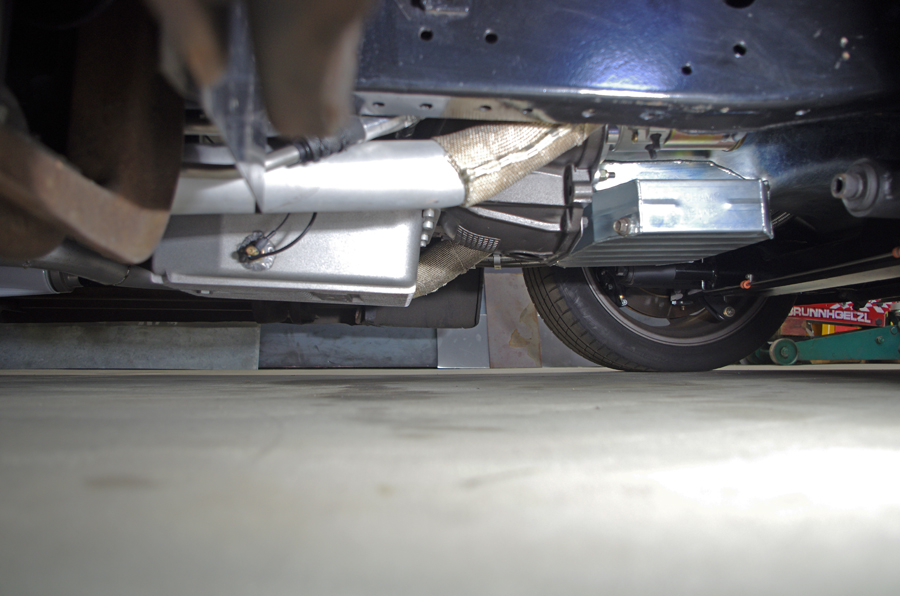
Here you can see how far the AODE transmission pan hangs below just about everything else. I should make clear that this is an extra capacity B&M pan. Basically the biggest pan I could find. I bought it before I really understood how far it would protrude downwards. I was just thinking of extra capacity and extra cooling at the time. The picture also makes it obvious that a dry sump system for the engine would be of little benefit for me. The transmission bell housing is already as low as the existing oil pan.
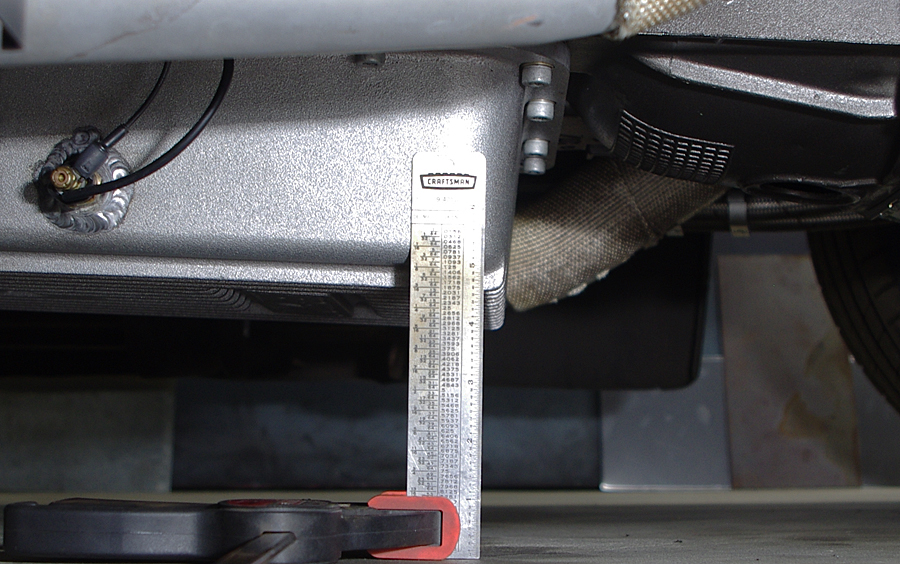
Here I have a little ruler to show the actual ground clearance of the transmission pan, which looks to be about 4.5 inches. It was lower before as I just finished raising the front of the truck a bit by welding new lower shock mounts on to my lower control arms. When I built the control arms and installed the new (shorter) shocks I did a lot of measuring and calculating, but nonetheless my ride height ended up a little low. And I could not turn the spring perches down far enough to compensate. So I moved the lower shock mounts up 1 inch, moved the upper spring perches up 3/4 inches and voila, a tad more ride height.
11-25-2016 #4
Registered User
- Join Date
- Apr 2011
- Posts
- 165
Hey Dr G Originally Posted by Dr G
Why dont u get rid of the pan, and make a new one, that is wide and shallow like your oil pan?
11-26-2016 #5
Starting The Transformation
- Join Date
- Feb 2010
- Location
- El Segundo, CA
- Posts
- 268
Well you read my mind. That is what I have in planned. Originally Posted by hotrod56
At a minimum I have to get rid of the deep sump B&M pan. It's just and accident waiting to happen. Though surprisingly I've scraped and bottomed the truck at various times, and yet the trans pan is pristine.
What I plan to do is fabricate a pan out of steel plate (0.250" rail and 0.125" pan). It won't be the lightest thing in town, but compared to the weight of the transmission it will be inconsequential. And it will offer at least some resistance to scraping the ground if/when that ever does happen. And it won't crack/shatter like a cast aluminum pan would on impact. After I weld it up and leak check it I will have a local machine shop fly-cut the gasket mating surface to true it up.
I'd like to make my custom pan as shallow as possible. How shallow is this? That is something I am still investigating. The following picture gives me some clues:
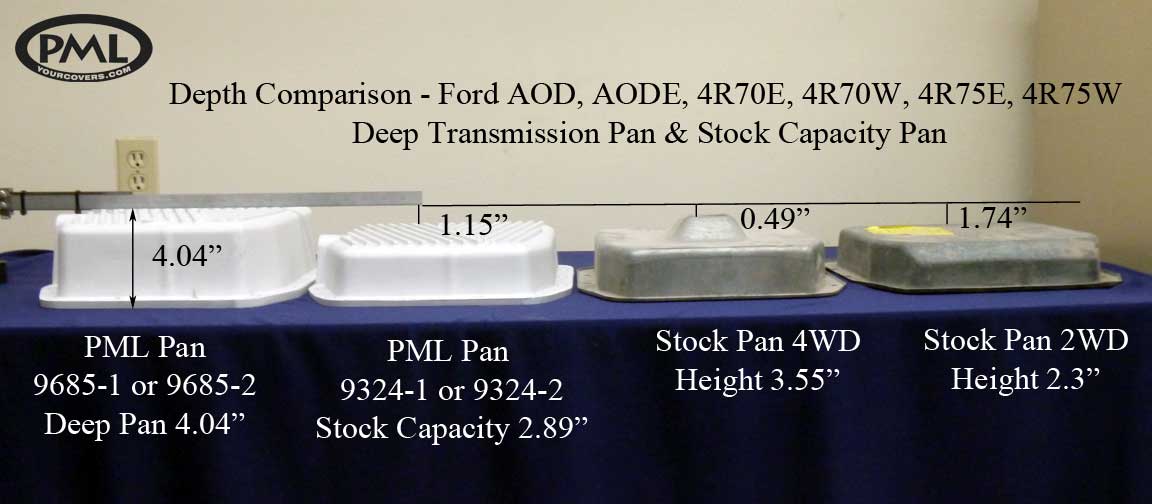
I would like to build a pan with a 2.3" depth like the one shown on the far right. I know my B&M pan is at least 4" deep probably more. So that gains me 2 inches of ground clearance right there. Nothing to sneeze at.
I'm just not totally sure if the pan shown on the far right is a standard 2WD AODE pan or an AOD-only pan. I know the bolt pattern is mostly the same for the AOD, AODE and 4R70W transmissions, but the AOD used a very different filter. The AODE/4R70W has two different filters for 2WD and 4WD applications:

Just looking at the filters it would seem to make sense that the 2WD filter is meant to work with the flat 2.3" deep pan, and that the 4WD filter is meant to work with the deeper 3.55" pan with the protrusion in the middle of it. That's what I'm going with for now, unless I learn something different. Sometime soon I will pull my B&M pan and check clearances for myself.
I am not happy about the loss of fluid capacity. As hotrod56 mentions, I have thought about flaring out the pan to the sides, similar to what is commonly done on road racing engine oil pans to gain capacity. But with the shallow depth it will make it tricky to access the bolts that attach the pan to the trans. I could get tricky and weld small tubes around the bolt holes to seal them to the gasket and them use longer bolts, or use bolts with sealing washers like the drain plug, or even a two-part pan. I've seen all these techniques used for oil pans. But there is not unlimited room to flare out the pan in any case, as the exhaust runs pretty close by. It will take some thinking. If I could get an extra two quarts capacity from the effort it might be worth it.
I've also thought about adding the equivalent of a surge tank to the return line from the transmission cooler. Just an empty aluminum tank to hold a few quarts of fluid. Fills from the bottom and exits from the top, non-vented. It should not add very much load to the transmission fluid pump. It would be kind of like a dry sump tank I guess. I can't think of any reason this would not work.
More to come on this.
11-26-2016 #6
Registered User
- Join Date
- Apr 2011
- Posts
- 165
I have the same problem, but with GM 4L80e. Originally Posted by Dr G

 Reply With Quote



