


Results 21 to 40 of 43
Thread: Long Trans-Am Style Lug Nuts
-
10-28-2009 #21

 -Moderator/Sponsor-
- Join Date
- Jun 2001
- Location
- Orlando, FL
- Posts
- 10,604
 I think that's wise. Your liability would have been enormous.
 Originally Posted by Mark
John Parsons
UnRivaled Rides -- Modern upgrades for your ride.
UnRivaled Rides recent project -- LS9-powered 69 Camaro
-
10-28-2009 #22
 Registered User
- Join Date
- Aug 2004
- Location
- Rustburg, Virginia
- Posts
- 3,436
If you use studs long enough to make good use of the extra thread engagement...it may help with the reduced strength differences of the SS lugs. I believe that grade of SS is softer than the normal lug nut material....no engineering expert here, so please take what I said with a grain of salt and research the materials for yourself.
1970 RS/SS350 139K on the clock:
89 TPI motor w/ 1pc rear seal coupled to a Viper T56 via Mcleod's modular bellhousing w/ hydraulic T/O bearing from the Viper, 12 bolt rear w/ 3.73 gearing, SC&C upper control arms, factory lowers with Delalums, C5 brakes at all four corners, Front Wheels 17x8's with Sumi 255/40/17 and Rear Wheels 17x9's with Sumi 275/40/17.
Brief description of the work done so far can be found here: http://www.nastyz28.com/forum/showthread.php?t=112454
-
10-28-2009 #23
 Registered User
- Join Date
- Mar 2006
- Location
- Monterey Peninsula
- Posts
- 2,150
I was wrong,mine are made from 316 ss bar stock...
'67 Buick Skylark GS400 funny car "Ingenue" 8/10 HRM / Gasoline (Swedish) cover & feature 2/12
World's only Buick-powered Buick Funny Car!
Used to be known as musclecarjohn
www.buickfunnycar.com
http://www.facebook.com/ingenuebuickfunnycar
-
10-28-2009 #24
 Registered User
- Join Date
- Sep 2006
- Location
- Southern Indiana
- Posts
- 4,709
Well after careful study,,,
Actually its probably the best possible version depending on which iteration 304,304H,304L your purchasing.
After checking Azom.com it appears to be rather ideal, just dont forget to get it heat treated.
For heat treating use the following process:
Solution Treatment (Annealing) - Heat to 1010-1120°C and cool rapidly. These grades cannot be hardened by thermal treatment.
As it IS recommended in its list of uses as threaded fasteners.
Now according to one of my engineer friends he said in 7/8 bar stock form the strength will be fine, but if you can get roll formed threads over cutting them the finished quality will be much better.
Using them with cut threads I would recommend using nickle based (silver in color) antisieze, The taper should have the smoothest finish your tooling can produce OR polish it.
Here is a table that I was given explaining few different types, I still agree, the 304 might be just right:
Possible alternative grades to grade 304 stainless steels are given in table 5.
Table 5. Possible alternative grades to 304 grade stainless steelWhy it might be chosen instead of 304Grade
A higher work hardening rate grade is required for certain roll formed or stretch formed components.301L
Lower work hardening rate is needed for cold forging of screws, bolts and rivets.302HQ
Higher machinability needed, and the lower corrosion resistance, formability and weldability are acceptable.303
Higher resistance to pitting and crevice corrosion is required, in chloride environments316
Better resistance to temperatures of around 600-900°C is needed…321 has higher hot strength.321
A lower cost is required, and the reduced corrosion resistance and resulting discolouration are acceptable.3CR12
A lower cost is required, and the reduced corrosion resistance and fabrication characteristics are acceptable.430
While 302HQ might be better in some respects it would require forging, where as 304 will serve you well, just remember the minimum thread engagement on wheel fasteners is it must pass through the hex area AT LEAST the same distance as the thickness of the stud.
As long as your(lets say 1/2") studs thread into the hex portion ABOVE THE TAPER 1/2" your ok at minimum. So dont forget to make your studs longer to engage more and I do believe you will be fine.
The engineer said they would not necessarily need heat treat but for longevity it would be a little better.
-
10-28-2009 #25
 Registered User
- Join Date
- Jul 2007
- Location
- Belvidere, N.J.
- Posts
- 290
Thank you for the explanation of why I went with the 304SS. The grade I'm going with will be heat treated and should be more than strong enough for this application. Just to make sure, I tested a standard 7/16" steel lug nut on a chevy rear end that I had laying around with a torque wrench and found that the lug will either strip out or break off the stud at around 85 lbs. When I finish my lug nuts, I'm going to test them and see how they do. I also am planning on threading the lug nuts about half way through the body, which will give you about 1" of thread to engage with the stud. This will more than stasify the requirements that you mentioned. Originally Posted by MonzaRacer

Thanks again for giving everyone a great explanantion on the properties of 304 stainless.Mark E.
'68 RS/SS Camaro, 350 c.i./400 hp, Thumper Cam, Hurst shifter, Muncie M-21, Pypes H-pipe w/violator mufflers, 18" Rushforth Battery Wheels
-
10-28-2009 #26
Registered User
- Join Date
- Aug 2004
- Posts
- 540
Unless you are calculating thread engagement or performing physical testing that accurately replicates the installed conditions and loads, you are gambling. Originally Posted by MonzaRacer
Changing materials puts a lot of variables in play, for instance, what will you torque the nuts to?
Common sense would dictate, "whatever the factory does", well you might be right, but that would be a happy coincidence and is unlikely to be correct. You have changed materials and consequently thread engagement, altered friction, and added anti-seize, all of which change the torque required to insure you don't have slippage in the joint.
Insufficient torque and you have joint slippage, over-torque and you pre stress the studs to the point they could fail catastrophically under accidental loading.
Unless you have done the simplest and most conservative of bolted joint design calcs, such that you are over-designing, I would leave this one alone -- if you want to learn how to do those calcs, this is a great book
http://www.amazon.com/Handbook-Bolts.../dp/0824799771
I would also suggest looking for a stainless steel lug nut sold by a reputable manufacturer to see what process and material they are using, and if you can't find an example, I would ask myself why isn't anyone using SS.
-
10-28-2009 #27
 Registered User
- Join Date
- Feb 2008
- Location
- Sesser, Il
- Posts
- 490
Isn't the torque on a stock Chevy between 80 and 100, depending on application? I'd believe it would take more like 120 - 140 ft/lbs to get one to strip/snap. Originally Posted by Mark68
I'm not trying to be negative. I'd like a set if/when you do these myself. Any chance you could have some 12mm sets made up? I'd have to find out the proper taper for my wheels. I guess I could go with 7/16" but then I'd have 20 studs to change out.Doug Gulley
 66 C10 383, AFR 190, Accel SuperRam, Hyd Roller 230*/236* 280XFI, aftermarket T56, *under construction*
-
10-29-2009 #28
Registered User
- Join Date
- Mar 2006
- Location
- Monterey Peninsula
- Posts
- 2,150
Standard torque range for a 7/16" stud and alloy wheels is 65-75#'s,I've always torqued mine @ 75#'s and have never experienced any issues.
'67 Buick Skylark GS400 funny car "Ingenue" 8/10 HRM / Gasoline (Swedish) cover & feature 2/12
World's only Buick-powered Buick Funny Car!
Used to be known as musclecarjohn
www.buickfunnycar.com
http://www.facebook.com/ingenuebuickfunnycar
-
10-29-2009 #29
 Registered User
- Join Date
- Dec 2006
- Location
- Out of the Burbs of Detroit to SoCal, then onto my ancestral homeland, the woods of Cascadia
- Posts
- 1,753
Last year he ha them in 7/16 24. I've got 19 of them in that size from Phil Originally Posted by Mark68
Greg Fast
(yes, the last name is spelled correctly)
1970 Camaro RS Clone
1984 el Camino
1973 MGB vintage E/Prod race car
(Soon to be an SCCA H/Prod limited prep)
-
10-29-2009 #30
 -Moderator-
- Join Date
- Apr 2001
- Location
- Central CA USA
- Posts
- 6,114
Now would be a good time to upsize the wheel studs to 1/2". Then whatever nut you use would be much stronger than a 7/16" version.
12mm wheel studs have a coarser thread pitch for less chance of galling, and would also make for a stronger (than 7/16") assembly.
I made up a set for a friend, used 7075 hex, for 7/16" studs. Two issues came up. These were the old style piloted lug nuts, a stainless washer was used along with a little anti-seeze on the threads only. The lugs lost a little torque after a bit of driving, the combination of slippery stainless washer and lube were responsible. After reducing the amount of anti-seeze further and switching to plated steel lug washers, they stayed tight. My friend bought the washers from a booth at Goodguys and to their credit they did warn us about them.
I don't think I'd make another set, - except for myself, using larger studs and coarser threads. Some of the commercial lug nuts out there are absolute junk. I'd think almost anything you could make out of stainless would be better, but I'm no engineer.
David
P.S.
Here's a listing for Gorilla brand lug nuts made from "304 stainless"
Gorilla Lifetime Stainless Steel Lug Nuts, Duplex Acorn 7/8, 9/16", 4 per pkg (96197SS)
E-mail this product to a friend
Gorilla Lifetime Lugs. Beauty, precision and a lifetime guarantee.
# Gorilla Lifetime Lugs have set new standards in lug nut design and construction.
# They are engineered to surpass the highest OEM quality standards and manufactured to remain rust free for life.
Polished stainless steel - the very best lug nuts you can buy.
# Lug body made from 304 Stainless steel - will never rust
# Cold headed chrome vanadium steel seating surface - for superior strength and durability
# Plated finish exceeds 240 hour salt spray test
# Individually hand-polished for a brilliant finish
# 5-point quality control inspection ensures exacting standards
# Unique auto clench assembly for guaranteed cap retention
SKU:Last edited by David Pozzi; 10-29-2009 at 11:56 AM.
David Pozzi http://www.pozziracing.com67 Camaro RS that will be faster than anything Mary owns.
-
10-29-2009 #31
-Moderator/Sponsor-
- Join Date
- Jun 2001
- Location
- Orlando, FL
- Posts
- 10,604
David,
304 SS is a poor material choice for threaded fasteners... and I'm an engineer. Note the Gorilla lug nuts use a tool steel (chrome vanadium) seating surface. And almost certainly, the threads are also tool steel. The 304 SS is only for the "body" of the lug nut, which never touches the wheel, only the lug wrench.
jpJohn Parsons
UnRivaled Rides -- Modern upgrades for your ride.
UnRivaled Rides recent project -- LS9-powered 69 Camaro
-
10-29-2009 #32
 Registered User
- Join Date
- Jun 2007
- Posts
- 292
What about 4140?
They would have to be heat treated and powdercoated but I would assume that is what the OEM's use.
I would not eyeball that heat treat either. Might need kiln's. Recipe is in the Machinist's Handbook.My candy dish is filled with razor blades submerged in Anti Freeze.
-
10-29-2009 #33
Registered User
- Join Date
- Jun 2007
- Posts
- 292
I Lie.
6150 is the stuff to use. You need a Kiln with digital ramping to properly heat treat.
Might consider this the next time I have access to a lathe.My candy dish is filled with razor blades submerged in Anti Freeze.
-
10-29-2009 #34
 -Moderator-
- Join Date
- Jul 2005
- Location
- Mountain View, CA
- Posts
- 9,583
I WOULD NOT try to do something like this unless you REALLY know what you are doing with the engineering of threaded fastners.
These designs have thousands of hard track miles on them.
I wouldn't run the AL on the street.
http://www.maecomotorsport.com/Catal...and_Wheel.htmlLast edited by Damn True; 10-29-2009 at 12:33 PM.
True T.
Whats new with Project 1/2-Trak?
Follow my wisecracks on Sports, Food, Politics and other BS on Twitter.
My blog
When they kick out your front door, How you gonna come?
With your hands on your head, Or on the trigger of your gun?
-
10-29-2009 #35
Starting The Transformation
- Join Date
- Feb 2005
- Location
- SF bay area, CA
- Posts
- 135
Arguing over what metal works on items that are the only things that hold your wheels to your car makes no sense to me. We're not talking coil brackets or rear view mirror mounts. I don't see the need for these, but if you really need the bling (a.k.a. "wtf are those things?" to the general public that looks at your wheels) can't you just machine the SS to press fit over existing lug nuts, such as the tuner-style lug nuts?
Don't be this guy:
http://www.youtube.com/watch?v=NgNDUTllw1s
-
10-29-2009 #36
Registered User
- Join Date
- Jul 2007
- Location
- Belvidere, N.J.
- Posts
- 290
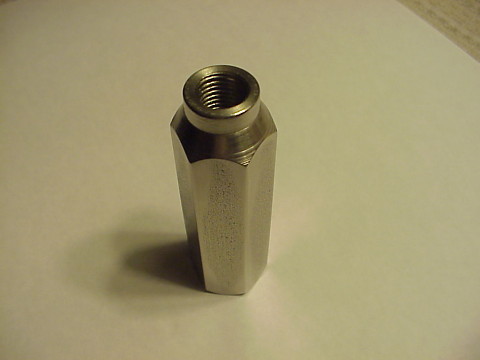
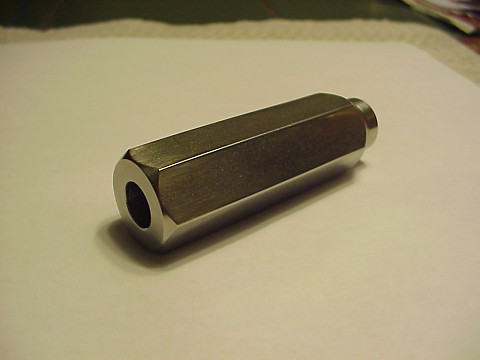
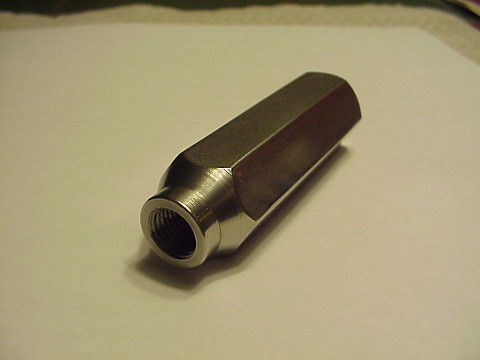
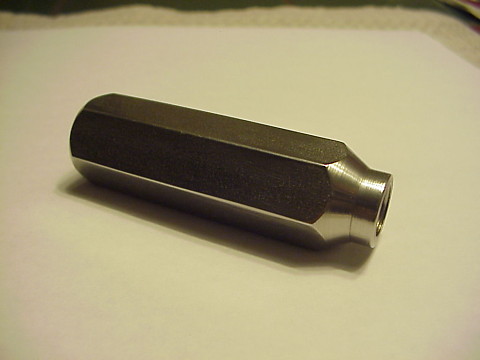
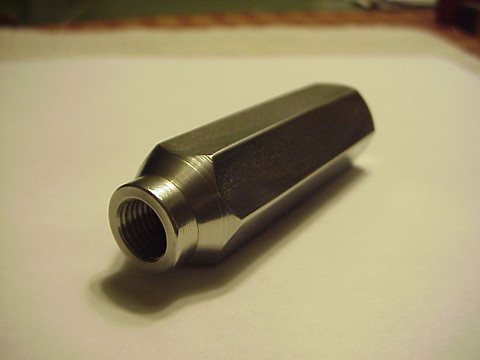
Here are some pictures of the finished lug nut. It is 13/16" in diameter and has 7/16" x 20 threads which run about halfway through it. The overall length is 2 7/8". The material used is 304 stainless steel. If anyone is interested in a set, please PM me and I will go over the details.
Mark E.
'68 RS/SS Camaro, 350 c.i./400 hp, Thumper Cam, Hurst shifter, Muncie M-21, Pypes H-pipe w/violator mufflers, 18" Rushforth Battery Wheels
-
10-30-2009 #37
Registered User
- Join Date
- Aug 2004
- Posts
- 540
How much do these weigh?
-
10-30-2009 #38 Registered User
- Join Date
- Mar 2009
- Location
- San Antonio, TX
- Posts
- 1,635
Those are friggen cool!
Nice work.
10-30-2009 #39
Registered User
- Join Date
- Jan 2005
- Location
- Netherlands
- Posts
- 1,012
When i first saw your post it suddenly hit me that i could use those but ofcours in a high quality non breakeble piece. Originally Posted by Mark68
Im driving realy fast for longer periods of time and was thinking about what would happend if some of the lug nuts in my wheels come loose and ore for some rezen give way.. when i saw yours i tought il bore some very little 2 mm holles at the end in them then use seal wire(air plain stijl) and conect ""all"" the lug nuts together!! so that none of the lug nuts would come ore vibertate loose if i drive 192 mph(faster in the future) . so please make a quality piece and il buy a set.
10-31-2009 #40
Registered User
- Join Date
- Sep 2006
- Location
- Southern Indiana
- Posts
- 4,709
Lug nut torque is the means to cause stretch in the fastener to hold two mating surfaces together. Its just like cylinder heads, your stretching head bolts and the elasticity of the metal in them are what holds the head down,with torque to yield they will stretch appropriately and not relax back to be reinstalled again, yet yield much more consistent torque figures, as the old style rely on X amount of torque which is twisting force.
As for torque according to the references I have all GM with 7/16 studs still list 100lb ft as torque, Ill look in other book I have at work.
Now according to the article in Modern Tire Dealer magazine the study they did for appropriate lubrication for wheel studs told them that nickle based (ie silver in color) antisieze is recommended and even beneficial to gain accurate lug torque in all automotive areas.
Remember your not doing this for twisting force, your twisting for lug stud/bolt stretch and this exerts clamping force upon the mating surfaces.
I whole heartedly agree that 1/2 in wheel stids on any and all cars would be a worthy upgrade.
As for the one who used stainless washers and had fastener creep this was most likely because of insufficient heat treat and lack of conical application design.
Ever see the heave thick wheel washers they are coned and this allows them to not squirm, where as flat washers can squirm and there by loosen easier. Now after multiple compressions the stainless washers will have some alterations in shape, and compression, all things combined they will then hold torque more uniformly.




