


Results 61 to 80 of 100
Thread: 3 link for my 65 falcon
-
10-14-2009 #61

 Registered User
- Join Date
- Aug 2004
- Posts
- 2,413
I think he is talking about Any racing he does will be on the strip then he wants it to corner well on the street.
My 3 link can be adjusted from 39% A/s to 140% A/S with a few hole changes.Nothing says "I built this" better than tool marks and dykem blue..
Follow my 3 link build. https://www.pro-touring.com/forum/sh...ad.php?t=61592
-
10-14-2009 #62
 Registered User
- Join Date
- Apr 2009
- Location
- san diego
- Posts
- 5,101

 Originally Posted by LowBuckX

correct, im aproximatly 45% to 145% with hole adjustments. ride height and pinion angle will be adjustable for different tire diameters. and preload from side to side will be adjustable also different sway bars will be easily changed from a steet/auto-x bar to a much stiffer drag bar. also adjustable length arms will be used with both setups to fine tune any sway. Im trying to build this as universal as i can. so that it ends up being a multi purpose suspension. I know you cant have the best for all conditions but im looking for good in all conditions.My build thread: https://www.pro-touring.com/showthre...ing&highlight=
The mustang build thread: https://www.pro-touring.com/showthre...el)&highlight=
-
10-14-2009 #63
Registered User
- Join Date
- Aug 2004
- Posts
- 2,413
We think alike. Originally Posted by falcon65
Nothing says "I built this" better than tool marks and dykem blue..
Follow my 3 link build. https://www.pro-touring.com/forum/sh...ad.php?t=61592
-
10-15-2009 #64
 Registered User
- Join Date
- May 2007
- Location
- Orlando, FL
- Posts
- 215
Yup! I forgot I was posting in a forum which includes autocross. Certainly, you'll want to back off from the 100% antisquat when you're concerned about wheel hop during braking. Originally Posted by LowBuckX
http://www.racetec.cc/shope
-
10-15-2009 #65
 Registered User
- Join Date
- Nov 2002
- Location
- state of confusion
- Posts
- 1,499
Then plan on keeping really good notes and try not to get lost in the tuning. Some adjustability is probably a good thing here, but won't necessarily be so good in the overall scheme of things if everything is adjustable in increments that are too fine and cover too wide of a range.
Norm'08 GT coupe, 5M, suspension unstockish (the occasional track toy)
'19 WRX, Turbo-H4/6M (the family sedan . . . seriously)
Gone but not forgotten dep't:
'01 Maxima 20AE 5M, '10 LGT 6M, '95 626, V6/5M; '79 Malibu, V8/4M-5M; '87 Maxima, V6/5M; '72 Pinto, I4/4M; '64 Dodge V8/3A
-
10-15-2009 #66
Registered User
- Join Date
- May 2007
- Location
- Orlando, FL
- Posts
- 215
Also, if it is to be a "jack of all trades," I hope you arranged for 100% driveshaft torque cancellation at 100% antisquat for optimum dragstrip performance.
http://www.racetec.cc/shope
-
10-22-2009 #67
Registered User
- Join Date
- Apr 2009
- Location
- san diego
- Posts
- 5,101
yes sir,
im still trying to figure out the packaging of the rear sway bar. I will have a drag bar and a street/auto-x bar.
I want to do a chassis mount bar with links on the rear end but it seams like that is harder to package for my car.
to simplify i may go with a panhard and change later to a watts if needed. this would give me a little more room for everything.My build thread: https://www.pro-touring.com/showthre...ing&highlight=
The mustang build thread: https://www.pro-touring.com/showthre...el)&highlight=
-
10-22-2009 #68
 Registered User
- Join Date
- Nov 2008
- Location
- TN
- Posts
- 954
Um... Why not do a splined swaybar and just have different adjustment holes for drag and street/auto-x? If you have a fairly stiff bar you could have long arms for the "softer" street rate and short arms for the drag. Or just different holes in the same bar. This would be a chassis mount bar that I am referring to.
Benjamin
Twin Dusters
'72 Plymouth Duster "Aero Duster" project
'72 Plymouth Duster "Daily Duster" project
https://www.pro-touring.com/showthre...RO-DUSTER-quot
-
10-22-2009 #69
Registered User
- Join Date
- Apr 2009
- Location
- san diego
- Posts
- 5,101
that would work but i think the sway bar would not have enough adjustment. I want to run a really stiff bar for drag and a softer bar for the street. something around a 1.5" hollow for drag and a .625" solid for the handling. what i would like to do is make the arms the same and run a different bar. and of course the arms would be adjustable.
My build thread: https://www.pro-touring.com/showthre...ing&highlight=
The mustang build thread: https://www.pro-touring.com/showthre...el)&highlight=
-
10-22-2009 #70
Registered User
- Join Date
- May 2007
- Location
- Orlando, FL
- Posts
- 215
Wouldn't it be far simpler to supply bracket adjustment holes at the rear (and/or front) of the lower links? Simply increasing rear roll stiffness will, indeed, help to cancel driveshaft torque unloading of the right rear while dragracing, but, since there will always be some roll stiffness at the front, this technique can never be completely successful. If, however, you allow adjustment to a higher right side antisquat than left side, you allow the possibility of complete cancellation and equal rear tire loading for any value of driveshaft torque. And, of course, you'd never have to touch the rear swaybar. Originally Posted by falcon65
You'll never "need" a Watts. Stick with the Panhard. Originally Posted by falcon65
http://www.racetec.cc/shope
-
10-22-2009 #71
 Registered User
- Join Date
- Nov 2008
- Location
- So. Cal.
- Posts
- 1,240
I think thats a great idea. If you go with a splined bar you can swap just the bar out and keep everything else. And the bars are only 90 bucks. Originally Posted by falcon65
For example, speedway engineering bars come in a large assortment of sizes. Like their 1.25" OD bars. Im not sure what rates you are considering. But for an example. A 39" long bar with 10" arms can have rates everywhere from 260-538 lbs. And thats just one bar length. Without adjusting the arm length (mounting holes). They have many sizes available.
I have one of their bars for each end of my car. The rear bar is a pretty straight forward install. The front bar was a lil trickier. I had to bend the arms to clear the wheels.
And while trying to figure out all the combos of rates I took their numbers that are for two inch arm length increments and figured out the rates for each inch of length, and its pretty linear across the length. That way I could drill the arms for the exact rate I wanted, not just in the inch lengths they show. You can get to the rate you need with where you drill your holes in the arms. JR
http://www.1speedway.com/swaybar39.htm
-
10-22-2009 #72
Registered User
- Join Date
- Nov 2008
- Location
- So. Cal.
- Posts
- 1,240
Yes, and no.. If he can fit a long enough PH bar in there then yes, they do work just fine. Ideally the bar would go from wheel hub to wheel hub in length. But thats tough. So they get a lil shorter and shorter. Before you know it they are 24" long (mine) and they dont work. Originally Posted by BillyShope
I have a lil sports car that has a pan hard bar, and it is almost hub to hub in length. It works great!!! No wallowing about of the rear end at all. But with that 24" bar just taking a slow turn onto a street the dip in the road caused the rear of the car to feel like I lost the rear end. LOL Yeah!! Like it completely came loose, and that was at 3mph, ugly for sure.
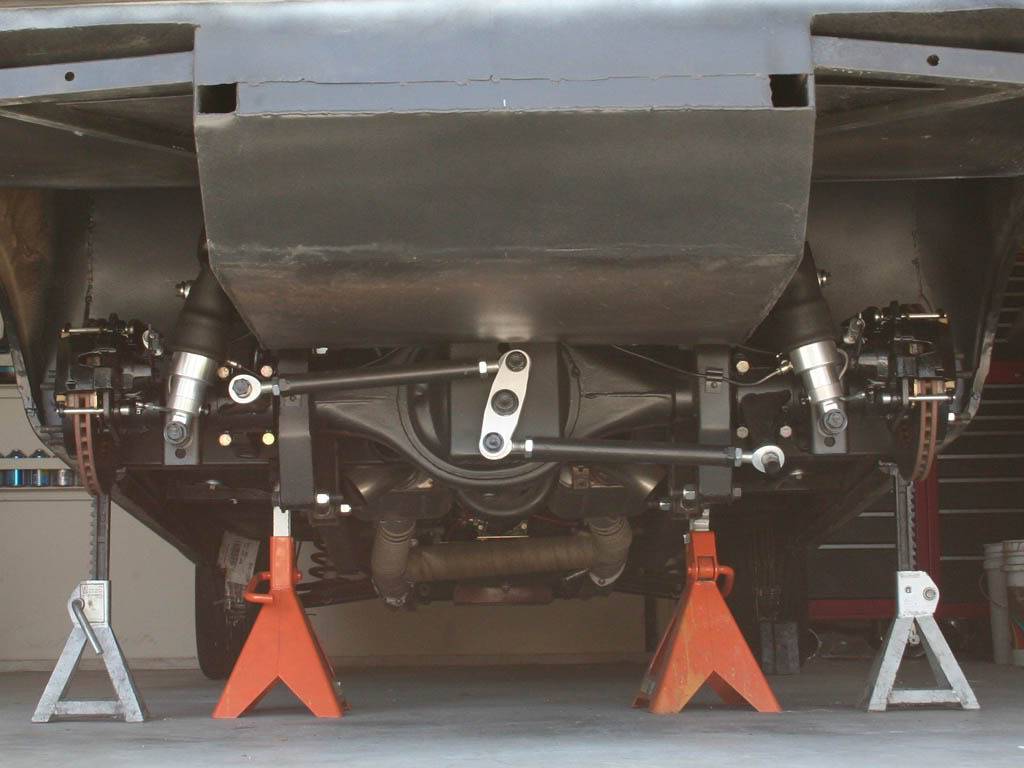
Packaging for both systems can be a headache. But sometimes one will package better than the other. For me it was the watts link that won out. And I really looked hard to use a decent length PH bar. I think I was just going for a short bar, and even after all kinds of goofy mounting ideas I still couldnt get it in there. I looked at above, and rear bar mounting ideas, no good. The closest I came was a rear mounting bar. But the entire length of it wouldnt clear my tank. And so I was able to fit the watts in the same space, but it had less moving parts.. LOL Now yer saying LESS moving parts?? What!!! Yer loopy.. Ok, maybe not less moving parts, but less moving area of parts. Instead of having one long 40" bar sweeping the entire area I have 28" of material swinging with the car body. Frame mounted center pivot. Only the links move. Not alot of interference.
So thats where I see the advantage of a watts link is, with the packaging. If you compare it with a similar amount of lateral controlling pan hard bar which is gonna be long to control the rear end.
Plus they just look damm cool. Cept when someone sees it and asks, whats that??? Then its school time JR
-
10-23-2009 #73
Registered User
- Join Date
- May 2007
- Location
- Orlando, FL
- Posts
- 215
Keep in mind that his goal is a "universal" setup with a minimum of compromise. When it is possible to achieve equal rear tire loading by simply switching the locations of a couple of bolts, the use of two swaybars would constitute both an unnecessary compromise and an unnecessary amount of work. Originally Posted by JRouche
Without knowing the roll rate of the car and the size of the dip, I can't accurately calculate the lateral shift of the axle housing, but it would seem that a 2 inch drop of one end of the 24 inch Panhard captures the worst of conditions. This would result in a lateral shift of 0.083 inch if the Panhard was originally horizontal. Your seat of the pants is much, MUCH more sensitive than mine. And, since the upper and lower links of the Watts linkage operate through different angles, even a Watts would not have kept the axle perfectly located. Originally Posted by JRouche
Since I consider its design perhaps the ultimate for a RWD beam axle car, I keep referring back to the early Jaguar C-Type, which managed to win Le Mans with a short Panhard.
He will never need a Watts with a '65 Falcon.
http://www.racetec.cc/shope
-
10-23-2009 #74
Registered User
- Join Date
- Apr 2009
- Location
- san diego
- Posts
- 5,101
every part of the rear setup will be adjustable. i can change the mounting location front and back of all links as well as length. i dont have an issue changing sway bars, that would be about a 25 minute operation.
as far as a watts vs panhard. watts on paper is perfect. however, when it comes to actual use with a limited travel rear suspension how much performance is gained with a watts? i think a panhard will be sufficient and cheaper and easier fab. However i will build this modular so a change can be easily made if i want to run a watts in the future.My build thread: https://www.pro-touring.com/showthre...ing&highlight=
The mustang build thread: https://www.pro-touring.com/showthre...el)&highlight=
-
10-23-2009 #75
Registered User
- Join Date
- May 2007
- Location
- Orlando, FL
- Posts
- 215
But, I would imagine you'd just as soon save the time and expense, wouldn't you? All I was pointing out was that, with the adjustment you say you'll have, you'll have not just an alternative, but a BETTER alternative. See my site for the adjustments required. Originally Posted by falcon65
This is true ONLY if...at some point in the suspension travel...the side links are both horizontal. Unfortunately, this configuration is rarely seen (though the above picture appears to be such a case). Originally Posted by falcon65
This is easy enough to calculate. To determine the maximum lateral shift of the axle housing, first estimate the maximum vertical travel, of one rear wheel relative to the other, expected in competition driving. (This is NOT the maximum as determined by maximum suspension travel, but the maximum you would expect to encounter while attempting to control the car.) Divide this number by the rear track. Determine the arc sine. Determine the cosine. Subtract from one. Finally, multiply by the Panhard length and you have the lateral shift of the axle housing. Originally Posted by falcon65
I think you'll be surprised at how small a number. And, remember, this is the MAXIMUM.
http://www.racetec.cc/shope
-
10-23-2009 #76
Registered User
- Join Date
- Nov 2008
- Location
- TN
- Posts
- 954
Ok.. Just checking but you would raise the rear roll center to decrease the roll in the back like a stiffer swaybar? Right mr. Shope? Or did I miss something?
Benjamin
Twin Dusters
'72 Plymouth Duster "Aero Duster" project
'72 Plymouth Duster "Daily Duster" project
https://www.pro-touring.com/showthre...RO-DUSTER-quot
-
10-23-2009 #77
Registered User
- Join Date
- May 2007
- Location
- Orlando, FL
- Posts
- 215
When determining the distribution of the lateral inertial force during cornering, BOTH the roll center height and the roll stiffness must be taken into consideration. But, when considering the fore-and-aft distribution of the driveshaft reaction torque, ONLY the roll stiffness distribution need be considered. Originally Posted by Bjkadron
The asymmetric adjustment of the lower links has nothing to do with either the roll stiffness or the roll center height. That portion of the weight transfer taken through the lower links has a vertical force component. With an asymmetric adjustment, the vertical force at the right link is greater than that at the left, resulting in a torque on the axle housing which is both proportional to the driveshaft torque and opposite in sense. So, with the proper link forces (and, with the help of that portion of the driveshaft reaction torque which is fed back through the springs), it is possible to achieve full cancellation of the driveshaft torque for dragracing.
(Actually, for dragracing, you'd want 100% antisquat, so all of the torque necessary for cancellation would be by the link forces. The 100% antisquat would be an average of the left and right link adjustments.)
http://www.racetec.cc/shope
-
10-23-2009 #78
Registered User
- Join Date
- Nov 2008
- Location
- So. Cal.
- Posts
- 1,240
Ok Billy, it seems you want to shoot down just about anyones ideas. Ok, so be it.
And as far as my original short PH bar and its lousy control of the rear end. It was more than just my seat of the pants feel. I saw the movement, and measured it in the shop before I even drove it. I actually DO measure more than I should. It was closer to1/4" with the full 4.5" travel. I was hoping to be able to live with it, I really didnt want to have to change it. I dont change something that works. Well not usually LOL But after some simple driving it wasnt gonna work.
The PH bar was pretty level. Its the standard art morrison bar used in their 4-link set up seen here, second clip down..
http://www.artmorrison.com/2006cat/34.pdf
But basically theres no way you can sit on your side of the computer and say my setup should work or prolly does. I built the car and drove it. Its right here in the flesh. So IMO Im the best source of info on whether it worked or not on my car. It didnt. And it wasnt my build, its the box stock setup from art morrison. But they did exactly what should have been done in the limited space.
I have yet to drive the watts link around, still wrapping the front end up. But Ill be more than happy, and honest to give my results. Seat of the pants or otherwise. Oh, and for otherwise I mean measuring the displacement of the rear end through its entire travel.
Well I did that already. And I have alot more travel now with the air ride. Not drive travel, but overall travel due to the additional air ride springs.
And with the watts link the rear end doesnt move side to side at all, not one bit. Mone doesnt anyway. And I really needed some decent control, my tire sidewalls are a half inch from my inner Q panels. So I put the rear end through all of its possible movements. And I do get some tilt of the wheels due to the rotation of the housing. But the tilt isnt bad and that was at 7.5 degrees of housing rotation which Ill never see on the road. But even at 7.5 degrees (digital protractor) of rotation (severe) the center line of the hubs were still only off from the center line of the car (yeah, I dropped a line and measured) by less than a 1/16". Meaning even with some extreme twisting and offsets the watts link was able to hold the rear end centered within the body.
And this idea that the arms on a watts link need to be horizontal is hog wash. Dont know where this comes from unless its engineers building on paper and they dont have a firm grasp on the way the links work.
A pan hard bar, yes. It is a two pivot link. So when you cross over the three or nine O'clock position you start going into the short side of the circle. So you will be shortening the arm length. Pulling the pivot points closer together and moving the rear end. So if its off from horizontal (dipping from the frame, pointing down) you will be pushing (growing bar) on the compression of the suspension and pulling on rebound. The rear end will move with the growing and shortening of the bar. And it gets worse the more the bar is angled.
The watts link has the all important key to the puzzle that takes all that shortening circle out of the equation. What is it? The center bell crank. Its the beautiful equalizer.
As one arm tries to pull the pivots closer together while it describes its curve during suspension travel the bell crank is like a moving pivot point. Think of it as the give and take equalizer. One side wants to take and the other side wants to stay put or take or give also. Ol Mr give and take bell crank will give to one and take from the other. If they both want to take or give she accommodates that too.
If both arms want to add to their length the the crank rotates counterclockwise. If they both want to shorten then the crank rotates clockwise. And whats cool is its completely variable. One maybe want not as much take than the other. The crank just rotates less.
If they are both moving but in opposite needs (one pulling and one pushing) the crank doesnt rotate at all.
The arms of a watts link do NOT need to be horizontal. The most important measurement? The need to be exactly the same length, eye to eye. And thats simple. And the bell crank needs to be of a sufficient length too. Six inches eye to eye is long enough.
I dont know. Build one, feel one, taste one. The watts link, if properly built is a pretty nice locating device.
So Billy.. Im kinda done with this part of the thread, I really want to see the Falcon up and going. Now that is what Im interested in. Its gonna be a really nice car when done. JR
Originally Posted by BillyShope
-
10-24-2009 #79
Registered User
- Join Date
- May 2007
- Location
- Orlando, FL
- Posts
- 215
Not at all! Nor do I seek to offend. But, when someone comes to the forum seeking advice and such an excellent example as the Jaguar C-Type is available, I believe that example should be offered. Originally Posted by JRouche
That's 3 times more than the example I gave, but I'm still not at all certain I could sense it. I have a friend who claims that Rusty Wallace could detect a 5 pound change in wheel loading, but I find it hard to believe. Still, I'm willing to concede that, to you, a quarter of an inch axle housing movement was easily discernible. Originally Posted by JRouche
And it shouldn't. As I pointed out, if the side links are horizontal at Originally Posted by JRouche
some point in the suspension travel, the axle housing lateral control is essentially "perfect."[/QUOTE]
I understand your concern. Originally Posted by JRouche
No, Watt, himself, is the source of this "hogwash": Originally Posted by JRouche
"The convexities of the arches, lying in contrary directions, there is a certain point in the connecting-lever, which has very little sensible variation from a straight line."
There is an animation of the travel...and the deviation from a straight line...available at:
http://en.wikipedia.org/wiki/Watt%27s_linkage
And, note that this is with the end links horizontal at one point. If this is not the case, the deviation is worse.
Suppose, for instance, that one 12 inch link is angled up at 5 degrees and the other down the same amount. This would result in an additional movement of about 0.090 inch as one link swings to the horizontal.
But, you don't need to worry about this latter effect, as it would appear that you have an excellent example of the Watt linkage in your car. If you fabbed it yourself, you did a great job and I can understand why you're proud to post a picture.
http://www.racetec.cc/shope
-
10-25-2009 #80
Registered User
- Join Date
- Aug 2004
- Posts
- 2,413
Was at Quaker steak and lube yesterday sitting under a Nascar stock car used at Watkins glenn and sears point. That car has a Panhard..And I bet it works plenty well on the road coarse. Look to be about 42-45 inches about the same as mine will be...
Billy Im hard pressed to find a pic of the rear suspension of a c-class You have a pic.
Nothing says "I built this" better than tool marks and dykem blue..
Follow my 3 link build. https://www.pro-touring.com/forum/sh...ad.php?t=61592
-

 Reply With Quote