


Results 1 to 20 of 22
-
03-03-2011 #1

 Registered User
- Join Date
- Mar 2010
- Location
- Orlando, FL
- Posts
- 266

Ideal spring rate for rear coilovers on a 68 camaro convertible???
I was wondering what the ideal spring rate for coilovers in the rear of a first generation camaro convertible with a small block. I'm ordering a four link and need to know ASAP so i can i get it shipped.
i realize a lot of people (as usual) are going to say it depends on what you are going to use it for... basically it will be used for hard cornering on the streets and light track use.
the company i will be placing the order with suggested 150lb at first then i told him prefer a slightly stiffer ride and he then suggested 170lb springs. now ive seen people say they run 250lbs and other run 220 etc etc. but i have no idea if there car is primarily for track or what.
what do you guys think?Live for today, tomorrow is never promised.
Project Eternity: https://www.pro-touring.com/showthre...rs-convertible
-
03-03-2011 #2 -Moderator-
- Join Date
- Apr 2001
- Location
- Central CA USA
- Posts
- 6,114
200 to 225 should work well, what size tires & horsepower?
David Pozzi http://www.pozziracing.com67 Camaro RS that will be faster than anything Mary owns.
03-03-2011 #3
Registered User
- Join Date
- Mar 2010
- Location
- Orlando, FL
- Posts
- 266
thanks david. could you elaborate a bit more as to why you would recommend those?
Live for today, tomorrow is never promised.
Project Eternity: https://www.pro-touring.com/showthre...rs-convertible
03-04-2011 #4
Registered User
- Join Date
- Mar 2010
- Location
- Orlando, FL
- Posts
- 266
i ordered the 200 springs. the salesman was surprised and although he didnt try and talk me out of it, he insisted that they very "stout". guess i will find out one way or another. thanks for letting me know what range mr. pozzi.
Live for today, tomorrow is never promised.
Project Eternity: https://www.pro-touring.com/showthre...rs-convertible
03-05-2011 #5 Registered User
- Join Date
- Apr 2009
- Location
- san diego
- Posts
- 5,101
When I choose spring rates I do (two) calculations.
First what is the weight of the car at that axle. Divide that number by 2. this gives you F (force or weight)
Since F=kx next is to determine the amount fo droop you want or the shock has. This amount of droop gives you the minimum preload on the spring at ride height. If you have 3" of droop you dont want the spring to become unloaded. take F/x=K. K is your MAXIMUM spring rate.
Now this is where personal preference comes in. I design around a 1G bump. How much travel do you have in your shocks from ride to full compression, this is your x for the next equation. Take F times 1G, or whatever number you want to design around. F/x=K this is you MINIMUM spring rate. Now you have a range.
The only way to adjust this is to adjust your shock length and your shock length at ride height.My build thread: https://www.pro-touring.com/showthre...ing&highlight=
The mustang build thread: https://www.pro-touring.com/showthre...el)&highlight=
03-05-2011 #6
-Moderator-
- Join Date
- Apr 2001
- Location
- Central CA USA
- Posts
- 6,114
I drove 3 Camaros last weekend, one at 200, one at 250, one at 325. The 200 rode the best but would be too soft on a Pro- touring car with 335 rear tires & 650 Hp. 200 felt pretty nice to me, way way smoother than a 175 lb leaf setup.
A stock Camaro mono-leaf is around 80-100 lbs, A stock multi-leaf is 125, aftermarket leafs are 175 but coils will ride better due to the lower un-sprung weight.Last edited by David Pozzi; 03-05-2011 at 07:44 PM.
David Pozzi http://www.pozziracing.com67 Camaro RS that will be faster than anything Mary owns.
03-05-2011 #7
Registered User
- Join Date
- Mar 2010
- Location
- Orlando, FL
- Posts
- 266
you california guys have all the fun. i have not seen a muscle or vintage car around here for months due to the weather. we still have snow on the ground up here... Originally Posted by David Pozzi

but anyway, any advice from you is law to me. so 200 it is. if anything i could go up or down later on down the line, but then again later on down the line will most likely mean more horse power and bigger tires as you mentioned. currently around 400HP at the crank (educated guess based off of other set ups) and 285s in the rear.
bryce, thanks for the calculations, i will take them into serious consideration after i have car officially weighed and can measure the shock length then go from thereLive for today, tomorrow is never promised.
Project Eternity: https://www.pro-touring.com/showthre...rs-convertible
03-06-2011 #8 Registered User
- Join Date
- Nov 2008
- Location
- Lawrenceburg, TN
- Posts
- 4,098
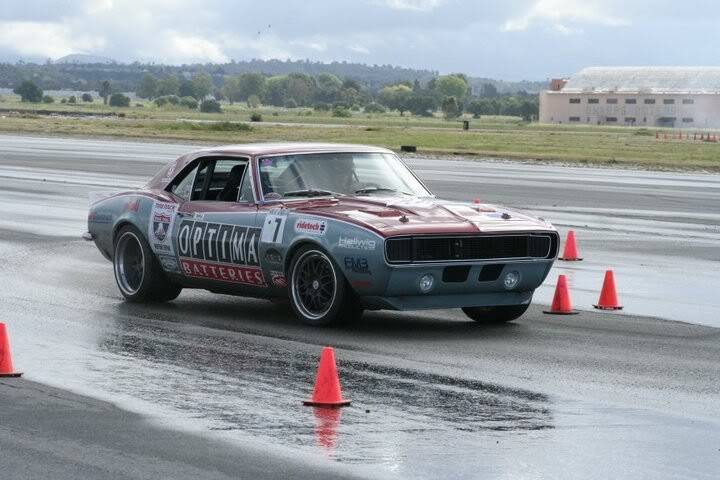
here is David testing one of those springs sets last weekend! LOL ........it really is him
03-06-2011 #9
Registered User
- Join Date
- Mar 2010
- Location
- Orlando, FL
- Posts
- 266
that old thing...
 . what springs rate are used, both front and rear, on the on lap camaro?
Live for today, tomorrow is never promised.
Project Eternity: https://www.pro-touring.com/showthre...rs-convertible
03-06-2011 #10
-Moderator-
- Join Date
- Apr 2001
- Location
- Central CA USA
- Posts
- 6,114
600 front, 250 rear is what we ran all last year. We have some stiffer rates in the car right now we are testing. With less horsepower and smaller tires you can vet by with less spring. Camaros weigh 1900 lbs on the rear.
DavidDavid Pozzi http://www.pozziracing.com67 Camaro RS that will be faster than anything Mary owns.
03-07-2011 #11 Registered User
- Join Date
- Jul 2001
- Location
- Calgary, AB
- Posts
- 1,826
 I know that you meant to say "here is Mary testing one of those spring sets for David last weekend"... Originally Posted by Rod
James
1967 Camaro RS - The OLC
1984 Camaro GT1
1989 Camaro 1LE - The BOC
03-13-2011 #12 Registered User
- Join Date
- Jan 2006
- Location
- Murphy, TX
- Posts
- 82
What would be best for 345 rear tires and 650 HP?The 200 rode the best but would be too soft on a Pro- touring car with 335 rear tires & 650 Hp.
03-17-2011 #13
-Moderator-
- Join Date
- Apr 2001
- Location
- Central CA USA
- Posts
- 6,114
That is my wife Mary driving the One Lap Camaro in that photo. I did drive it a couple of days later.
Rates from 250 to 275 work well for most rear coilovers. You can go stiffer than that & still ride ok with the right shocks.David Pozzi http://www.pozziracing.com67 Camaro RS that will be faster than anything Mary owns.
03-17-2011 #14
Registered User
- Join Date
- Jul 2005
- Posts
- 202
Another thing to consider is the natural frequency of the front and rear. It is determined by the wheel rate (spring rate and motion ratio) and the sprung weight on each corner. The higher the spring rate the higher the natural frequency and the more jarring the ride will be and the stiffer the shocks need to be to control the springs. On the other side if the natural frequency is very low the car will feel like a boat. It's also a good idea to have the front and rear wheel rates set so the natural frequencies are not too far apart.
Good luck70 Mach I, dry sump & lots of mods
70 1/2 Z28 project car
03-18-2011 #15
Registered User
- Join Date
- Jan 2010
- Location
- Elk River, MN
- Posts
- 676
David, do you find roll center height and rear bar stiffness to have a large effect on what springs handle best? Only reason I ask is that I have a G-body with the stock triangulated 4-link geometry, plan to run a rear bar, and only have about 300 horse at the crank right now, so I went with 175's hoping that they'll be pretty close. Since my bar options are limited and my roll center height is fixed without a major redesign, I had planned to do my tuning with the springs (stiffer to loosen, softer to tighten the car) as I get some road time with the car. Am I on the right track?
-mattMatt Peterson 84 Monte Carlo - Sold :( | 99 Corvette Racecar | 2001 Z06 Daily Driver
https://www.pro-touring.com/showthre...ng-Bertha-Back
http://ls1tech.com/forums/conversions-hybrids/1499192-84-monte-5-3-build.html
https://www.pro-touring.com/threads/...rvette-Racecar
03-18-2011 #16
Banned
- Join Date
- Aug 2003
- Location
- Orlando, FL
- Posts
- 8,745
The installed angle of the shock will play into the rate required also. The more angle in the shock, the more spring rate you need.
03-18-2011 #17 Registered User
- Join Date
- Nov 2010
- Location
- Ventura County CA
- Posts
- 556
Depending on what you're shooting for, one way to select springs would be to consider the ride frequency as funcars suggested. Typically you want the rear ride frequency to be slightly higher than the front. This is so that as you go over a bump, the rear will respond a little faster than the front so it can catch up (the front hits the bump first) and prevent uncomfortable pitching. You can optimize this for a specific wheelbase and speed, but I have seen rules of thumb in the neighborhood of 10% frequency difference front to rear.
To calculate the ride frequency, you need to know the sprung weights at each corner and the effective spring rates at each wheel. Let's assume a vehicle with sprung weights of 1800/1450 lbs fr/rr and springs 600/250 fr/rr. Corner weights would be appoximately 900/725 fr/rr and effective spring rates about 300/250 fr/rr assuming a 0.5 motion ratio on the front and 1.0 ratio on the rear.
Ride frequency front: 3.13 * sqrt(300/900) = 1.807hz
Ride frequency rear: 3.13 * sqrt(250/725) = 1.838hz
Difference front to rear: about 1.7%
You'll find if you do these calculations that ride frequency delta front to rear is sensitive to small changes in spring rate or sprung weight, so accurate measurements would be important if you want to optimize. For this example, if we were changing rear springs only and shooting for the 10% rule of thumb, we would need 246.5lb/in rear springs
Ride frequency front: 3.13 * sqrt(300/900) = 1.807hz
Ride frequency rear: 3.13 * sqrt(292/725) = 1.998hz
Difference front to rear: about 10%
Furthermore, consider that a difference in driver weight or fuel in the tank also impacts this calculation. Consider 12 gallons of gas weighs about 70lb. If we assume the last example was at a fuel tank (12gal) and the tank is centered over the rear, with an empty tank the new numbers are
Ride frequency front: 3.13 * sqrt(300/900) = 1.807hz
Ride frequency rear: 3.13 * sqrt(292/690) = 2.038hz
Difference front to rear: about 13%
The new required rear rate to get back to a delta of 10% would be 278lb/in.
A lot of things coming into play that make this a difficult thing to decde. What works for one car or what's comfortable for one person will be different than for another person or car, especially considering that each car and person probably has different weight distributions and driver preferences.
Next factor in things like shocks, anti-sway bars, roll centers, tires, weights that are changing, varying track conditions, etc and you will soon find there is no right answer to this problem.Clint - '70 Nova "restomod" cruiser & autocross family car

03-19-2011 #18
-Moderator-
- Join Date
- Apr 2001
- Location
- Central CA USA
- Posts
- 6,114
I don't choose springs for cornering characteristics at all. I choose a spring rate to control chassis height & look at rise & squat, which are also influenced greatly by shock settings. I like to work with anti roll bars & rear roll center height & shocks to some degree to balance handling.Mimwouldnt expect a spring rate change to affect oversteer or understeer much. Originally Posted by monteboy84
Last edited by David Pozzi; 03-19-2011 at 09:01 PM.
David Pozzi http://www.pozziracing.com67 Camaro RS that will be faster than anything Mary owns.
03-21-2011 #19 Registered User
- Join Date
- Nov 2002
- Location
- state of confusion
- Posts
- 1,499
Please check math. I'm getting 1.7%. Originally Posted by TheBandit
Not that the percentage is really the important parameter anyway. I'd choose spring rates and motion ratios, etc., to work with typical vehicle loading conditions for the car's purpose such that the theoretical "flat ride" speed is more toward the lower end of the anticipated speed range that the car will be using. Reason being that there's more "room" on the high side than on the low before the frequencies get "X" amount out of sync.
The presence of damping will shift the frequencies downward a little. But you have to have at least performance handling levels of damping or higher amounts for this effect to amount to anything much.
Norm'08 GT coupe, 5M, suspension unstockish (the occasional track toy)
'19 WRX, Turbo-H4/6M (the family sedan . . . seriously)
Gone but not forgotten dep't:
'01 Maxima 20AE 5M, '10 LGT 6M, '95 626, V6/5M; '79 Malibu, V8/4M-5M; '87 Maxima, V6/5M; '72 Pinto, I4/4M; '64 Dodge V8/3A
03-21-2011 #20
Registered User
- Join Date
- Nov 2002
- Location
- state of confusion
- Posts
- 1,499
If your tuning options are limited to spring changes, then that's what you have. Originally Posted by monteboy84
But I'd rather see you choose a spring first with an eye toward flat ride behavior and do your tuning with an adjustable rear sta-bar. You could always try a couple of different springs, with more than one bar setting with each spring.
Norm'08 GT coupe, 5M, suspension unstockish (the occasional track toy)
'19 WRX, Turbo-H4/6M (the family sedan . . . seriously)
Gone but not forgotten dep't:
'01 Maxima 20AE 5M, '10 LGT 6M, '95 626, V6/5M; '79 Malibu, V8/4M-5M; '87 Maxima, V6/5M; '72 Pinto, I4/4M; '64 Dodge V8/3A

 Reply With Quote



