


Results 1 to 20 of 38
-
06-17-2011 #1

 Registered User
- Join Date
- May 2011
- Location
- Central FL
- Posts
- 216
Aftermarket First-gen F-Body A-arm Geometries
I'm not sure if I'm saying this the right way, but I noticed that none of the aftermarket manufacturers of A-arms list their product's suspension geometry improvements over stock. Product descriptions list the materials used, and benefits of using their product, such as additional header clearance, less weight, or less shimming for caster/camber over stock. But not one manufacturer makes any comparison over stock A-arms to caster/camber/toe improvements. Why is this?
Surely each manufacturer has done internal testing of their A-arm product, but it seems they're trying to justify the $400-$700 range based on materials used in construction and how strong the lower mounting surface is when a coil-over is used (as an example). Isn't the primary purpose of this product to improve steering angles?
In some ways, I feel the wool is being pulled over our eyes. Manufacturers saw a demand, created a product, but forgot to advertise the actual improvements to steering angles compared to a stock part. I'd like to challenge the manufacturers to include these improvements in their product descriptions. I read the thread about steering angles when using tall upper/lower ball joints, but again, this was performed by a private individual, not the manufacturer.
Manufacturers of A-arms, please share with us how your product improves steering angles/geometries over a factory A-arm. Cam manufacturers share their HP/torque curves, cylinder head and air filter manufacturers share flow characteristics, tire manufacturers share traction characteristics. Getting the point yet? All these products were designed to meet or improve upon a factory design, and their primary purpose is tested and results used in advertising to show improvements or differentiation from other aftermarket manufacturers of the same part. I'm feeling a bit jipped that this isn't the case with aftermarket A-arm products. If your A-arm wasn't designed to address improved geometry, then be transparent and say so. What are you hiding?
And yes, I am in the market for a set of uppers/lowers with coil overs, so I've been looking at products, and will buy when I can compare apples to apples.- David
1967 Camaro - In remembrance of my friend Scott
-
06-17-2011 #2
Registered User
- Join Date
- Jan 2009
- Posts
- 98

If an aftermarket control arm is using a stock upper ball joint and a stock spindle, then the dynamic camber is exactly the same as stock. The only way to change the camber curve is by effectively changing the spindle height / virtual ball joint pivot, which can be accomplished with a taller spindle, a taller ball joint, or redrilling the UCA mounts (Guldstrand mod, which can be done with stock or aftermarket upper arms). Some uppers are shorter to add more negative static camber, and some uppers and lowers have a modified ball joint position to add caster (improved high speed stability).
To my knowledge, you have only a few options for control arms that improve the dynamic camber (i.e. improved camber curve):
Hotchkis Upper Arms with optional Tall Ball Joints: http://www.hotchkis.net/tall_upper_b...t_af_body.html
Pro-Touring F-Body Upper Arms with optional Tall Ball Joints: http://www.pro-touringf-body.com/control_arms.html
SC&C Street Comp Package: http://scandc.com/new/node/28
Any stock or aftermarket arm and order the tall ball joints separately: https://www.pro-touring.com/showthre...amaro-Chevelle
Sorry if I missed any.
06-17-2011 #3 Registered User
- Join Date
- Nov 2005
- Location
- Auburn, WA
- Posts
- 1,360
I can see this being a good thing and a bad thing for the manufacturer and the customer. It's good because it gives the customer more information, and if understood correctly, that's a good thing.
But, there is alot of people out there that have no idea what those numbers mean. Take bumpsteer for instance:
Company A has a system (say, UCA, LCA and spindle) that advertises .015" toe-in at 1" of bump. Company B has zero.
Which one would most people buy? Probably Company B's system, because most people believe that less bumpsteer is better. But what the customer doesn't know that the particular vehicle the system was designed for makes good use of the toe-in during bump, as this helps keep the vehicle straight during braking, which may make Company A's product better. See my point? The numbers can be published, but you may not know why the company arrived at those numbers. Was it from careful design iterations, or just because that's where the packaging forced it to be?
So it's not a easy situation for anybody. We have no problem sharing details about our suspension, but you have to ask first - and that's what I would try with other manfacturers.Last edited by silver69camaro; 06-17-2011 at 08:10 AM. Reason: Spelling
Matt Jones
Mechanical Engineer
Art Morrison Enterprises
06-17-2011 #4
Registered User
- Join Date
- Jan 2009
- Posts
- 98
I agree with Matt 100%.
For most customers, the important information won't be exactly what the specs are - bump steer, camber, caster, etc - the important information will be whether or not these are changed from factory specs AT ALL.
There isn't much of a benefit to installing a tubular upper or lower control arm that is just a stronger (heavier) version of the factory arm. The benefit comes from modifying the geometry (if it's done in the correct way). The easiest way for the customer to tell if an arm is using stock geometry (specifically camber gain) is to ask if it uses a taller ball joint or taller spindle. If it doesn't, then it is effectively the same as stock.
06-17-2011 #5
Registered User
- Join Date
- May 2011
- Location
- Central FL
- Posts
- 216
So this is good stuff. When I started my search for replacement A-arms, I was under the impression that these products alone (without taller B/J's) tried to improve upon stock geometry, at least in static camber through a shorter upper, or better caster designed into either the upper or lower arm. The truth and the facts are finally coming into alignment :P for me. If a manufacturer's design does change the static setting in any way, it would be nice to have this listed in the product description.
As for releasing information that consumers could potentially be confused on, I hear your argument, but think it is the manufacturer's duty to understand their target market and represent the data in a way which those consumers would understand. I don't buy it that the data would lead to more confusion than understanding. Flat panel TV screen manufacturers talk in terms of progressive scan, interlacing, and GHz; their target market understands what these terms mean and can use them to compare product offerings. Those who don't understand ask for help or expert opinion. Relative terms or percentages over stock could be used instead of absolutes. For example, if a lower A-arm was designed to give more static caster than a stock lower, then it could be said the product improves static caster by 25%. I'm not asking for gobs of raw data, but I would like to know if your product is in fact a shorter distance from the pivot point on the frame than factory and why you think that's an advantage over stock. I don't mind calling and asking as long as someone is willing to have this discussion with me without an agreement from me to buy first.
Matt, I do realize that many of your customers are very accomplished racers, and as such, they are very well educated in the area of suspension geometry. I wouldn't think Art Morrison is worried about confusing these buyers. Zack's comment that there isn't much benefit to a tubular upper or lower without a taller ball joint is very enlightening and reinforces MrSuspension's comment about using taller ball joints or spindles to affect geometry.
Perhaps I am (was) the only one with the impression that installing a set of tubular uppers/lowers improved geometries all by themselves. I'm not the smartest guy in the room. So now I can begin my research over again, comparing these products based on qualities other than improving on stock geometry. I've already printed out a few versions of the Gulstrand template as it seems this is an inevitable modification for the goals I've set on my build.- David
1967 Camaro - In remembrance of my friend Scott
06-17-2011 #6
Registered User
- Join Date
- Nov 2005
- Location
- Auburn, WA
- Posts
- 1,360
That's a good analogy about a brand new TV and all it's features and how that relates to the customer. With suspensions though, it's not that cut-and-dry. If you compare two TVs, one will have X and Y features and the other one will not, let's say. Suspensions have much more grey area, some will have more camber gain and the other will have a little less. Does it have less because the engineer (or whoever) decided to add more antidive and therefore had to lengthen the FVSA to make that happen? Why did he do that? What data did he have to support that? How much anti-dive do YOU think it should have? There is no right answer. When you have limitations on any metric of suspension design, it will become a give-and-take design approach. If you want more of one property, you'll have to give up something else. If you want to decrease bumpsteer, you'll have to move the engine back - stuff like that.
Part of where I come from is that we make entirely new suspensions instead of optimizing stock desings within stock packaging limits. I totally get your point on say, a LCA. If it's longer, say how much - and tell me what that does and why I should buy it. If we're talking about, say our bolt-on Chassis for a Chevelle with a start-from-scratch IFS design, that gets complicated.Matt Jones
Mechanical Engineer
Art Morrison Enterprises
06-17-2011 #7 Registered User
- Join Date
- Dec 2006
- Location
- California
- Posts
- 1,368
No, I was also under the assumption that aftermarket arms improved caster (and even camber, according to some arms' manufacturing claims) all by themselves. Originally Posted by MyFriendScott

This is kind of surprising to find that without changing the spindle height, it's impossible to change caster/camber, IMO.Matt
69 Nova - 357, TKO600, Tru Turn, some other stuff, awaiting LS1 swap
71 Duster - all stock, slant 6, automatic. awaiting HEMI/T56 swap
06-18-2011 #8 Registered User
- Join Date
- Mar 2005
- Location
- St George Utah
- Posts
- 1,243
you are correct sort of , some brands (sorry cant say which ones) do say the uca/lca will improve camber gain. like stated above unless the ball joint pin is taller there there is NO camber improvement. Caster is able to be improved when designing the arms, either by moving the upper ball joint back, or the lower forward or a combimation of both.. Originally Posted by DarkoNova
The BEST camber improvement that can be made is with a taller spindle, second is to lower the inner mount on the UCA ( guildstrand mod) on the A & G bodies it is not very practical to do this mod. and third is a taller ball joint.
We are currently working on the G body platform, and the stock geometry is Horid!! there is no room to drop the UCA inner mount, so the Best improvement that can be made is the AFX Tall spindle, which is taller than the stock spindle and raises the roll center by almost 4 inches. the ackerman and bump steer are also improved altho still not the "BEST" it is all you can do and still have a bolt on design, the other option is to call Matt and order a complete chassis.
Like matt said it is ALWAYS a game of compromises, especially when you don't know the finished ride height. like with the Morrison chassis they know the finished ride height, with a bolt on system yuo dont, and you can only design the parts to be optomized at one ride height either side of that and everything starts to change.
06-18-2011 #9 Registered User
- Join Date
- May 2002
- Location
- Northern California
- Posts
- 10,716
well....nvrm
MrQuick ΜΟΛ'ΩΝ ΛΑΒ'Ε
06-20-2011 #10
Registered User
- Join Date
- Jan 2009
- Posts
- 98
Blake, Originally Posted by killer69
Definitely agree with you that the best option is an AFX tall spindle if it within your budget!
Some things to consider about the Guldstrand mod vs. Tall Ball Joints:
1. The G-Mod is free, which is great, but it's also more or less irreversible.
2. The G-Mod restricts droops travel.
3. Tall Ball Joints are about $100/pair (uppers only, you don't use tall lowers on 1st Gen F-Bodies), which is $100 more than free, but it's also reversible.
4. If you have plans to eventually upgrade to a tall spindle but can't afford it now, Tall Ball Joints are a great short-term option. If you do the G-Mod, you can't use a tall spindle like the AFX spindle.
06-20-2011 #11
Registered User
- Join Date
- May 2011
- Location
- Central FL
- Posts
- 216
I did another review, this time just capturing the steering geometry claims from the manufacturer only in the comparison. How each product claims to address caster and camber is my primary interest; materials, powder coating and colors, and other product features are left out of this analysis. All pricing was taken directly from the manufacturer's website so YMMV. I've listed the manufacturers in no particular order, and making no claims about winners or losers. I just wanted a reference table of A-arm manufacturers, their claims about geometry improvements, and price.
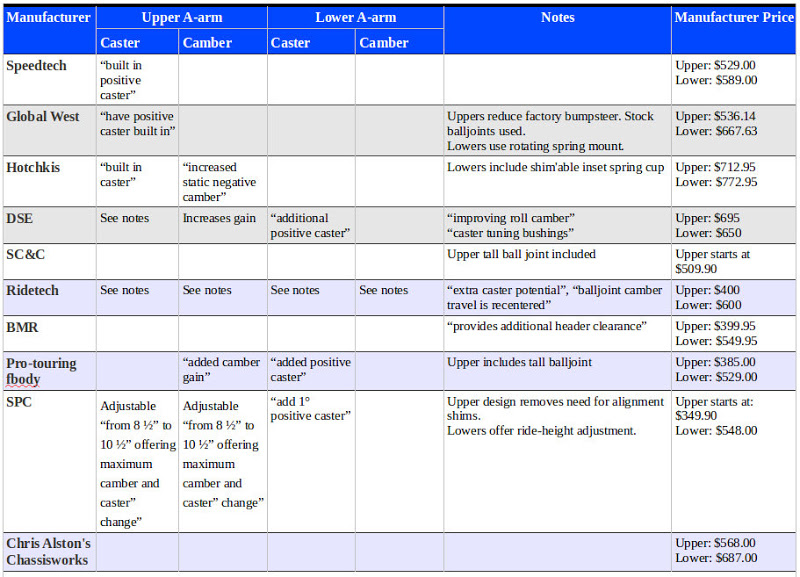
When reviewing the table, no one manufacturer has an upper and lower that addresses both caster and camber by design. This is neither good nor bad, I'm just stating the facts. ridetech used the same wording on the upper and lower product descriptions when talking about caster and camber, so it may appear their uppers and lowers address both, but the product only seems to directly address camber by design (whatever "camber travel is recentered" means). Caster improvement still appears to be a manual process and not designed directly into the product.
BMR's A-arms don't claim to address camber or caster at all. If you want just a tubular A-arm replacement for the lowest price, BMR seems to be a good choice. SC&C also makes no claims about improving caster/camber by design but includes a tall upper ball joint to help improve suspension geometry.
Hotchkis is the only manufacturer that claims to have designed improvements in both caster and camber into their upper A-arm. They are also the most expensive uppers in the group.
DSE and Pro-Touring F-body are the only manufacturers that specifically claim to address caster in their lower A-arm product. No other A-arm that I researched, made any claims to improve caster or camber against a stock part.
So it seems, that if you don't plan on doing a G-mod on your 1st gen F-body, but you want replacement A-arms to help improve suspension characteristics, most of the listed manufacturers make claims to improve either caster or camber, but by how much is unknown. This is what I hope the manufacturers will work toward including in their part descriptions (I know, keep dreaming), otherwise I wouldn't bet on any of them to be any better than stock. Claims do not equal real world results so buyer beware.
Using a taller upper ball joint, or tall spindle, along with dialing in your preferred caster settings during an alignment might still be the best way to guarantee improvement over stock (versus accepting manufacturer claims). Those products with built-in caster may or may not be better for you depending on how much caster adjustment you desire.
If I missed a manufacturer in this comparison, it wasn't intentional. I used the icons on the right hand side of the forum pages to get the list of manufacturers with A-arm products.Last edited by MyFriendScott; 06-21-2011 at 04:49 AM. Reason: Updated review to include SPC
- David
1967 Camaro - In remembrance of my friend Scott
06-20-2011 #12
Registered User
- Join Date
- Mar 2005
- Location
- St George Utah
- Posts
- 1,243
great comparison
06-20-2011 #13 - Sponsor & Rat Pack Member -
- Join Date
- Oct 2004
- Location
- Indiana
- Posts
- 1,371
Excellent questions and observations! First, I would like to clarify a couple of our terms...
1. Extra caster potential...we move the upper balljoint position back horizontally to allow you to run more positive caster without a huge stack of shims in the front control arm bolt. This extra caster will do a couple of things: increase straightline tracking stability, and increase your camber gain when turning.
2. Balljoint travel re- centered...our systems are designed to ride at a lower ride height than the oem version. If we did not recenter the balljoint position in the middle of it's travel at that new lower ride height, it could potentially exceed it's articulation capabilities and bind the balljoint pin against the balljoint housing. About the third time this happens you experience a catastrophic failure. Never pretty.
It's always important to remember that suspension SYSTEMS are meant to work in harmony with a known collection of parts. Either you know them or we know them. WE know that OUR parts work together correctly. We DONT know if they will interface properly if you choose a different spindle, steering arm, Balljoint, etc. They might...or they might not. The point is, use a complete system. All the manufacturers you have listed make fine products, although we all may reach our intended design criteria via different paths.
Pancakes are good. So is oatmeal. So is bourbon. Just not together.Bret Voelkel
Director of Innovation Fox Powered Vehicles Group
Founder/ Former Owner
RideTech/Air Ride Technologies, Inc.
How do you spell Impossible?
06-20-2011 #14
 Registered User
- Join Date
- Nov 2006
- Location
- Mountain Springs, Texas
- Posts
- 4,825
Nice summary. You missed the SPC lower arm that SC&C sells. It has increased caster and some unique features for adjusting ride height.
1969 Camaro - LSA 6L90E AME sub/IRS
1957 Buick Estate Wagon
1959 El Camino - Ironworks frame
1956 Cameo - full C5 suspension/drivetrain
1959 Apache Fleetside
06-20-2011 #15
Registered User
- Join Date
- Mar 2005
- Location
- St George Utah
- Posts
- 1,243
Couldn't agree more Bret, I would think most of the maunfacturers would adjust the ball joint angles to compansate for the lower rde height, i know we do. Originally Posted by bret
only thing i have to disagree with you on is the fact that you say Bourbon is Good!! lol
06-20-2011 #16
Registered User
- Join Date
- Dec 2006
- Location
- California
- Posts
- 1,368
ESPECIALLY together! Originally Posted by bret
Matt
69 Nova - 357, TKO600, Tru Turn, some other stuff, awaiting LS1 swap
71 Duster - all stock, slant 6, automatic. awaiting HEMI/T56 swap
06-21-2011 #17
Registered User
- Join Date
- May 2011
- Location
- Central FL
- Posts
- 216
Thanks. I've updated the table to include SPC's products. As an update, SPC joins DSE and Pro-touring F-body now as manufacturers that claim to directly address caster in their lower A-arm design. Actually, SPC is now the only manufacturer I've been able to find that provides a value for how much their arm changes a factory setting. Originally Posted by dhutton
- David
1967 Camaro - In remembrance of my friend Scott
06-21-2011 #18
Registered User
- Join Date
- Oct 2009
- Location
- San Diego, CA
- Posts
- 226
The SPC adjustable upper arms are the only off-the-shelf suspension part I'm using on my whole car. Mainly, because they're adjustable.
Would be nice if somebody offered a similarly adjustable LCA, including a threaded spring perch for standard diameter springs. Might have to locate the adjusters outboard of the spring cup to keep the spring itself from sitting at weird angles, which would/could make the arm a bit more expensive to design and manufacture.--Jason Rhoades
http://www.rhoadescamaro.com/build
06-21-2011 #19
Registered User
- Join Date
- Mar 2005
- Location
- St George Utah
- Posts
- 1,243
i would be curious to know what adjustments you are planning on making with the SPC UCA?
06-21-2011 #20
Registered User
- Join Date
- May 2011
- Location
- Central FL
- Posts
- 216
Table updated again to include the Alston Chassisworks A-arms. In reviewing their A-arms, I think they are missing an opportunity to provide a better description of their product.
I'm going to guess and say that you don't see adjustable LCA's because of the tensile and compression forces applied to the LCA compared to the UCA. A threaded stud as part of the LCA design, could be a very weak point of failure. Originally Posted by j-rho
A few of the LCA's offered, do have adjustable or rotating spring cups to allow ride height adjustment and/or to account for springs that have been cut. I did note that in the table.- David
1967 Camaro - In remembrance of my friend Scott

 Reply With Quote