


Results 1 to 20 of 45
Thread: Help me understand...
-
12-31-2010 #1

 Registered User
- Join Date
- Jul 2009
- Location
- Grand Rapids, MI
- Posts
- 1,559

Help me understand...
If you haven't seen my build thread to know what I need help understanding, you can check it out HERE. To save you the trouble of going through, I'll paraphrase:
I'm building a '69 Dart using 2003 Viper suspension. Problem is, the UCA's are too wide to fit my 5.7 Hemi between them. The only option was to shorten the UCA's. I picked up some from AFCO that are about 1.5" shorter than the stock Viper. That however, changes my geometry and I need to figure out where to locate things and determine if I can use the stock Viper LCA's (preferred option) or if I need to build some shorter ones to optimize the geometry.
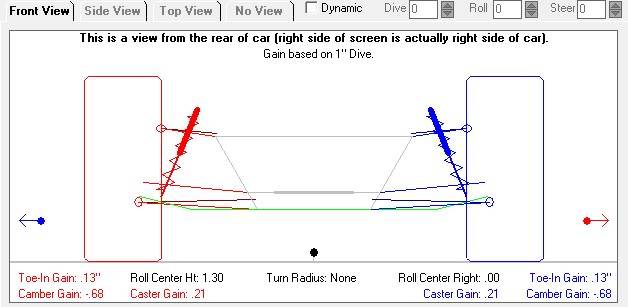
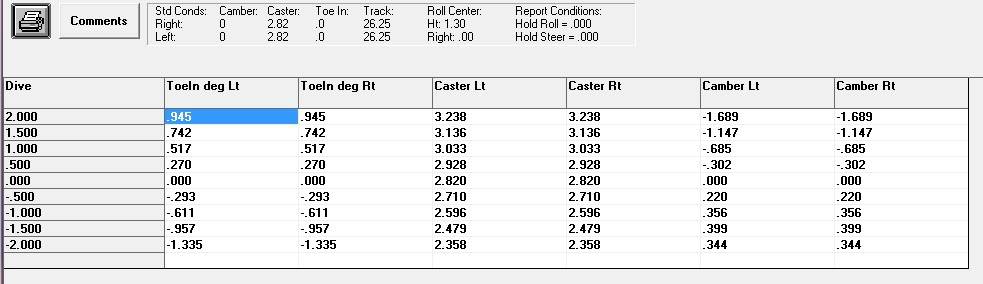
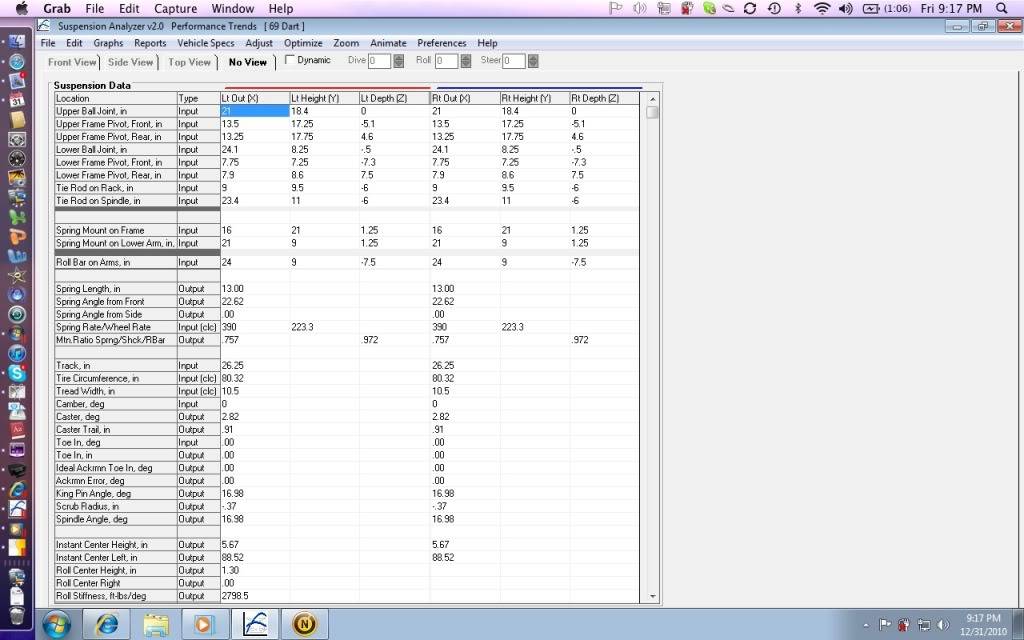
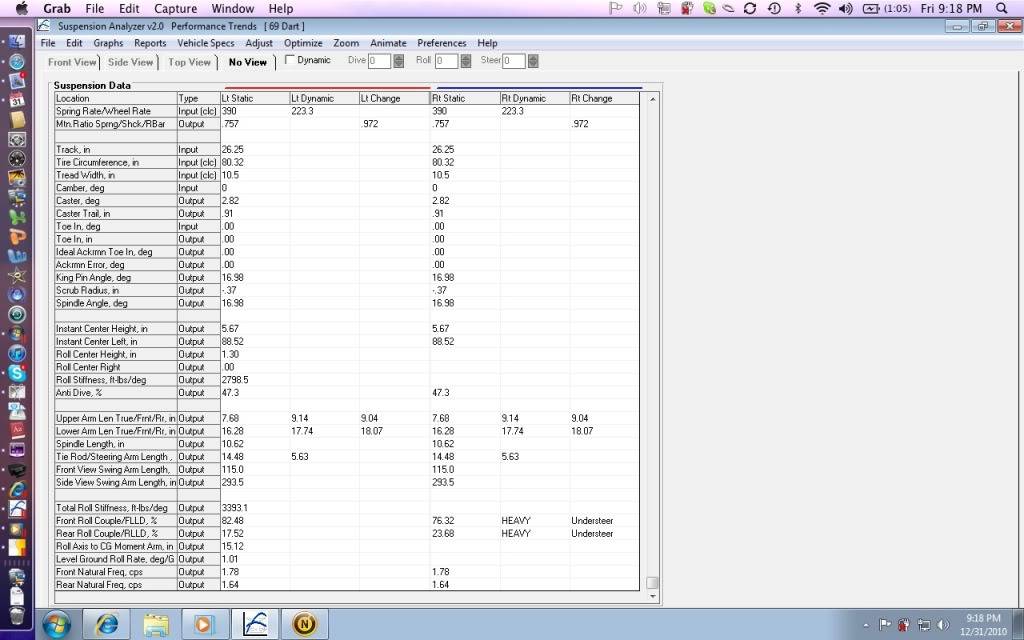
I downloaded a trial version of Suspension Analyzer from Performance Trends, plugged in my data as it sits now with the UCA's in almost the same Y & Z locations as stock Viper, but larger X. Attached are some images I pulled of the input data and output. The only input data I did NOT change was rollbar, spring rate, camber and toe. Now I need help understanding whether this data is any good or not and what I can do to optimize it. I don't have my chassis engineering book with me to help me understand the info but I'm hoping some of the suspension guys here can help.
Thanks and HAPPY NEW YEAR!!!
Will
-
01-01-2011 #2 Registered User
- Join Date
- Oct 2009
- Location
- New Derry, PA
- Posts
- 1,265
The short UCA length is giving you a fair amount of camber gain...which isn't all bad, but it depends on what tire/wheel combo you are using. The more sidewall height you have, the more camber gain you will need. Hard to say what is "right" or "optimal" until you match the geometry to the tire.

Ray Kaufman - Wyotech Chassis Fab and High Performance Instructor. Words of Wisdom from an old master... at Asylum Custom Interiors website
01-01-2011 #3
Registered User
- Join Date
- Jul 2009
- Location
- Grand Rapids, MI
- Posts
- 1,559
Thanks Ray. The wheel/tire I'm using is an 18x10 wheel, with a 275/35-18 tire.
01-01-2011 #4 Registered User
- Join Date
- Nov 2008
- Location
- So. Cal.
- Posts
- 1,240
You know whats weird is you didnt get as much camber gain (not always a good thing, more is not always better) as I thought you would by shaving 1.5" off the UCAs. I would have expected to see more of a dive, a fast dive in camber than the program shows. 1.5" off the top should have shown a massive camber gain, specially at the 2 inches of dive.
Which means one of maybe more things. One is the stock suspension didnt have ANY camber gain due to the car and it didnt need it and tire wear was more important. Or two, the software isnt giving proper numbers. Ok, or three is that the arms are so long that 1.5" is not that big of a deal. They would have to be pretty long. And no doubt, they prolly are.
Im thinking number three, massive arms and one and a half inches is petty.
So with all that. Just going off of the computer output I dont see an issue. Id like to set it up on my caster/camber gauge to see the real numbers. Kinda hard for me to see removing 1.5" out of the top doesnt create more of a change.
But.. With that full degree of toe makes me think the program is seeing the changes. The toe numbers are a lil high, and they should be with the short upper arm. And that would be due to the 1.5" of upper arm. Thats ALOT of toe change. But not something you couldn't correct for. Thats kinda simple. If the camber and caster numbers are correct then I think its doable. Just gotta mellow the toe out some. JRWhat I write is opinion, none of it is factual. 2010
Even though I'm conscious it doesn't mean I'm coherent. 2011
I'm getting better with age. Best thing about old age is I don't know any better. 2012
01-01-2011 #5 Registered User
- Join Date
- Nov 2009
- Location
- the dirty mitten
- Posts
- 1,217
I know that you are getting a custom steering rack. Try messing with the numbers and use a wider rack, that should decrease your toe changes during the suspension cycle.
That graph only gives readings for 2 inches up and down. Am I correct in assuming that you will be running more than 4 inches of total travel? I assume at least 6-8 for the front which would make for a better ride.
Also, Im very new to the design of a front suspension but I thought that the lower arm mounts and the arms themselves are supposed to be level with each other and that the uppers are the ones that get angled to create suspension geometry voodoo.Steve
1968 Dodge Charger All Wheel Drive project Red Bull<script type="text/javascript" src="safari-extension://com.ebay.safari.myebaymanager-QYHMMGCMJR/5cce6da5/background/helpers/prefilterHelper.js"></script><script type="text/javascript" src="safari-extension://com.ebay.safari.myebaymanager-QYHMMGCMJR/85dc54c0/background/helpers/prefilterHelper.js"></script><script type="text/javascript" src="safari-extension://com.ebay.safari.myebaymanager-QYHMMGCMJR/85dc54c0/background/helpers/prefilterHelper.js"></script>
01-02-2011 #6 Registered User
- Join Date
- Nov 2008
- Location
- TN
- Posts
- 954
If you have the time I would imput the stock specifications, then print them out and compare to see exactly where you are coming from and see what the changes did.
Benjamin
Twin Dusters
'72 Plymouth Duster "Aero Duster" project
'72 Plymouth Duster "Daily Duster" project
https://www.pro-touring.com/showthre...RO-DUSTER-quot
01-02-2011 #7
Registered User
- Join Date
- Jul 2009
- Location
- Grand Rapids, MI
- Posts
- 1,559
Thanks for the input guys.
@Steve, I can definitely play with track width but can't go outboard any further without running into rubbing issues at full compression. The Viper air springs I "hope" to run (limiting factor may now be the shorter UCA's but we'll see) allow just under 4 inches of shock travel so that's where that number came from. My understanding is the same as yours about the LCA being level and dive being adjusted in the canting of the UCA. The Viper stuff is just plain odd to me in that regard. The UCA's are almost level while the LCA's are mostly canted.
@BJ, unfortunately I'm out of time for this trip and am losing my demo of suspension analyzer (I'm on a Mac and was borrowing a PC for it). Over the next six weeks I'm going to get back into the Herb Adams book and study up on this some more to make sure I understand as much as I can, what certain changes will do to things like camber gain and toe. When I get back I will be playing with a few various changes to see what they do and I like your idea of comparing the stock Viper stuff in order to see what it starts with and where it goes.
@JR, Thanks a bunch for your feedback. That's what I was hoping to hear. I still want to do some more study and analysis of what I have before I solidify the settings but it's good to hear I'm going in the right direction.
Thanks again guys.
01-02-2011 #8
Registered User
- Join Date
- Nov 2008
- Location
- TN
- Posts
- 954
Well If you think about it it is doing the same thing either way. It is more the difference in angle than the tilting. We are just used to seeing it on the UCA. Originally Posted by wellis77

I see, does the demo expire? or it is a limited program and you just have it on the borrowed PC? As for comparing it to the stock viper, I thought it was a good idea because you are using mostly viper components, and the viper geometry must not be too shabby since it currently holds lap records around the ring and Laguna Seca. Just remember that your track is MUCH narrower and you will have more weight transfer and roll so a little extra camber gain is probably a good thing. Originally Posted by wellis77
Originally Posted by wellis77
Benjamin
Twin Dusters
'72 Plymouth Duster "Aero Duster" project
'72 Plymouth Duster "Daily Duster" project
https://www.pro-touring.com/showthre...RO-DUSTER-quot
01-03-2011 #9
Registered User
- Join Date
- Jul 2009
- Location
- Grand Rapids, MI
- Posts
- 1,559
Thanks Ben. The demo expires after 10 days, and it's on a borrowed PC; double whammy! My in-laws have a PC as well and I may try it on their's when I get back, just to do some more playing with it.
01-03-2011 #10
Registered User
- Join Date
- Oct 2009
- Location
- New Derry, PA
- Posts
- 1,265
Just one thing to add to that, Ben. If you use the LCA for camber gain, it will be pushing against the bottom of the wheel (and contact patch of the tire), rather than pulling the top in. That's why we normally try to keep the LCA level, to minimize side thrust from the suspension. Originally Posted by Bjkadron
Ray Kaufman - Wyotech Chassis Fab and High Performance Instructor. Words of Wisdom from an old master... at Asylum Custom Interiors website
01-04-2011 #11
Registered User
- Join Date
- Jul 2009
- Location
- Grand Rapids, MI
- Posts
- 1,559
Ray, when you say "try to keep the LCA level", are you referring to the side to side (front view) or front to rear (side view)? Would it be a smart move to level the LCA's in the X & Y planes then relocate the UCA mounts?
01-04-2011 #12
Registered User
- Join Date
- Oct 2009
- Location
- New Derry, PA
- Posts
- 1,265
If the LCA is at much of an angle in front view, it will have an effect on camber, as noted. If it is angled in side view (pivot bolts), it will force a caster change with suspension travel, as the lower ball joint is moving up and down at an angle. Some racers use this as a tuning tool, but for all around use you're probably better off keeping it flat in both planes. Originally Posted by wellis77
The UCA mounts are typically angled in side view to give braking anti-dive (usually the rear pivot is lower than the front). Be careful with this angle, as anti-dive is designed from the factory for the original car weight, F/R weight distribution, and stock tire design. Too much anti-dive will make the front end too stiff and chatter the tires under heavy braking. Having said that, if you're pulling everything off a Viper; the stock anti-dive angle (UCA pivots relative to ground) should serve you fairly well.
BTW, back to your original plot of the camber gain with the shorter UCA... With that low profile tire, you probably don't need as much progressive camber gain as your simulation is giving you. Note how it only gains .685deg in the first inch of travel (good), but gains almost a full degree more in the second inch. If the car is stiffly sprung (NOT always the best for grip) and corners very flat, you should be ok. If you let the front end move around (softer) to go easy on the tire sidewall, you may end up with the outside of the tread pulling up. If as you say there is only 4 of available travel, don't give it a second thought, it will have to be stiff as hell anyway to keep from bottoming something.
Ray Kaufman - Wyotech Chassis Fab and High Performance Instructor. Words of Wisdom from an old master... at Asylum Custom Interiors website
01-04-2011 #13
Registered User
- Join Date
- Nov 2008
- Location
- TN
- Posts
- 954
I was talking about side view for anti-dive. But I may be slightly confused. Originally Posted by exwestracer
Benjamin
Twin Dusters
'72 Plymouth Duster "Aero Duster" project
'72 Plymouth Duster "Daily Duster" project
https://www.pro-touring.com/showthre...RO-DUSTER-quot
01-04-2011 #14
Registered User
- Join Date
- Oct 2009
- Location
- New Derry, PA
- Posts
- 1,265
No, you were right. I misread that in his post. Normally you would see the anti-dive in the UCA, but I'd think the LCA would have to be canted the opposite way (down in front) to get the same result...? Originally Posted by Bjkadron
Ray Kaufman - Wyotech Chassis Fab and High Performance Instructor. Words of Wisdom from an old master... at Asylum Custom Interiors website
01-05-2011 #15
Registered User
- Join Date
- Nov 2008
- Location
- TN
- Posts
- 954
It is, the front is down. If you can see the tiny numbers on his inputs. I don't see any reason it wouldn't work as you are basically tilting the Z-axis (of the regular setup: UCA Tilted) forward the same amount as the anti-dive angle. The suspension moves exactly the same. If that wasn't clear let me know. Originally Posted by exwestracer
Benjamin
Twin Dusters
'72 Plymouth Duster "Aero Duster" project
'72 Plymouth Duster "Daily Duster" project
https://www.pro-touring.com/showthre...RO-DUSTER-quot
01-05-2011 #16
Registered User
- Join Date
- Jul 2009
- Location
- Grand Rapids, MI
- Posts
- 1,559
Ben is right. The front is definitely down on both the UCA and the LCA. They are both down just a little bit; the front UCA is down 1/4" while the front LCA is down 1/8". I thought it was strange the anti-dive was setup this way, between both control arms rather than just setting the LCA level, front to rear and side to side, then lowering the rear of the UCA. This seems to make a pretty long side swing-arm length (to me anyway). Both arms canted the way they are also creates a higher side instant center which, if I understand correctly, creates the huge percentage of anti-dive, 47.3%. Herb Adams book mentions some street cars have as much as 30%, while this seems to have quite a bit more. The result of that would be the car stays level under hard braking, correct? If that's the case, to me that would be a good thing.
Ray, you mentioned the camber gain from 1" to 2" is a bit high, but since I'll only have a max compression of 2" I shouldn't be too concerned. Is that amount of camber gain going to make the car feel unstable, and if so, how can I reduce the amount of camber gain?
I may just have to spend the $250 and buy the software so I can play with some settings...
01-05-2011 #17
Registered User
- Join Date
- Nov 2008
- Location
- TN
- Posts
- 954
Ok wait.. If they are both down, and the upper is down more that would cancel out the LCA tilt, and give a negative value for the antidive. Where did you get the numbers? did you measure them directly from the frame? Originally Posted by wellis77
Antidive helps account for softer spring rate that would normally cause brake dive. But it does cause caster change under braking which can be disconcerting.
If you want to we might be able to go in together on the program and when you are done with your suspension I could use it for continued development on mine.Benjamin
Twin Dusters
'72 Plymouth Duster "Aero Duster" project
'72 Plymouth Duster "Daily Duster" project
https://www.pro-touring.com/showthre...RO-DUSTER-quot
01-05-2011 #18
Registered User
- Join Date
- Jul 2009
- Location
- Grand Rapids, MI
- Posts
- 1,559
My measurements I pulled from the suspension components on the chassis table after pulling the Viper frame section out. The numbers I mentioned in my last post are output numbers that came from suspension analyzer. I'll try to attach the jpegs for you to get a better look at, maybe you can download them and get a better look.
That may not be a bad idea to go in together on the program since I only need it for this one build. I wonder if it can be loaded to one computer or more than one? Hmm. Have you tried the demo of it? You may want to first to see if it's something that will be all good for you.
01-05-2011 #19
Registered User
- Join Date
- Nov 2009
- Location
- the dirty mitten
- Posts
- 1,217
Can you run that program on a Mac? Ill be needing it too when I have to set my stuff up
Steve
1968 Dodge Charger All Wheel Drive project Red Bull<script type="text/javascript" src="safari-extension://com.ebay.safari.myebaymanager-QYHMMGCMJR/5cce6da5/background/helpers/prefilterHelper.js"></script><script type="text/javascript" src="safari-extension://com.ebay.safari.myebaymanager-QYHMMGCMJR/85dc54c0/background/helpers/prefilterHelper.js"></script><script type="text/javascript" src="safari-extension://com.ebay.safari.myebaymanager-QYHMMGCMJR/85dc54c0/background/helpers/prefilterHelper.js"></script>
01-05-2011 #20
Registered User
- Join Date
- Jul 2009
- Location
- Grand Rapids, MI
- Posts
- 1,559
You can if you run windows via a virtual PC (i.e. Parallels). I run Parallels and have windows on my Mac but the time period expired so I'm out of luck on that one. The more I think about it, the more I'm leaning towards buying it just because I can play with it on my time over the next 6 weeks and dial in my setup. The dilemma is by the front only version, or the rear as well so I can dial in the rear geometry for my car too; $150 difference though.
Another option is from Auto-Ware, though I don't really know much about it. You can find it HERE. Seems okay and they seem to have pretty good support to.

 Reply With Quote