


Results 21 to 40 of 55
-
12-29-2009 #21
 Registered User
- Join Date
- Nov 2009
- Location
- Colorado
- Posts
- 163

So mounting the temp switches on the inlet of the water pump would work best?? Sorry but i thought on the head or the intake manifold would work best. How would i install them on a SBC water pump inlet?
-
12-30-2009 #22
Registered User
- Join Date
- Feb 2007
- Location
- USA, TN
- Posts
- 850
You mention normal engine load. If the engine operated in the same environment all the time, then I would agree. It wouldn't mater where you put the sensor.
I also agree that it is best to run the engine a little warmer. It also helps to evaporate contaminates off of the oil.
However, most street driven engines operate in a wide operating range. Ambient temps can vary by 100 degrees, loads can range from rolling down hill to high speed freeway driving with a fully loaded car and the AC running. If you engine temps start pushing 230 or 240 you need to back off a little. If you are measuring the cold water coming in, you can only estimate the actual engine temps and thats assuming the radiator and water pump are working correctly. If the water pump starts pumping less (loose impeller?), then you estimate will be way off.
12-30-2009 #23 Registered User
- Join Date
- Feb 2009
- Location
- muggy midwest
- Posts
- 533
I understand where you are coming from...my point is that any street engine is only going to build what amounts to 30 degrees of heat give or take a few degrees during its combustion cycle-now, if you know what the temp is leaving by way of an intake temp sensor for the gauge and exiting the engine via the t-stat-say 200 in this case, then if you had your fan switch in the intake, it would be triggered to come on prematurely because you have not allowed enough time for airflow to remove heat from the radiator-and by this I am talking about highway speeds. With proper shrouding, your fan should not have to come on-the inlet temps should drop by at least 30-40 degrees so then the combustion cycle would increase by 30 degrees or so again and be leaving the engine at 190-200 again. If the coolant exiting the t-stat is so high that it runs the risk of engine damage, imo you have a mechanical failure somewhere in the system. Knowing that the amount of heat the engine builds up during combustion is relatively constant even under light loads, it is better to maintain a steady incoming temperature-the engine stays within a narrow temp range which improves thermal efficiency, increase mileage and allows for a more extended electric fan life since it has to cycle on/off much less. Simply drilling/tapping the water pump arm is all that you need to due to add a sensor or two-just be careful of belt interference. I have found it pretty easy to do and avoid any belt problems. I've done this mod often enough to know that it allows you to run a stable engine temperature no matter what the driving conditions are. This was my solution to the fan always kicking on and off on the freeway-this way, i eliminate that problem and it runs much better. Btw, I'll check on those Delphi numbers you pm'd me about-I dont see why I can't get them...I'll get back to you.
12-31-2009 #24 Registered User
- Join Date
- Sep 2006
- Location
- Southern Indiana
- Posts
- 4,709
Putting the temp sensor in odd places is pointless, after 20 plus years of building cars, installing salvage yard fans and different controlers I simply see people using overly expensive controlers, trying to reinvent the wheel so to speak.
What your trying to do with a cooling system is maintain a steady temp, which is controled by air flow over the radiator AND fan on/off time to help it maintain thwt at low speeds.
I used the simple thermostatic controlers slide the temp bulb in up near the upper hose of std flow and lower hose on reverse flow (depending where you have the hot side coming in). and never have had issues EXCEPT when I had a fan/shroud I got at a swap meet, wound up removing the crap shroud later on.
As for heat and damage yopu would be surprised what these engines can handle with little or no issues.
I also quit trying to run engines in the 140-160 range, its just not worth the hassle.
If your cooling system is done right, and you have good air flow both at slow speed and at hwy speed your not gonna have issues.
Another great tool for cooling systems I have been selling is Evans Coolings NPG line of coolant, boiling point a like 375degrees, with no pressure, no corrosion as it has zero water, and freeze point as low as 70 below.
Most people are going to large tube aluminum radiators so the NPGR or NPG+ work well, and they sell application specific pumps too.
My big block 402 was cooled by a single fan from a Cavalier, shroud and all, and all with a 3 core Chevelle radiator and usually ran either 180 or 195 thermostats.
My car never ran over 220 and that was in standing traffic, and had idled in gear for long time (did have trans going out and this was with week old big block) that engine has over 100k and is sitting under tarp waiting till I can drop it in my 84 Caprice.
I never saw creep from that cooling system but that once.
My 77 Monza had a small rad, got my 355 and it never ran over 210 max and had that fan that had the crap shroud i took off.
Only heat issue that car EVER had was one day I went to drag strip and I had some vapor lock issues.
And that was with factory Monza V8, 3 row radiator, VERY small.
I actually used my Intellitronics temp gauge that had a fan out put to control the fan, ran that to a relay.
I see guys spending incredible amounts and just dont have major heat issues on cars.
Since I have found a decent 31x19 all aluminum rad for cheap, I figure the Caprice wont get hot and I have 2 fans from a 90 Grand Prix with no shroud, they will just sit behind the rad, no shroud, leaving it clean between the rad, fans and engine, Iam also looking into a very larger condenser to reinstall the AC.
I will wire the main fan to run when I want, then use the second to come on at a point higher than the first but not hot enough to hurt the engine, and then both will turned on for AC use.
As for having fans kick on and off going down the roadI rarely see it any system I have built, heck I have used the Hyper tech fan switches for sbc that go in the heads like on 80s Camaro.
But the simple adjustables seem to work just fine when hooked up to the relays.
The stock GMs usually come in around 215-230, and off in the 195-200 range, works great.
Keeping an engine in/around the 200 range help on wear, makes more power for street cars, and besides it never has hurt my power making issues except that once.
12-31-2009 #25
Registered User
- Join Date
- Feb 2007
- Location
- USA, TN
- Posts
- 850
H20,
Excellent explanation. I'm just the paranoid type and try to build things to accommodate failure. My paranoia drove me to GXL wire instead of TXL wire in rewire. Given I only have one temp sensor that controls my gauge and hi & low fan, I put it in the manifold to monitor exit temps. I will have a second sensor connected to a warning light mounted in the head.
MonzaRacer,
I'll have to look up the Evans coolant.
01-01-2010 #26 Registered User
- Join Date
- Aug 2008
- Posts
- 35
Just got back from holiday with family, started to work on my car again and have few more questions after reading the reply's.
Would it be ok to run coolant sensor/switch at the T-stat housing?
Whats a good coolant temperature gauge I should buy?
I decided to run just single fan speed on my setup, besides the fan life being short any other negative reason for doing this?
01-01-2010 #27
Registered User
- Join Date
- Feb 2007
- Location
- USA, TN
- Posts
- 850
Mine's in the manifold near the t-stat housing. Any of the name brand gauges should be fine. I recommend an electric gauge.
01-07-2010 #28
Registered User
- Join Date
- Aug 2008
- Posts
- 35
Both of the links appear to be the same, can you get the link for the one with the metal bracket no diode. Thanks Originally Posted by TnBlkC230WZ

by the way the DG85B's will fit my controller right?
What determines if i need SPST-NO, or SPDT?
01-07-2010 #29
Registered User
- Join Date
- Jan 2010
- Posts
- 1
Fans
I would run two controllers, with my Spal fans I run two so if one goes down I still have the other fan working....We noticed a while back that only one fan was working and it turned out that one of the wires was loose on a controller causing the problem...easy fix and it was back...hope this helps
01-07-2010 #30
Registered User
- Join Date
- Feb 2007
- Location
- USA, TN
- Posts
- 850
This one does not have a resistor or diode. Straight metal bracket Originally Posted by STROKED
http://www.newark.com/durakool/dg85b...lay/dp/30M9185
This one has a resistor, no diode and straight metal bracket
http://www.newark.com/durakool/dg85b...lay/dp/30M9199
As long as your controller will hold a 5 pin relay with 1/4 inch blades, an SPDT will work. They are sometimes refered to in metric dimensions 6.3 mm. Most SPDT relays are NO, they just don't state it. NO = Normally Open = Off. Off is when the #30 and #87 pin are not connected. I perfer the the SPST relays because they often have a higher rating. It is rare that I need the 87a pin. I like the relays with diodes, you just have to keep up with pin 85 and 86 and know which one is the ground. On none-diode relays it doesn't matter.
This is my prefered relay. It is an SPST with straight metal bracket, no diode.
http://www.newark.com/durakool/dg85b...lay/dp/30M9198
01-07-2010 #31
Registered User
- Join Date
- Nov 2009
- Location
- Colorado
- Posts
- 163
So does anybody have any temp switch part numbers that may work? I would at least want to run the low speed for now. I have been looking but am confused on how to wire dual fans with dual relays and one temp switch???
 any ideas.... I already have the green relays that i pulled out of a Chrysler "something".
01-08-2010 #32
Registered User
- Join Date
- May 2009
- Posts
- 99
There's a few in here (some kits listed too, but several individual thread-in ones as well).
http://www.summitracing.com/search/Department/Cooling-Heating/Part-Type/Fan-Switches-Thermal/Sending-Unit-Style/Thread-in/?Ns=Rank|Asc
GM 3053190 is one from a Grand National, I think it's 210 ON, 200 OFF. (EDIT: More like 203 ON)
I believe that # is discontinued, but you should be able to cross-ref it at an auto parts store.
01-08-2010 #33
Registered User
- Join Date
- Feb 2007
- Location
- USA, TN
- Posts
- 850
There are a few ways. The only one I found that would read an engine mounted temp switch is the Dakota Digital controller. It works very well and uses it's own switch or can read the electric sender from most any name brand temp gaugae. Mine is hooked to an autometer sensor. It's only down side is it has to be in a dry environment. I started with it inside the car, but have now mounted it in a NEMA 4X rated box and put it under the hood. Originally Posted by 85GPLEf41
It is in the putty colored box
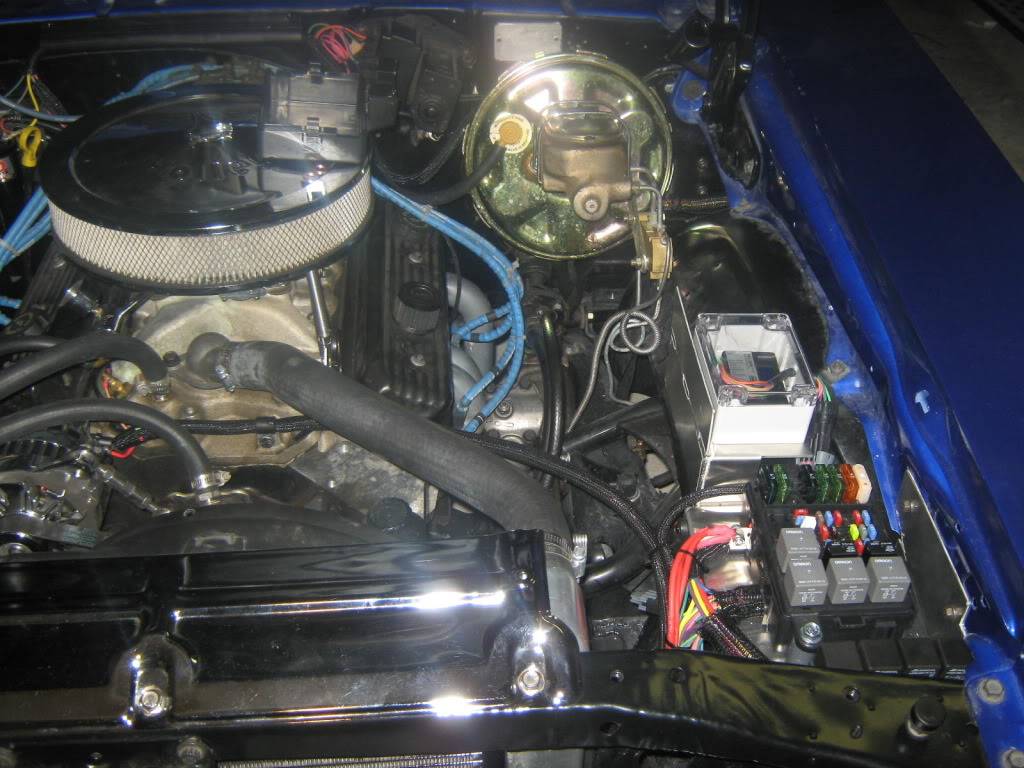
01-08-2010 #34
Registered User
- Join Date
- Nov 2009
- Location
- Colorado
- Posts
- 163
Originally Posted by treed_cutlass
Thanks! i will try and see what i can cross reference it with. Is it a 1 or 2 spade? Is that a good temp to run a SBC efficiently? BTW thanks for helping me too @ GBody forum too.
TnBlkC230wz i like that controller but its a little over priced for my low budget build. lol I also want to wire it as simple as possible using parts that can be easily replaced from a autoparts store.
01-08-2010 #35
Registered User
- Join Date
- May 2009
- Posts
- 99
That is a single terminal, but from what I remember it uses a somewhat special terminal (not just a regular spade). The connector pig tails should be readily available. It's kind of like a bullet connector, if you know what I mean. Originally Posted by 85GPLEf41
Napaonline cross-refs 3053190 to an Echlin brand switch:
Switch: FS113
http://www.napaonline.com/Search/Det...113_0217662982
Connector pig tail: FSC10
http://www.napaonline.com/Search/Det...C10_0252408144
Hopefully this fits the bill.
To be 100% honest, I'm no engine guru. It seems to me that your average SBC has a 195° F thermostat. This tells me that the thermostat will keep the engine at 195° most of the time. The fans are only there if the rad can't do that, due to insufficient air flow, so if your temps get to be around 210°, this means the thermostat/rad ain't doin' it, and the rad needs more air. Originally Posted by 85GPLEf41
I don't think that 210° F is too hot. I believe that some of the 3rd Gen F-body guys use this "Grand National" switch to lower their fan turn-on temps, which I _think_ were something in the order of 225° F???? Not sure on that. I know they do use it as a cooler fan switch though. My logic here is that if it's a cooler fan switch than a SBC in a stock F-body, it shouldn't be too hot. If your thermostat opens at 195°, this will typically regulate engine temps to 195°, so 210° shouldn't be too cold. So if it's not too hot, and it's not too cold, it at least won't damage anything. As far as engine temperature vs. max efficiency goes... I don't know. The way I see it, you'd need to change your thermostat to really affect the temperature of your engine. That's my convoluted logic anyhow.
You're welcome! Anytime. Originally Posted by 85GPLEf41
01-08-2010 #36
Registered User
- Join Date
- Feb 2007
- Location
- USA, TN
- Posts
- 850
210 on is not too high, but I wouldn't want it any hotter than that. The factory turns them on betweek 210 and 220.
01-09-2010 #37
Registered User
- Join Date
- May 2009
- Posts
- 99
Hrm, now that I'm digging around a bit, I'm finding some information suggesting that the 3053190 switch may be more around 203° F on.
Different people are reporting seeing different temperatures with it, I'm assuming due to different install locations and variations in the accuracy of switches between brands (and accuracy of temp gauges).
This makes me wonder what the off setting is. Hopefully not too low that it'll run all the time with a 195° F thermostat.
If you decide to go with one, let us know how it works out. Yes, you are now being used as a guinea pig!
01-10-2010 #38
Registered User
- Join Date
- Sep 2006
- Location
- Southern Indiana
- Posts
- 4,709
Fan controls,
You can source some lower degree grounding switches from Hypertech and others.
I use what ever I can find from NAPA sensor books that have proper temp ranges and right threads or can be adapted.
As for GM temps it depends, some cars go all the way up to 231 to turn on, others are computer controlled and come on as low as 210.
As for temps the radiator works by air flow, no other thing cools like volumes of air. Hence we have fans.
Again if you need more cooling try looking at this company, the products are top notch bar none: www.evanscooling.com.
The NPG+ would be ideal for pretty much everyone on here as most of us are going with large tube aluminum radiators.
01-10-2010 #39
Registered User
- Join Date
- Nov 2009
- Location
- Colorado
- Posts
- 163
That's cool thanks for the part numbers i will try to get one this week from Napa i can get parts at jobber prices. I hopefully will get it done this weekend if the weather cooperates. Originally Posted by treed_cutlass
01-16-2010 #40
Registered User
- Join Date
- Aug 2008
- Posts
- 35
First time wiring all this up myself, is it alright to tap into positive coil wire for my igntion feed on my cooling fan controller?

 Reply With Quote