


Results 1 to 12 of 12
Thread: Looking for direction...
-
07-31-2009 #1

 Registered User
- Join Date
- Jul 2009
- Location
- Grand Rapids, MI
- Posts
- 1,559

Looking for direction...
So I have almost decided that I'm doing an AME G-Max Chassis under my 69 Dart. Problem is, I'm just learning to weld and haven't done any fab yet, hence the direction I'm looking for. Does anyone know of good resources, books, videos, etc, that I can pick up to give me some basic understanding of floor panels, how to weld them in, mounting bodies, and what not? I've seen a couple metal fabricators books that discuss tools, patterns/layouts, metal shaping, restoration, sheet-metal interiors, but don't know how good they might be. I will continue to hone my welding skills before I start welding car to chassis, but when it comes to welding in floors, I don't know if it should be welded to the frame or the body, or weld the body to the frame, or use mounts so it's removable... I'm sure the list goes on. At this point though, I'm looking for a resource to help give me a basic understanding of how to do some of these things. Any thoughts??? Thanks guys.
-
07-31-2009 #2 Registered User
- Join Date
- Dec 2004
- Location
- Midwest
- Posts
- 2,263
Here's a short video on doing floors on a Firebird..
http://v8tvshow.com/content/view/770/1/
Chevelle trunk floor..
http://v8tvshow.com/content/view/617/43/
More trunk and wheelhouse...
http://v8tvshow.com/content/view/490/43/
Main complete floor in '69 Chevelle...
http://v8tvshow.com/content/view/401/43/
Maybe it will help a little.Last edited by oestek; 07-31-2009 at 11:38 AM.
Kevin Oeste
V8 Speed and Resto Shop
V8TV
Muscle Car Of The Week
V8 Radio Podcast
All about us:
https://www.v8speedshop.com

07-31-2009 #3 Registered User
- Join Date
- Mar 2008
- Location
- Everett, WA
- Posts
- 501
The above videos are very good, pretty much exactly how I replaced the floor in my Nova!
The sheet metal should not be welded to the frame. The body should stay separate from the frame with mounts between the two. This is so that the frame and body can flex independently and not tweak the sheet metal. Originally Posted by wellis77

Welding takes practice. Period. I very strongly suggest you enroll in a basic MIG welding class at a local community or technical college. Tech college is where I learned how to weld... it was required for my engineering degree. I'm thankful for both the welding classes I took! I use the knowledge all the time - from oxy-acyl. brazing to stick to MIG to TIG.The few, the proud, the crazy... the LT1 owners.
08-04-2009 #4 Registered User
- Join Date
- Apr 2005
- Location
- dayton, oh
- Posts
- 952
the class would be optimal, but you can learn a lot from just spending hours on the internet and practicing.
the one thing I will mention is to make sure you get a good unit. I had a crappy old Clarke 85 that I could NOT get a good weld to save my life. then I bought a brand new Miller 140 and it's a dream to use. but I almost had to learn all over again.
08-04-2009 #5 -Moderator/Sponsor-
- Join Date
- Jun 2001
- Location
- Orlando, FL
- Posts
- 10,604
Morrison has some "clip install" videos that are pretty good.
I've got some fab sequences on my website about how I did similar work. I'm happy to answer any questions you might have as you look at them.
jpJohn Parsons
UnRivaled Rides -- Modern upgrades for your ride.
UnRivaled Rides recent project -- LS9-powered 69 Camaro
08-04-2009 #6
-Moderator/Sponsor-
- Join Date
- Jun 2001
- Location
- Orlando, FL
- Posts
- 10,604
I'm wondering why you would say that. For a frame and floor replacement using one of Morrison's full framerail chassis, that's exactly what you want to do: make a uni-body ultra-stiff with the addition of the beefy frame.The sheet metal should not be welded to the frame. The body should stay separate from the frame with mounts between the two. This is so that the frame and body can flex independently and not tweak the sheet metal.
jpJohn Parsons
UnRivaled Rides -- Modern upgrades for your ride.
UnRivaled Rides recent project -- LS9-powered 69 Camaro
08-04-2009 #7
Registered User
- Join Date
- Mar 2008
- Location
- Everett, WA
- Posts
- 501
Really? Huh... guess it shows that I've only worked on production cars and never done a Morrison chassis. Originally Posted by parsonsj
 I guess it makes sense if everything is directly tied together then you are going to get one heck of a rigid ride. How does one avoid breaking/bending/fubar'ing the thinner metal if you have thick walled steel chassis tied into thin 20 gauge sheet metal?
The few, the proud, the crazy... the LT1 owners.
I guess it makes sense if everything is directly tied together then you are going to get one heck of a rigid ride. How does one avoid breaking/bending/fubar'ing the thinner metal if you have thick walled steel chassis tied into thin 20 gauge sheet metal?
The few, the proud, the crazy... the LT1 owners.
08-04-2009 #8
-Moderator/Sponsor-
- Join Date
- Jun 2001
- Location
- Orlando, FL
- Posts
- 10,604
Really.
One welds 20g (and 22 and 24g) steel to the frame rails with skill and practice. It's important to keep the right flanges around to allow such welding like in the quarter panels, rocker panels, rear package tray, cowl etc.
That's how Morrison recommends it, and that's how builders all over the country do it. It's how I did it.
You're right: it does lend itself to an extremely rigid chassis/body.
jpLast edited by parsonsj; 08-04-2009 at 10:56 AM.
John Parsons
UnRivaled Rides -- Modern upgrades for your ride.
UnRivaled Rides recent project -- LS9-powered 69 Camaro
08-04-2009 #9
-Moderator/Sponsor-
- Join Date
- Jun 2001
- Location
- Orlando, FL
- Posts
- 10,604
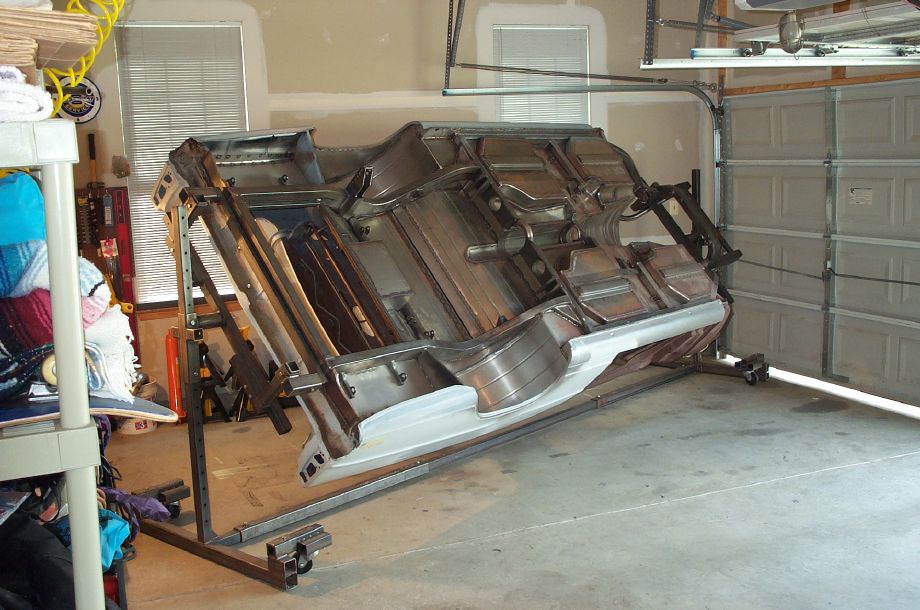 Here's a good shot of what I'm talking about.
John Parsons
Here's a good shot of what I'm talking about.
John Parsons
UnRivaled Rides -- Modern upgrades for your ride.
UnRivaled Rides recent project -- LS9-powered 69 Camaro
08-04-2009 #10
Registered User
- Join Date
- Mar 2008
- Location
- Everett, WA
- Posts
- 501
Perhaps I wasn't clear. Fabricating it isn't what I'm having difficulty imagining. I do large/small combo welds all the time. Originally Posted by parsonsj
It's holding up to the flexing of hard driving. I suppose that if everything is tied together, then the smaller stuff has nowhere to go... but wouldn't the thicker metal flex at a different rate? This would then lead to breakage? Fatigue?The few, the proud, the crazy... the LT1 owners.
08-04-2009 #11
-Moderator/Sponsor-
- Join Date
- Jun 2001
- Location
- Orlando, FL
- Posts
- 10,604
I understand what you are concerned about, but I think it is a non-issue. For example, how does this differ from a unibody car? The floors, body, frame rails, inner fender wells, package tray, etc. are all welded together. You could argue that the frame rail metal (at .120) is thicker than the OEM rails, but that's a distinction without a difference. The thicker frame of the aftermarket chassis will inhibit flex, and thereby reduce fatigue of the thinner metals, not increase it.It's holding up to the flexing of hard driving. I suppose that if everything is tied together, then the smaller stuff has nowhere to go... but wouldn't the thicker metal flex at a different rate? This would then lead to breakage? Fatigue?
Taking a uni-body car and separating the body from the frame is far more likely to induce new stress and cause problems, I would think.
jpJohn Parsons
UnRivaled Rides -- Modern upgrades for your ride.
UnRivaled Rides recent project -- LS9-powered 69 Camaro
08-14-2009 #12
Registered User
- Join Date
- Jun 2005
- Posts
- 543
You're also discounting the fact that frame rails on a uni-body car are also a lot thinner than actual factory frame rails on a full frame car, and the fact that unibody cars are designed and engineered that way, while a lot of these "hot rods" are not. Unibody cars are designed from the factory with intense design aspects like crumple zones, air bag sensors, etc. The level of engineering is entirely different than what you're suggesting for a hobbyist pro touring car and so is the intent of the vehicle. Mathius Originally Posted by parsonsj

 Reply With Quote