


Results 1 to 20 of 107
Thread: Fuel pressure regulator plumbing
-
09-24-2006 #1
 Registered User
- Join Date
- Sep 2004
- Location
- Near Dayton, OH
- Posts
- 547
Fuel pressure regulator plumbing
Hello all,
I just recently received my intake back from being converted over to EFI and I'm trying to lay out the plumbing for it.
Here's a few pictures:
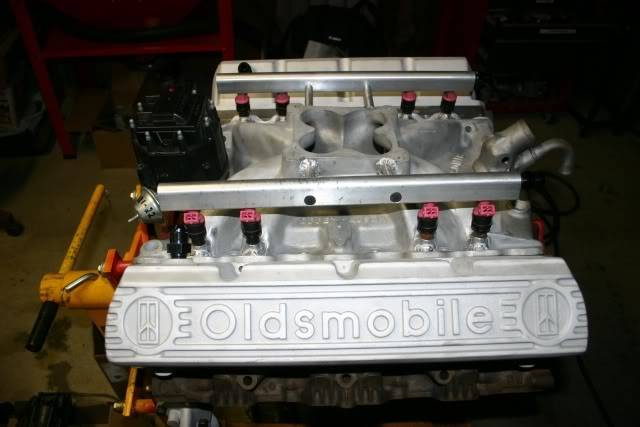
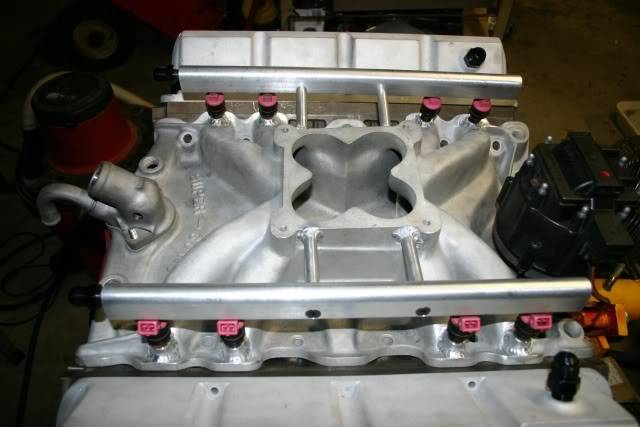
And here is my thought on the plumbing layout:
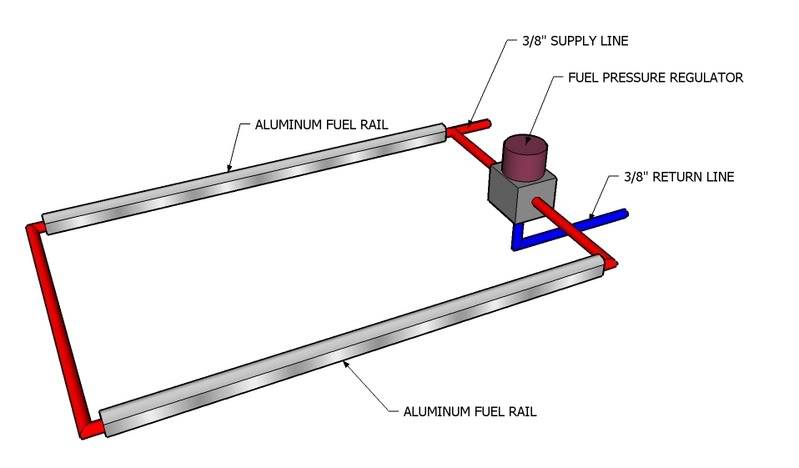
Would this layout work properly? Or do I only want the supply line going to one side, looping around and going out the regulator?
Any other ideas? Thanks,Andrew
1987 Olds Cutlass Supreme FE3X Clone
EFI455/T56/9" w/ 4.30 gears
__________________________________________________ __
-
09-24-2006 #2 Registered User
- Join Date
- Aug 2001
- Location
- Wilton, CA. (Sacramento)
- Posts
- 2,995

I don't like to plumb the regulator on the back side of the rails; you end up really heating the fuel and then returning the hot gas to the tank. On long runs it can cause issues. Ask many of the Power Tour participants.
I like the regulator before the engine, and on my car it will not even be close to the engine; it will bypass from the rear of the car right after the pump.
Jody
09-25-2006 #3
Banned
- Join Date
- Aug 2003
- Location
- Orlando, FL
- Posts
- 8,745
Jody,
What regulator are you using? All the Aeromotive wants to regulate the return, after the rails.
09-25-2006 #4 Registered User
- Join Date
- Aug 2004
- Location
- Harriman, Tennessee
- Posts
- 1,308
On my Holley system, it has the fuel going into one rail, then from that rail to the second, then through the regulator. I hope this description makes sense.
Next topic; FE3X clone, eh? Cool! Did you get one of the kits I have seen online? Any more pics?
Shiny Side Up!
Bill
'72 442 "Inamorata"Why do termites eat houses?
Because they have Munchausen Syndrome.
09-25-2006 #5 -Moderator/Sponsor-
- Join Date
- Jun 2001
- Location
- Orlando, FL
- Posts
- 10,604
Right: Aeromotive wants the regulator behind the rails because the regulator provides precise fuel pressure that way. The regulator does it's best work when the rails are between it and the fuel pump. Drops in pressure due to acceleration are compensated for more quickly.
Putting the regulator in "sideways" with one input from the pump and one from the rails 6 feet away means less precise control.
The disadvantage, as Jody mentions, is that it can heat the fuel if your pump can overwhelm the needs of the engine. Aeromotive has a couple of fuel pump controllers to allow the pump to run slower in lower need situations. DC Controls also has a fuel pump controller that uses the TPS signal as input.
jpJohn Parsons
UnRivaled Rides -- Modern upgrades for your ride.
UnRivaled Rides recent project -- LS9-powered 69 Camaro
09-25-2006 #6 Registered User
- Join Date
- Jul 2003
- Location
- Anaheim Hills, CA
- Posts
- 11,967
In a perfect world the reg is mounted AFTER both rails. This yields consistent fuel pressure to each injecter. Originally Posted by camcojb
HOWEVER, this tends to send hot gas back to the tank. You could help this by installing a cooler on the return line.
I opted to mount my regulator back by the tank and send a single supply line to the fuel rail. This made for a cleaner install and my return line is only a foot or so long. Technically this is not the "best" way to do it but it's the most practical and besides the reg on a vet (even the Z06) is back by the tank. Heck on a f-body the reg is IN the tank.
Having the reg closer to the engine and/or after the rails becomes more important as you get higher up in power. My way did save me a bundle on fittings, hose and hassle."A ship in port is safe, but that's not what ships are built for."
1968 Track Rat Camaro:
https://www.youtube.com/watch?v=SGHJ5c1yLIo&t=2s
1971 Chevelle Wagon with a few mods:
https://www.youtube.com/watch?v=WBVPR3sRgyU
09-25-2006 #7
Registered User
- Join Date
- Aug 2001
- Location
- Wilton, CA. (Sacramento)
- Posts
- 2,995
I hesitated to mention what I was doing because everyone has been taught that the fuel pressure will be more precise when you have the regulator as close as possible to the rails/injectors. Physics says that's simply not true. The pressure at one end of the line is exactly the same as the other end, even if it is 10 feet away. You cannot have different pressures at different injectors in the fuel rail if they're all connected together. Many new cars come without return lines and are regulated at the tank like the Corvette, GTO, etc.
I have run the rear regulator (Aeromotive Frank) at the rear of the car in the yellow car and the fuel pressure was spot on. It eliminates a lot of extra plumbing, cleans up the engine compartment, and eliminates heating the fuel from the exhaust, engine compartment, and fuel rails. Yes, you can add a cooler (the latest trick to combat the problem) but in my case it is not necessary.
Bottom line, several forward-thinking EFI guys are going to these systems because of the heat issues doing it the other way. We're talking setups with well over 1000 HP and not a bit of fuel pressure deviation at all. The OEM's have been doing it for nearly 10 years on some vehicles like the Corvette.
Jody
09-25-2006 #8
Registered User
- Join Date
- Aug 2004
- Location
- Harriman, Tennessee
- Posts
- 1,308
Hmmm... cool. I guess it makes sense. Wish I had thought of it though, would have made things easier!
Shiny Side Up!
Bill
'72 442 "Inamorata"Why do termites eat houses?
Because they have Munchausen Syndrome.
09-25-2006 #9
Registered User
- Join Date
- Aug 2004
- Posts
- 582
That's not exactly what the physics says. fuel is not perfectly incompressible, and so pressure spikes do occur as injectors open and close. They traverse through the fuel system, albeit at fairly high rates. You are stating a purely steady-state situation. Don't run a returnless system unless you also run a pressure damper at the engine, or you will experience serious problems with harmonics in your fuel rails.
09-25-2006 #10
-Moderator/Sponsor-
- Join Date
- Jun 2001
- Location
- Orlando, FL
- Posts
- 10,604
Right, also remember that the primary heat source for the fuel is the pump, and that is the same in both set ups. In other words, a return-less system puts the same amount of heat into the fuel as that running a return line.
jpJohn Parsons
UnRivaled Rides -- Modern upgrades for your ride.
UnRivaled Rides recent project -- LS9-powered 69 Camaro
09-25-2006 #11 Registered User
- Join Date
- Mar 2003
- Location
- Rochester, MN
- Posts
- 120
Each fuel rail is fed in parallel. There is a "Y" block that's not shown in the picture that feeds each rail. This is exactly the way Aeromotive recommends plumbing it.
09-25-2006 #12
Registered User
- Join Date
- Aug 2001
- Location
- Wilton, CA. (Sacramento)
- Posts
- 2,995
Hmmmm, done it that way and experienced nothing negative. Maybe I got lucky. And so are a lot of other people I guess, as I've personally witnessed several cars done this way. I would be interested in a simple pressure damper if I could find one, can't hurt. Out of curiosity, have you ever tried it? Originally Posted by Fuelie Fan
Like I said, I shouldn't have said anything. I will stop and help you Power Tour guys who have the regular system and are stuck on the side of the road!
JodyLast edited by camcojb; 09-25-2006 at 04:54 PM.
09-25-2006 #13
Registered User
- Join Date
- Aug 2001
- Location
- Wilton, CA. (Sacramento)
- Posts
- 2,995
I know the pump is a heat source, but the engine compartment and rails are MUCH more of a source of heat. I do not agree that a returnless system puts the same amount of heat into the fuel as a standard return system. That would mean that the engine, engine compartment, exhaust, etc. would be adding no heat at all, and that is simply not possible. Originally Posted by parsonsj
Jody
09-25-2006 #14
Registered User
- Join Date
- Jul 2003
- Location
- Anaheim Hills, CA
- Posts
- 11,967
I wouldn't say the "same" amount. When you return after the rail you also send back gas warmed by the engine. Originally Posted by parsonsj
To me the small varience in fuel pressure betweent the two ways is not worth all the extra hassle. If someone told me I could pick up 5hp by running the reg by the rail I would still mount it out back.
I have a pressure guage by the rail and at the reg so I can adjust accordingly. I am also trying a small finned cooler on the supply line to the engine, it's an experiment "A ship in port is safe, but that's not what ships are built for."
1968 Track Rat Camaro:
https://www.youtube.com/watch?v=SGHJ5c1yLIo&t=2s
1971 Chevelle Wagon with a few mods:
https://www.youtube.com/watch?v=WBVPR3sRgyU
09-25-2006 #15
Registered User
- Join Date
- Jul 2003
- Location
- Anaheim Hills, CA
- Posts
- 11,967
Just remember.. even it is a "technically" better way that doesn't mean it's better enough for you to notice in real life. Originally Posted by camcojb
The new LS7 Z06 returns back by the tank.. hmmm..."A ship in port is safe, but that's not what ships are built for."
1968 Track Rat Camaro:
https://www.youtube.com/watch?v=SGHJ5c1yLIo&t=2s
1971 Chevelle Wagon with a few mods:
https://www.youtube.com/watch?v=WBVPR3sRgyU
09-25-2006 #16
Registered User
- Join Date
- Aug 2001
- Location
- Wilton, CA. (Sacramento)
- Posts
- 2,995
My thoughts are exactly that. Until it becomes a problem for me and my friends who are doing it, many with 1000+ Hp setups, I will not change. It's simpler, cleaner, and eliminates any engine or exhaust heating of the fuel. This was a real issue on Power Tour, as many had the same heating of the fuel issues and were stuck on the road trying to cool everything down so the pump worked. This didn't show up for them before the Tour as they only made shorter trips. The car I got to use on the Tour was plumbed the normal way and after an hour or two of driving on the freeway the return line and gas tank were so hot you couldn't hardly touch them. In fact, the only way we finished the long haul was to plumb the return line into the trunk and through 20' of copper line in an ice chest full of ice, then return the cold fuel to the tank. Each day started with a guess of whether it would be a 6 bagger or 8 bagger, the amount of ice bags we'd need to get to the next stop on the Tour! Originally Posted by Steve1968LS2

Jody
09-25-2006 #17
-Moderator/Sponsor-
- Join Date
- Jun 2001
- Location
- Orlando, FL
- Posts
- 10,604
Jody, you're famous for the "ice-cold" fuel.In fact, the only way we finished the long haul was to plumb the return line into the trunk and through 20' of copper line in an ice chest full of ice, then return the cold fuel to the tank. Each day started with a guess of whether it would be a 6 bagger or 8 bagger, the amount of ice bags we'd need to get to the next stop on the Tour! Frost-brewed fuel, or something like that.
OK, so your premise is that the heat in the fuel mostly comes from running through the hot fuel rails? And that the pump is a minor player in the heat generation?
Could be ... I may take a crack at the thermodynamics of all that ... how much fuel pressure do you run? Any idea what you IAT typically reads?
jpLast edited by parsonsj; 09-25-2006 at 03:38 PM.
John Parsons
UnRivaled Rides -- Modern upgrades for your ride.
UnRivaled Rides recent project -- LS9-powered 69 Camaro
09-25-2006 #18
-Moderator/Sponsor-
- Join Date
- Jun 2001
- Location
- Orlando, FL
- Posts
- 10,604
Another observation based on your 1000+ hp: that's a twin turbo engine, right? With extraordinarily high under hood temps?
It seems that maybe twin turbo motors are best off with a return-less system, since the fuel is acting as a medium to transfer heat from the engine to the tank.
It is possible that us NA guys with ordinary underhood temps (my IAT was reading 107 here in 95 degree Orlando) won't see this problem. I drove mine for a solid hour yesterday, but didn't think to check the tank and lines for excessive heat. I will next time ... and I'll post my observations here.
Now, where is that thermo book?
JpJohn Parsons
UnRivaled Rides -- Modern upgrades for your ride.
UnRivaled Rides recent project -- LS9-powered 69 Camaro
09-25-2006 #19
Registered User
- Join Date
- Jul 2003
- Location
- Anaheim Hills, CA
- Posts
- 11,967
Hmmm.. the fuel rails do get pretty warm so that heat has to transfer to fuel to some degree. Also the lines (assuming braided) and the engine bay mounted reg would all soak up some heat and xfer it to the fuel. Most fuel lines have to pass somewhat near a header on the way to and from the engine so that's another heat source. Then that fuel would return to the tank, be sucked up by the pump and sent through the warm rails and bay again. You would have to calculate how often that fuel moves through the engine bay based on the fuel pump but each time it would pick up just a bit more heat and return it to the tank. Originally Posted by parsonsj
Again, if it's good enough for a new LS7 then most likely it's good enough for most everyone even if the other way is "theoretically" better (which it is since it yields better pressure over each injector)"A ship in port is safe, but that's not what ships are built for."
1968 Track Rat Camaro:
https://www.youtube.com/watch?v=SGHJ5c1yLIo&t=2s
1971 Chevelle Wagon with a few mods:
https://www.youtube.com/watch?v=WBVPR3sRgyU
09-25-2006 #20
Registered User
- Join Date
- Aug 2001
- Location
- Wilton, CA. (Sacramento)
- Posts
- 2,995
I think the rails, regulator, and exhaust heat the fuel more than the pump. Drive your car around for a while and then pull over and grab your rails and regulator. Originally Posted by parsonsj
The last car I did this to was the yellow 69. I ran 43 psi (3 bar) with that car. IAT's were usually ambient +10 to 20 degrees when cruising down the road, and would jump when stopped in traffic. My sensor was in the injector hat (aluminum) when I had the 4 barrel tb and in the Wilson 90 elbow with the monoblade tb, so some of the temp increase was due to the metal part it was in.Last edited by camcojb; 09-25-2006 at 04:46 PM.

 Reply With Quote