


Results 1 to 12 of 12
-
09-07-2021 #1

 Registered User
- Join Date
- Sep 2010
- Location
- Orange County, CA
- Posts
- 675
Whats the best method to make the ground connections?
I’m preparing for powder coat on the chassis so I’m trying to pre-plan all of the ground locations. I don’t want to grind off powder coat later on. I am thinking about drilling a hole in the frame rail and then welding a nut (Stainless?) over the hole or possibly somewhat countersink the nut. Then I can essentially bolt the ground cable to the chassis with good thread engagement. I would do this in a few locations along the frame rail, near the trunk mounted battery, the engine, and the core support. Is this a good plan, or are there any better ideas of mounting ground cables? Thanks!

-
09-08-2021 #2 Registered User
- Join Date
- Jul 2008
- Posts
- 509

You could do that or go with a rivnut gun setup, just don't cheap out on the nuts.
I would make it VERY, VERY clear to the powdercoater those locations need to be capped off before spraying powder. You can run a clean up tap through the threads afterwards, but it'd be much better to just keep them clean beforehand.*Jeff*
Project Salty - 1964 4 door Malibu, beaten, neglected, red headed foster child
Cammed LQ4 / T56 Swap Project Thread <-click to read! 😁
09-08-2021 #3
 Registered User
- Join Date
- Sep 2010
- Location
- Beach Park IL
- Posts
- 3,032
https://allstarperformance.com/weld-...-4pk-all18550/
I use these, drill a big hole, set them in with the should proud and burn a weld around them. After powdercoating, chase the threads and hit the face with your favorite roloc abrasive and you are on your way.
 Donny
Donny
Support your local hot rod shop!
09-08-2021 #4 Registered User
- Join Date
- Feb 2013
- Location
- South Carolina
- Posts
- 935
My current plan is to use a copper terminal block about 4"x4"x0.5" mounted to the frame just at the rear of the engine bay. battery wire from trunk to there and then use that as my ground terminal.
09-08-2021 #5
Registered User
- Join Date
- Oct 2011
- Posts
- 718
What car is this for? For my 69 Camaro, I used existing holes so I didn’t need to make extra holes. I grounded the powder coat back only the size of my washer and used dielectric grease so it won’t rust. Here’s the holes I used:
Trunk battery to body: I used a hole on the wheel tub (it’s about a 1/2” hole not sure of the purpose but it’s nice and close to the battery.
Body to frame: In engine compartment where inner fender bolts to the body (bolt, washer, ground cable, hole, inner fender, nut is the sequence). I used the manual clutch bracket hole on the frame (I converted to hydraulic so don’t need that threaded hole).
Engine to frame: same hole as for clutch bracket
Frame to radiator support (bolt that holds radiator support to frame, ran ground from that bolt to a hole in the radiator support.
It came out very clean and you can’t really see the ground cables in the engine compartment which is what I was going for. There’s plenty of holes in these old cars that can utilized no need to make more in my opinion. Also I welded in A LOT of holes in my build. Every hole at least in the engine bay has a purpose so it’s not like I have a bunch of empty holes.My Very Ambitious 69 Build
https://www.pro-touring.com/threads/...lls?highlight=
09-08-2021 #6
Registered User
- Join Date
- Sep 2010
- Location
- Orange County, CA
- Posts
- 675
Exactly what I need, same idea just a lot cleaner looking. Thanks. Originally Posted by dontlifttoshift

@ joeko23 its an aftermarket chassis for a 55 Chevy. There are no existing holes in it, so I need to make my own. Also it’s all boxed so I can’t just use a nut and bolt through the frame rails.
These are the planned ground locations, please correct me if I missed any
1. Trunk mounted battery to chassis
2. Engine block (LS3) to chassis
3. Body to chassis
4. Core support to chassis
09-08-2021 #7
Registered User
- Join Date
- Jan 2018
- Location
- Saint Louis, Missouri
- Posts
- 86
I gotta ask, what needs to be grounded to the frame ?.
If you have the battery in the trunk, you are running a large power cable up to the front for powering the starter so one could run a dedicated ground from the battery to the engine block and then up front and in the rear tie the ground of the engine to the firewall or radiator support and then in back tie the battery ground to a spot in the trunk.
If you are wanting to use your frame as a ground path from the battery up to the motor, if the frame is not one piece from the back where you want to make a connection in the back from the battery negative to the back part of the frame and then up front where your other connection would be from the front part of the frame to the motor, then this is fine but if the frame is made up in stamped sections and riveted together, you will not have a good electrical connection from front to back. Structurally you might be solid but electrically it may not be solid.
If you have something grounded to let's say the front bumper like parking/turn signal lights and it is a housing that relies on the light housing to be bolted to the bumper for a ground, then the bumper to bumper brackets to continue the ground, and then the bumper brackets to the frame to continue the ground some more then maybe rethink the wiring and have a direct ground from those light housings to a place like the radiator support of front fenders.
If you are doing large battery wire, try and use copper and not the copper clad aluminum (CCA) junk out there. CCA wire while cheaper must be run in a larger gauge than straight copper wire.
Jim
09-08-2021 #8
Registered User
- Join Date
- Sep 2010
- Location
- Orange County, CA
- Posts
- 675
Hi Jim, it’s got an Art Morrison chassis which is 2x4 rectangular tubing front to back. It has an LS3/T56. I have an American Autowire Highway 22 wire harness for it. There will be nothing 1955 on it other than the body itself. Originally Posted by Jim Streib
I’ve seen the battery ground cable ran both ways, to the frame or to the engine block. I just picked grounding to the frame for no other reason than to eliminate the routing of additional cable. That’s how my Chevelle was done and it works fine. But if I find one way to be better than the other I would do it. I just have to make a plan and move forward. As far as the headlights and other front end accessories go I was planning to ground those to the core support, and then ground the core support the frame. And yes, I’ll definitely use copper cable. Actually I used welding cable on my Chevelle and it was easy to route and works good, but I did add some protection to it where it could potentially rub. Thanks.
09-09-2021 #9
Registered User
- Join Date
- Jan 2018
- Location
- Saint Louis, Missouri
- Posts
- 86
Just throwing some things out. Originally Posted by 65 drop top
I helped with a Street Rod build a few years ago and before we painted the frame, I modified it to where we ran the brake lines, fuel line, and electrical lines inside of it.
I too have wired cars both ways with using the frame as an electrical path and not using it. Both if done correctly should be fine.
As far as protection for rubs that is a good thing to do as well as adding protection on the wires at the source of power. I put on many an ANL fuse for the main battery wire as you can get them in values of 80A all the way up to 500A. I also bought a new style of cube fuse that requires a special fuse holder but it is a more compact design than the ANL style.
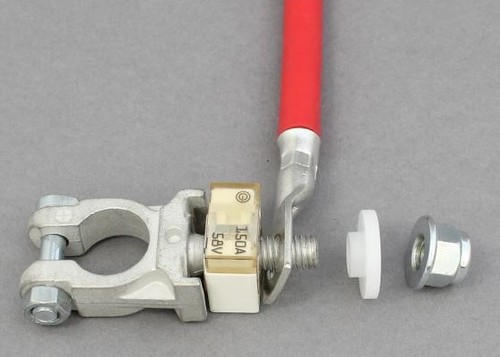
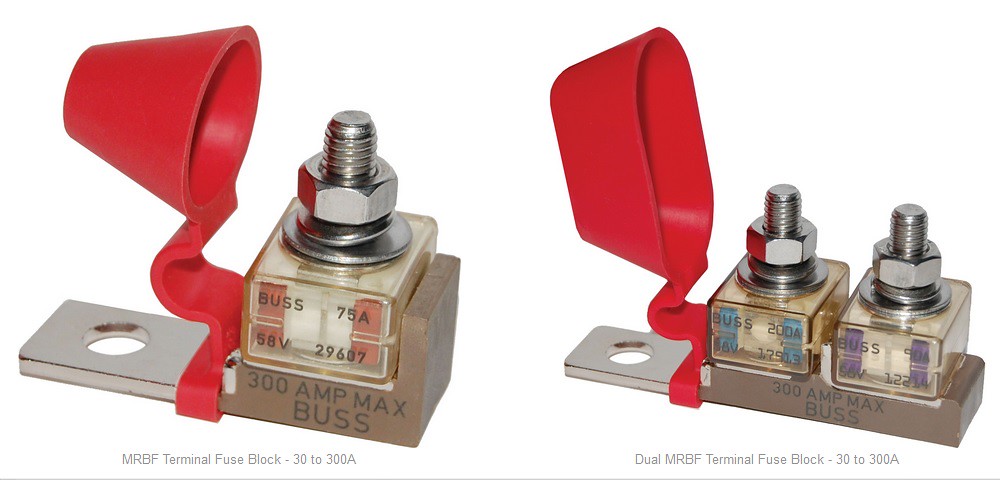
Jim
09-09-2021 #10
Registered User
- Join Date
- Sep 2010
- Location
- Orange County, CA
- Posts
- 675
I haven’t seen those type of fuses before, they’re pretty cool. Thanks
09-12-2021 #11
Registered User
- Join Date
- Aug 2007
- Posts
- 727
When I do a battery in the trunk I use the isolators that require a larger hole. So short run positive and negative to the isolator. Then from under the car along the frame to the starter and the engine or trans with the ground cable. Then from the engine one large ground cable on both sides of the engine to the frame. Also rad support to frame cables.
09-12-2021 #12
Registered User
- Join Date
- Sep 2010
- Location
- Orange County, CA
- Posts
- 675
Clean install! Originally Posted by 79 Camaro

 Reply With Quote