


Results 81 to 100 of 107
Hybrid View


-
10-15-2007 #1

 Rat Pack Member

- Join Date
- Dec 2004
- Location
- Morehead City, NC
- Posts
- 929

I haven't found a mometary switch to be necessary. I just installed this setup on a 502 crate motor. I have oil pressure in about two revolutions. The 502 starts almost instantly.
-
10-15-2007 #2 Registered User
- Join Date
- Mar 2007
- Location
- Florida
- Posts
- 2,391
Talked to the mechanics at the garage next door to my bike shop and they said the same thing. No momentary switch necessary, particularly since that car is carbed and there's plenty fuel in the bowls to fire it up anyway.
01-07-2008 #3
Registered User
- Join Date
- Dec 2005
- Location
- Connecticut
- Posts
- 83
Steve
How did you mount your hand held extinguisher to the seat?
thanks Vin
01-09-2008 #4 Registered User
- Join Date
- Jan 2008
- Location
- Frederick, MD
- Posts
- 70
I have a Firefox 10lb system in my C5. I selected this system because I'm in a closed cockpit and I wanted something that would work in the classes where I want to race (Maxton ECTA standing mile). My car is a street car, so I wanted to be able to keep the install as hidden as possible.
I put the pull near the shifter, so I could reach it with arm restraints (required by class) on me. The hard SS lines are run under the interior trim pieces with 2 nozzles under the dash pointing towards the firewall and 2 nozzles in the engine bay.
I mounted the bottle behind the seats, between the rear rollbar points.
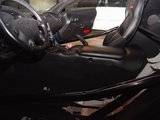
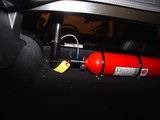
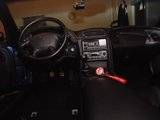

I don't think this system will save my car, but I'm just looking for more time to get out in the event of a fire.-- Wayne - http://www.ls6.net/garage/
-- 1969 Camaro - white/red stripes - LT1/4L60E
-- 2003 Corvette - electron blue - LS2/turbos/6spd
01-09-2008 #5 Registered User
- Join Date
- Apr 2001
- Location
- Rockford Illinois
- Posts
- 3,949
having worked with E stops on machines forever. If it is a push style, it is for certain it will accidentally get pushed

 .
.
Pull is the best way to make sure it is intentional
10-22-2007 #6 Registered User
- Join Date
- Jul 2003
- Location
- Anaheim Hills, CA
- Posts
- 11,967
Got my Safecraft fire system
I got my fire system today but I doubt I will get it all installed by SEMA. Too much to do.
Anyways, it comes with 10-ft of alum tubing hardline. is there a reason one couldn't use a more flexible material like teflon lined braided hose? Seems like it would be easier to route.
Just curious is there's a reason, line flex under pressure? (during discharge)
I also bought thier 1211 Halon 2.5-lb handheld unit.. man, that is one beautiful fire extinguisher.Last edited by Steve1968LS2; 10-22-2007 at 08:37 PM.
"A ship in port is safe, but that's not what ships are built for."
1968 Track Rat Camaro:
https://www.youtube.com/watch?v=SGHJ5c1yLIo&t=2s
1971 Chevelle Wagon with a few mods:
https://www.youtube.com/watch?v=WBVPR3sRgyU
10-22-2007 #7 Registered User
- Join Date
- Aug 2004
- Location
- Red Deer, Alberta, Canada
- Posts
- 1,364

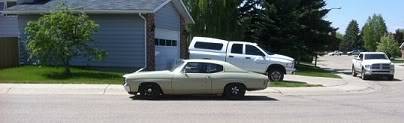
pics
Matt
72 Chevelle 370ci, 76mm single turbo, TKX, Speedtech Track Time, Millerbuilt Strange full floater 9", Brembo brakes, BC Forged 18x11s with 315s square
Instagram: Cst_koon
10-22-2007 #8 Registered User
- Join Date
- Dec 2002
- Location
- Lost Wages, Nevada
- Posts
- 2,683
I've done -4 systems in PTFE stainless (just like the brake hose)... and I think it would work just fine for your application.
10-23-2007 #9
Registered User
- Join Date
- Jul 2003
- Location
- Anaheim Hills, CA
- Posts
- 11,967
Since the new carpet if glued to the tunnel it sorta killed my original routing. Thinking of mounting to the rear roll cage and running the lines down the drivers side rocker channel to under the dash. From there I can go through the firewall. Originally Posted by chicane67
I think I will try to bend the hardline but if I can get it looking beautiful it's nice to know I have another option.
I also need to draw out my bracket to mount the hand held to the front of the passengers seat.
I will post some pics later."A ship in port is safe, but that's not what ships are built for."
1968 Track Rat Camaro:
https://www.youtube.com/watch?v=SGHJ5c1yLIo&t=2s
1971 Chevelle Wagon with a few mods:
https://www.youtube.com/watch?v=WBVPR3sRgyU
11-12-2007 #10 Registered User
- Join Date
- Jul 2007
- Location
- Calgary, Canada
- Posts
- 662
Ordered some Safecraft
Just ordered some Safeguard equipment for FueL. Looks like winter outside so I have some time to install it:
http://www.safecraft.com/index.asp
Model RS5 3 head Pull Cord (two engine outlets, one drivers area)
At3 Automatic (truck/ fuel tank area)
PB2 hand held unit (passenger area mount)
Thanks to Penny/Steve and Chicane67 for all the info in this thread>>
https://www.pro-touring.com/forum/sh...ad.php?t=34996
ALL winter long to wait for the track.... Dave
Dave
FUeL 69 Camaro RS BuilD by G-Force Design & Concept
68 Corvair coupe
65 Impala SS
64 Corvair Rampside
62 Corvair Greenbrier
Asst. daily drivers
http://www.sourceboards.com/
11-15-2007 #11
Registered User
- Join Date
- Jul 2003
- Location
- Anaheim Hills, CA
- Posts
- 11,967
That's exactly what I have. I just need the time to install the big system. Eventually I will have the AT3 auto unit in the trunk
Hey, I came up with a simple bracket for mounding the handheld to the front of the passengers seat. It's a great location. I need to make an adjustment to it and have my waterjet guy punch out a few more. Let me know if you want one."A ship in port is safe, but that's not what ships are built for."
1968 Track Rat Camaro:
https://www.youtube.com/watch?v=SGHJ5c1yLIo&t=2s
1971 Chevelle Wagon with a few mods:
https://www.youtube.com/watch?v=WBVPR3sRgyU
11-15-2007 #12
Registered User
- Join Date
- Jul 2007
- Location
- Calgary, Canada
- Posts
- 662
Been a bit of a set back, they can't ship/export Halon into Canada. Not sure what I should do. I could get the other agent in there, not as good and costs more. Or just wait until I take a trip down to the States and bring it home.
Steve your bracket for mounting, is it to mount the billet mount or did you not get that billet piece?Dave
FUeL 69 Camaro RS BuilD by G-Force Design & Concept
68 Corvair coupe
65 Impala SS
64 Corvair Rampside
62 Corvair Greenbrier
Asst. daily drivers
http://www.sourceboards.com/
11-23-2008 #13
Registered User
- Join Date
- Mar 2007
- Location
- Florida
- Posts
- 2,391
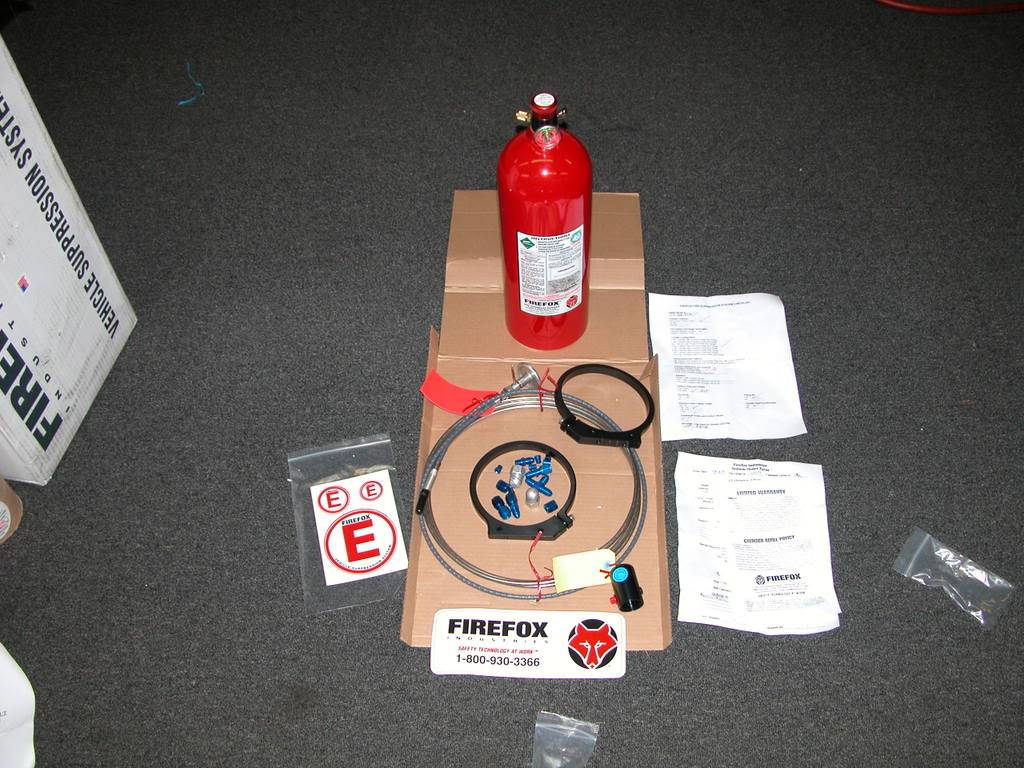
After reviewing as much info as I could find, going through the rulebooks of the sanction bodies I have/will run with, and discussing fire systems with anyone I knew who already had one as well as some tech folks from sanctioning bodies I decided on 2 Firefox systems. While the Halon systems are clean, the sanctioning bodies seem to be leaning toward foam for the future requirements as rules are updated. I had originally thought I'd be using a Halon type system because of the lack of cleaning necessary if the systems ever activated however after my research I decided on a the Firefox setup for my application. http://firefoxind.com/firefox.html While there are other very effective systems in the end it's a personal decision.
The Firefox systems I am installing use a bladder type system using Fire X Plus/Gem Foam. I will have 2 systems in the car. A 6.5 lb. 2 nozzle will take care of the passenger compartment (Kinda overkill) and a 10 lb. 4 nozzle system for the engine compartment and fuel tank/pump area. I will use 2 seperate pull type activators located within easy reach while harnessed in, and accessible by both the driver and navigator. There is a way of using one pull handle to activate both systems however I've decided to run them as seperate systems for a couple reasons with each system being a stand alone system. The systems are about $400.00 and $600.00 respectivly.
If the car ever catches fire and I activate the systems I'll be thinking about how it may have reduced my injuries, saved my life, or preserved my car while complaining about cleaning up the mess. As far as continued operations after a fire occurs and the system needs to be activated? Well if my car catches fire, and it doesn't burn to the ground, I'm gonna call it a day and pack it up in my trailer if I'm at a track event, or call a roll back flat bed tow truck if I'm out on the streets and head home. One car fire a day is my limit!
Here's the 6.5 lb Firefox system
11-05-2009 #14 Registered User
- Join Date
- Oct 2009
- Location
- Houston, tx
- Posts
- 123
Halon system info
Lots of information about Halon systems and I thought I would throw in my $0.02.
Back in the day I was in the army in the mech cavalry. Halon is used as a fire supression system on Bradleys and Tanks. The instruction we recieved is that halon is a colorless odor less gas that is heavier than air. It is usually mixed with a powder so you can see it went of and where it went.
It puts out fires by displacing oxygen and interupting the chain reaction. The old joke was that Halon was designed to save the tank and kill the crew.
I was in a Bradley that got struck by an IED in Iraq in 2005. We had a flash fire that went through the fuel cell and into the ammo box. The halon system kicked on and killed the fire for a few moments. The crew was able to bail out of the vehicle. A few seconds later the fire reignited and burned the Bradley to the ground. Halon is designed to supress a flash fire and get people out. I could still breath, but I was so focused on getting out, I forgot to check to be sure.
If you are in a Bradley they tell you to close the hatches and try to keep the halon in the vehicle, but if the ignition source is still there when the halon displaces the fire will reignite. Halon is designed to save the crew, not the vehicle.
Not trying to tell a war story here, just telling you about being in a vehicle fire when a halon system went off and what my experiences were.David
1968 Camaro in many pieces
11-05-2009 #15
Registered User
- Join Date
- Jul 2007
- Location
- Calgary, Canada
- Posts
- 662
However a good war story! Interesting for sure.
Ultimately I guess if there is a fire, getting out alive is the key saving the car from burning up is secondary. Easy access to your hand held is important, assuming your together enough to get out then fight the fire from the outside.Dave
FUeL 69 Camaro RS BuilD by G-Force Design & Concept
68 Corvair coupe
65 Impala SS
64 Corvair Rampside
62 Corvair Greenbrier
Asst. daily drivers
http://www.sourceboards.com/
11-06-2009 #16
Registered User
- Join Date
- Oct 2009
- Location
- Houston, tx
- Posts
- 123
Pictures of Halon equiped vehicle
Got me thinking about that day, dug up some pictures.
David
1968 Camaro in many pieces
11-06-2009 #17
Registered User
- Join Date
- Jul 2007
- Location
- Calgary, Canada
- Posts
- 662
and what you didn't want to close the hatch and stay in there??? Originally Posted by 1968Maro
 Dave
Dave
FUeL 69 Camaro RS BuilD by G-Force Design & Concept
68 Corvair coupe
65 Impala SS
64 Corvair Rampside
62 Corvair Greenbrier
Asst. daily drivers
http://www.sourceboards.com/
08-10-2012 #18 Registered User
- Join Date
- Aug 2006
- Location
- San Francisco, CA
- Posts
- 808
Hey guys, I found this article on 3M's new "1230" gas....apparently at least a few of the NASCAR teams are using it for their fire suppression...thoughts?
http://solutions.3m.com/wps/portal/3.../PressRelease/
08-20-2012 #19
Registered User
- Join Date
- Aug 2006
- Location
- San Francisco, CA
- Posts
- 808
I really sunk my teeth into this topic in the past 2 weeks, and put together a writeup about this history and science behind fire suppression systems. Fact-checking is most welcome.
History
AJ Foyt's team debuted the first on-board fire suppression system in 1967 at the Indy 500. He used Halon 1301, and it didn't take long for everyone else in racing to adopt the system using 1301. It was the standard for nearly 30 years in almost all forms of professional racing.
Halon 1301 had a big drawback though-that it has to be stored at HIGH pressure to keep it aqueous, which proved problematic in racing applications where heat and other harsh environment factors were causing accidental release failures. This is where Halon 1211 stepped in. With a much lower aqueous pressure and similar suppression effectiveness, it supplanted 1301. Here's the problem with 1211, it’s more toxic to breathe. In toxicology speak, it has a much lower LOAEL (lowest observed adverse effect level) concentration than 1301. Using the SFI 17.1 test procedure for enclosed driver compartments, a 5lb system will net you 12X the LOAEL for 1211, versus 1.7X for 1301. Once the SFI procedure was established and racing governing bodies adopted the standard (ie NASCAR) and saw toxicity ratios greater than 1.0 for both systems, Halons got BANNED. You may see that nearly all rule books today prohibit it.
DuPont, seeking to fill the void in the racing market, began promoting their FE-36 product, which is the trade name for the gas HFC-236fa. It passes the SFI 17.1 toxicity criteria with a ratio of 0.83, doesn't deplete the ozone like Halons (in the 1990s ozone depletion was another nail on the coffin for Halon), and best of all, it puts out fires just like Halons. DuPont's FM-200 (chemical name HFC-227ea) is also SFI tested and passed, and there isn't any meaningful information to distinguish it from FE-36. So what you will find are FE-36 and FM-200 are the DuPont products are on the short list of SFI 17.1 approved suppression systems.
3M is now recently in the racing market (last 12months) with their own gas C6F12O, trade name Novec 1230 which is now on the SFI approved list. Discerning if this gas is any better than the DuPont products is also difficult without really digging into the chemistry. The bottom line is there appears to be no citations of meaningful technical differences among FE-36, FM-200, and 1230, so I'm assuming that most racers will decide based on price points. If someone knows more than me on this please fill in the blanks.
Powder vs Foam vs Gas
This issue really has been the core of the discussion on the forums. I believe we can all agree that there is no bad choice. Even an ABC handheld extinguisher sometimes has its advantages over suppression systems, in that you can fight the fire from outside your car (or in a moment of racing comradery, your competitor's car).
Handheld Extinguisher
Here's a great story from my father, who owns child care centers and transports 14 kids at a time to and from school each day. He has a fire extinguisher mounted in the 15 passenger van on the leg of the first bench seat where the 'big kids' sit. One of the hooligans got bored during the drive one day, pulled the pin out and wanted to see what would happen if she kicked the handle with her foot. It was depressed for at most 2 seconds, but the powder quickly dispersed and FILLED the whole van in seconds. Visibility was 0 and so was breathability...the powder induces heavy coughing and discomfort. Fortunately he was going 5mph in front of a school at the time, came to a stop and everything turned out fine, but it could have been a lot worse. The bottom line is it is really is unwise to try to use an ABC powder extinguisher while you're still in the car. The powder is overwhelming, disorienting, and in most situations probably more of a hazard to your safety than a benefit.
Foam System
There are several SFI approved foaming suppression systems...and since they pass the 17.1 test you can trust that they will do their primary job: giving you time to get out of the car, and secondarily, hopefully stifling the fire sufficiently to allow the fire crew to get there. The distinct shortcoming of a foaming system has already been discussed by many of you-the coverage is not omnidirectional. It simply doesnt propagate like a gas; foam can't be relied on to get in the many hard-to-reach places in a car. The other two concerns are logistical: foam is corrosive...so there is appreciable cleanup necessary to prevent the foam from damaging your car, including the metal itself. In fact, the reason foam systems must be sent back for certification every 2 or so years is to ensure that the coating is preventing a corrosive reaction in the cylinder. The second issue is that foam is a surfactant; it's slippery. Foam on the track has been claimed to be a slipping hazard to the cleanup crew, and a difficult to clean up from the track surface. Whether or not your system wets the track is conjecture, but it is something to know in the decision process.
Gas System
The gas systems mentioned from 3M and DuPont are also on the SFI approved list; but have the reputation that the gases are suffocating. In essence yes, it is not sustainable to breathe the stuff; flourocarbons are bad for you. And I can't tell you from first hand experience what the sensation is to inhale these gases. However, the important takeaway that the suppliers emphasize is that the suppression gases are not replacing 100% of atmospheric air in the car with suppressant. The concentration of a 5lb or 10lb system fully discharged in the cabin is between 10% and 12%, which is all that is necessary to snuff the fire. The design concentration of the system is such that the occupants can remain alert and functional. The SFI criteria takes into account LOAEL levels, so you can expect that the system isn’t going to knock you out. You can see in the video above a validation of this, as the person walks in and out of the test room seemingly unfazed by the room full of the stuff he's breathing.
The design discharge rate of fire suppression systems is targeted between 0.25 and 0.5 lbs per second, which equates to 10 to 20 seconds depending on the number of nozzles used. Until learning of this, I had assumed that supression systems were an instantaneous "dump" of the tank. Also, another debunked misconception is that a 10 lb system does not inject 2x as much suppressant as a 5 lb into the cabin. For reasons of complying with LOAEL levels, the 10 lb system is designed to be plumbed into the trunk area, not to double down on the amount of gas in the cabin. At this point, it is important to consider the importance of a trunk firewall, as it has important implications on the gaseous concentration of the system.
Conclusion
If there's any conclusions I've reached for myself, is that there seems to be a significant racing precedent for using a gas system. I don't plan to hotbox myself to find out for sure, but think I am reassured that the gas systems are designed to keep occupants breathing. I think the real appeal of a foaming system is that the sprayed surfaces stay "wet" which could suppress the fire for a longer time. If fire crews take a while to reach the scene, this could play out to a real advantage in minimizing carnage. However, personally I am more compelled by the lower maintenance of gas suppression systems, and the omnidirectional coverage of a gas filling the car.
I hope this was helpful! Like I said I'm not an expert at this stuff, just fearful of fires and fascinated by the history, science, and design of suppresion systems. Please contribute if you see areas where I missed or am just flat out wrong.
Link to SFI approved fire suppression systems:
http://www.sfifoundation.com/current171products4.pdf
02-02-2019 #20 Registered User
- Join Date
- Apr 2010
- Location
- Jersey Shore
- Posts
- 695
Id like to bump this thread in hopes of getting some setup help... I have a Safecraft LT 5lb bottle of 3M Novitec with 3 nozzles. I havent been able to find a good guide on placement/positioning of the nozzles for maximum effectiveness. I realize this probably varies car-to-car, but at least some general knowledge would be very helpful.
The nozzles in my kit have a 120* spray pattern.
Any pros or cons to mounting with a forward facing spray? Or should they discharge in the down position? My engine compartment (C3 Corvette) is pretty low profile meaning I wont be able to get the nozzle too high up in relation to the engine, fuel pressure reg, oil tank, etc...
For interior placement, the car has a stock style dashboard, is it more common to put a nozzle under the dash in the footwell area? Higher up behind the dash? Ive seen some that dump centrally overhead but I would assume this is not ideal for a gas suppression being the windows will likely be open.
Any info is greatly appreciated!-Chris
'69 Corvette
'55 Chevy Hardtop
AutoWorks Middletown, NJ
@autoworksnj for corvette and shop car pics
https://www.pro-touring.com/showthre...e-Build-Thread

 Reply With Quote