


Results 1 to 6 of 6
Thread: Calc Bar Rate for Rear Sway Bar
-
07-01-2019 #1
 Registered User
- Join Date
- Aug 2004
- Location
- Texas
- Posts
- 327

Calc Bar Rate for Rear Sway Bar
I have a oem a-body rear sway bar and would like to calc the bar rate using this diagram:
But the oem sway bar does not attach the same way. Would I use 5" or 11" for A and C and 33" for B? Bar is 7/8" and I suspect the rate will be fairly low.
-Bob (66 Nova)
-
07-01-2019 #2 -Moderator-
- Join Date
- Apr 2001
- Location
- Central CA USA
- Posts
- 6,114
rear bars that attach to the lower links do not deliver much of their calculated rate, so I don't think you will learn much by doing the calculations. Hellwig makes a rear bar that attaches end links to the chassis and is a better way to go.
David Pozzi http://www.pozziracing.com67 Camaro RS that will be faster than anything Mary owns.
07-01-2019 #3
Registered User
- Join Date
- Oct 2014
- Location
- DFW, Texas
- Posts
- 422
Are you making assumptions for the wall thickness and base material modulus?
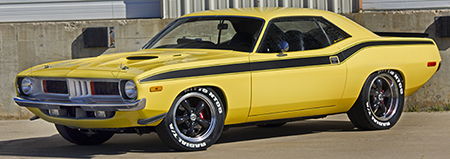
1972 Plymouth 'Cuda - Not LS-swapped, 5.7L Hemi [MS3 Gold Box], T56 Magnum 6-speed - 'Cuda Build Page
1976 Dodge D100 - Warlock
2016 Subaru WRX - E30 Tune
07-01-2019 #4
Registered User
- Join Date
- Aug 2004
- Location
- Texas
- Posts
- 327
I have found several relationships for calculating the rate - they are all the same except for the constants - this one assumes both the bar and arm(s) are steel. The bar is solid so the ID = 0.
David, my application is a street cruiser (this is a 56 Chevy Panel with a triangulated a-body suspension) - just looking to firm up and stabilize the ride - I'm sure its not as effective as an aftermarket style but for my app its probably good enough. Additionally, I'd like to determine the bar rate to help design the front bar. My understanding is, regardless of application, I probably don't want the rear rate higher than the front - is that correct?-Bob (66 Nova)
07-02-2019 #5
-Moderator-
- Join Date
- Apr 2001
- Location
- Central CA USA
- Posts
- 6,114
The trouble is, even with a rear bar rate, you don't know the motion ratio so the rear bar "effective" rate isn't known.
You do want the front bar rate to be higher than the rear.
I would take a guess that the front bar rate should be in the 800 to 1100 lb range. It could go as high as 1500 lbs if you have wide sticky tires an autocross but for a street car with not huge tires you won't need as much bar. That rear bar is delivering less than rated because it's attached to the lower links. Maybe 2/3rds or half of what the bar is rated at. The front bar is also delivering less than rated depending on where the end links attach to the lower A arms.
I'd look at what size bars are used on a Chevelle and size yours to be similar.David Pozzi http://www.pozziracing.com67 Camaro RS that will be faster than anything Mary owns.
07-03-2019 #6
Registered User
- Join Date
- Aug 2004
- Location
- Texas
- Posts
- 327
I've searched a lot for a-body bar rates w/o much luck. I've seen "guesses" of 500 front and 300 rear and oem bar sizes of 1.125-1.25 front and 0.875 rear - all solid bars. Any better info out there?
-Bob (66 Nova)

 Reply With Quote