


Results 1 to 20 of 24
-
08-28-2009 #1
 Registered User
- Join Date
- Aug 2004
- Location
- Dunwoody, GA
- Posts
- 4,983

what carries the weight? lugs or hub?
So I couldn't think of a better title but I'm hoping this gets turned into a fundamental thread that deals with more than just use these adapters or no no you can't use a spacer in this situation.
Here goes. On hub centric rims, is not the weight of the car being transmitted directly to the wheel through the hub and not the lugs? I ask this because there is a lot of confusion over spacers versus adapters and what's appropriate and when. Obviously adapters are better and that's been explained before many times. However, most places(actually so far all of them aside from Skulte) will not make an adapter less than 1 inch thick. So what do the rest of us do that need between 0 and 1 inch spacing? If a spacer was made that was hub centric to the rim and the hub and longer studs were used, why would this not be safe if it was between 1/4 (supposedly the thickest spacer you should run) and just under 1 inch? Of course, I am assuming that the weight of the vehicle is transferred through he hub and not the studs to the wheels. Where am I wrong if I am?
If you want to get personal, I need 1/2 inch of spacing and would prefer adapters since I'm going to a metric bolt pattern but am not finding anyone willing to do this. I'm sitting here thinking of solutions like a good engineering student and am hoping to get more technical than "Oh just get these parts and voila, your problems are solved".
The one solution I am thinking of is to have a precision spacer made and not just use some sloppy universal spacer. To take it even further if necessary, I'm thinking of having a set of 1/2" spacers made that are precise to the Kore3 hubs and the BMW rims but have the lug holes drilled to the tap diameter size for the 1/2" studs I am using. I'd then clamp the spacer to the hub(yes, the brake rotor would be between them) and run a tap through the hub and through the spacer. This would ensure the spacer's threads were clocked correctly with the hubs. Aside from the brake rotor being in there, this would be the equivalent of making the hub 1/2" thicker. The brake rotor being in there is the only point of concern. I don't think that will be an issue though. What say you with more knowledge and experience than I? My situation goes back to the second paragraph though which is much broader and hopefully more meaningful and educational for more people which is what I'm after.
Or in short, what solutions are there for people who need between 1/4" and 1" spacing?Trey
"The early bird may get the worm, but the second mouse gets the cheese."
~ Jon Hammond
1979 WS6 Trans Am stock LT1/T56 drive train out of my Formula. BMW M-parallel rims. C5/C6 brakes
build thread https://www.pro-touring.com/showthre...ghlight=begins
-
08-28-2009 #2 Registered User
- Join Date
- Feb 2008
- Location
- Sesser, Il
- Posts
- 490
I've been looking into adapters myself and although I haven't done any serious measuring yet, I'm looking at somewhere between .75" - 1.25". From what I can gather, the reasoning they can't/won't go any thinner is because of the lugnut cone angle, thickness of material left after the cone, and also thickness of the lugnut securing the adapter to the hub. There has to be enough material between the lugnut and the hubside of the adapter to retain required strength. If you had a lugnut 1/2" thick, and the proper angled cone, that would only leave 1/4" material between the end of the lugnut and the backside of the adapter. I'm no metal expert but that seems awfully thin to me. Granted, it *may* be stronger than I think it is.
I think that may be the reason the thinner adapters are so hard to come by. If that is the case, could they be made from some type of steel for higher strength?
Ideally, you want the weight to be carried by the hub but there are some vechicles or wheel brands that are lug centric. If I can get my needed adapters made, they will be hub centric.Doug Gulley
 66 C10 383, AFR 190, Accel SuperRam, Hyd Roller 230*/236* 280XFI, aftermarket T56, *under construction*
08-29-2009 #3 Registered User
- Join Date
- Oct 2007
- Location
- Newark DE
- Posts
- 238
I was once told you rims have to have dimples on the mounting face to run less then 1.25 adapters.

Here is a place that custom builds what you are looking for.
http://www.motorsport-tech.com/wheel_spacers.html
08-29-2009 #4
Registered User
- Join Date
- Aug 2004
- Location
- Dunwoody, GA
- Posts
- 4,983
You're both right about the adapters. There are holes in the back of the rims that will accommodate the lugs from the adapter.
There has to be a way to make all this work out. I just can not believe there is a gray area where you're screwed. This is too simple to be impossible.Trey
"The early bird may get the worm, but the second mouse gets the cheese."
~ Jon Hammond
1979 WS6 Trans Am stock LT1/T56 drive train out of my Formula. BMW M-parallel rims. C5/C6 brakes
build thread https://www.pro-touring.com/showthre...ghlight=begins
08-29-2009 #5 Registered User
- Join Date
- Dec 2006
- Location
- So Cal
- Posts
- 920
The adapter would have to be made out of heat treated steel to have enough strength. Originally Posted by WS6

You would have to attach it to the hub with flat head screws that could be tightened down properly to give the assembly enough mechanical integrity. This would require tapping threads in the hub for the screws and of course buying some good hardware (socket head flat head screws) to get it on there.
Forget about the need for any kind of clearance in the back of the of the wheel mounting surface lugs or studs, there won't be enough meat in the thin adapter to make use of a stud or lug nut to attach the adapter.
From a pure engineering (I'm not an engineer, but I work directly with them almost daily) standpoint it's easy to see why the makers of these adapters won't offer the thin ones. It's a lot of expense and hassle to get a thin plate in there and attach it in a way that maintains the structural integrity needed to keep a wheel properly attached to a high performance car.
It's not a simple bolt-on deal and there is liability involved for the adapter manufacturer, so nothing thinner than 1" seems quite prudent and practical from their standpoint.
It's certainly not impossible to do, but you'd not only need some pretty robust flat head fasteners to hold the plate to the hub, but also you'd need to use wheels studs that screw directly into the steel plate. And of course machine work that's right on the money.
There would still be a limit to how thin you could make it, about .750" looks to be the limit in my opinion.
The best option is to buy wheels with a little less backspacing, and if necessary you can have the mounting pad on the wheel trimmed a bit (within reasonable limits) to get a perfect fit.
I understand your frustration, hopefully this may help shed a little light on why there are no thin adapters readily available.Bart F.
'64 Tempest - LS3/4L70E - Grandma's Poor-Touring car '64 GTO - 455 HO/TH400 - Ex-bracket racer, street bruiser'02 WS6 convert - LS1/4L60E - Pure stock, pure pleasure
08-29-2009 #6
Registered User
- Join Date
- Aug 2009
- Location
- Little Rock, Arkansas
- Posts
- 6
Maybe this info will help. It is not the hub or the lugs that hold the wheel on when the lug nits are tight; it is the friction of the mounting surface between the wheel and the wheel mounting flange (or brake rotor hat). A lot of aftermarket wheels are lug centric because the larger opening in the wheel allows them to fit a wider variety of cars.
The only time the studs or hub helps to hold the wheel, is when the lugs are loose. Try to run down a rocky road in a heavy truck after loosening the torque on the lugs to finger tight and the wheel will sheer off the lugs and break free of the truck.
The wheel’s leverage to break off the studs increases with spacers in proportion to the thickness of the spacer. The flange on the hub in a hub centric wheel is a safe design that will help keep wheel sheer from happening when lugs are loose.. Aftermarket wheels and wheel spacers/ adaptors remove that safety.
I have seen wheel adaptors made for heavy off road racing 4WD trucks that have a hub lip on the wheel adaptors that fit inside the wheel center bore just like the factory wheel hub flange which retains the safety of the hub centric flange.
!/2” is the thickest recommended spacer for normal driving conditions – IF you also get ½” longer studs. For the autocross, I’d get harder racing studs and lugs if at all possible.
I know that I did not answer your questions directly, but maybe some of this information will point you towards a solution to your problem.
Cody
08-30-2009 #7
Registered User
- Join Date
- Aug 2004
- Location
- Dunwoody, GA
- Posts
- 4,983
You're correct and this is why those normal universal spacers are crap to use. However, my idea is to use a precision made spacer that is hub centric to not only the Kore3 hub but also the rim. I would think this should be a much better design and take away the excess leverage caused by using just spacers typically. In essence it would be equivalent to making a 1/2" thicker hub. The problem is I was not 100% sure that the hub does indeed transfer the weight of the vehicle to the rim and it's not just the lugs. Originally Posted by CadVetteStang
I left something out of my original post by accident. I have 1/2" screw in studs on my Kore3 hubs. I do not have the press in M12 studs. I'm also already running ARP 2-1/2" studs. So my comment about clamping the spacer down to the hub and tapping through the hub and through the spacer would be for the ARP studs not some other bolts.
Thanks guysTrey
"The early bird may get the worm, but the second mouse gets the cheese."
~ Jon Hammond
1979 WS6 Trans Am stock LT1/T56 drive train out of my Formula. BMW M-parallel rims. C5/C6 brakes
build thread https://www.pro-touring.com/showthre...ghlight=begins
08-30-2009 #8
Registered User
- Join Date
- Dec 2006
- Location
- So Cal
- Posts
- 920
Tapping the spacer wouldn't add to the structural integrity of the hub/rotor/spacer as a unit.
The only thing that tapping the spacer would do is negatively affect the ability of the studs to clamp the spacer, rotor and wheel to the hub by not allowing the studs to stretch freely while torquing the assembly down. Threading the spacer would not add strength, it would end up doing just the opposite.
Keeping the wheel on the car is the clamping force of the lug studs. In the case of modern cars that sandwich the rotor between the hub and wheel you're dealing with 4 surfaces being clamped together already (wheel to rotor, rotor to hub) and by adding another item in there you lose clamping ability, now you're trying to clamp 6 surfaces and the holding ability of the fasteners will be taxed. Add in the extra added length of the spacer creating more leverage on the studs and you have a weaker assembly overall.
I know we're not talking drag racing here, but it's not uncommon to see drag cars lose a wheel on the rear when running a wheel spacer between the wheel and the brake drum or rotor. The studs snap right off because they can't clamp those extra surfaces together tightly enough.
Having a hubcentric spacer won't make the whole assembly any stronger when cornering forces are applied that would try to pry the wheel from the hub assembly.
Hubcentric wheels serve to more precisely locate the wheels on center and perhaps add integrity to the assembly by taking some of the brunt when you hit a dip or bump, but the studs or bolts holding (clamping) the wheel to the hub are what really do all the work.
08-30-2009 #9
Registered User
- Join Date
- Oct 2007
- Location
- ridgefield ct
- Posts
- 876
all the lugs do is clamp the rim to the hub. the hub lip is what supports the weight. even if properly torqued the lugs still have vertical forces on them that cause flex and will eventually snap them. i've seen a number of people (kids with imports actually) put on rims with out the right centerbore and no adapter rings and sure enough, they snapped lugs. a number snapped all of them. not pretty!.
 work in progress--for the next 10 years.
1987 monte carlo ss 383ci, 9.7:1, xe274 cam, vortec heads, 200r4, 3.73 posi.
08-30-2009 #10
Registered User
- Join Date
- Dec 2006
- Location
- So Cal
- Posts
- 920
There are plenty of aftermarket wheels out there that are not hubcentric. Having a wheel that's not hubcentric doesn't mean they will fail. Most of the aftermarket wheels offered during the '60s and '70s were not hubcentric, they were made to fit a lot of different cars with a simple bolt pattern change at the time of manufacture.
None of the Centerline wheels made in the late '70s through the early '90s I've used on both GM cars or old air-cooled VWs were hubcentric, none were unsafe nor did any of them experience lug stud or bolt failure or have lug loosening problems.
By design the factory '67 and older 5 on 205mm wide-5 pattern VW wheels can't be hubcentric, the lug bolts alone locate the wheel and keep it in place.
The guys out there snapping lugs and losing wheels are using wheels that don't seat on the hubs properly or are improperly tightened, the wheels not being hubcentric isn't an instant recipe for failure.
I adapted a set of '84 Corvette wheels onto my '66 VW Type II pickup. I redrilled the 5 on 112mm '71 Bus front rotors for the 5 on 120.65mm (5 on 4.75") Corvette bolt pattern and they're not hubcentric either, same goes for the rear drums I redrilled. This truck was my daily driver for over 5 years and I put 90K miles on it, I never had any issues with it and I drove it very hard through the corners every chance I could get.
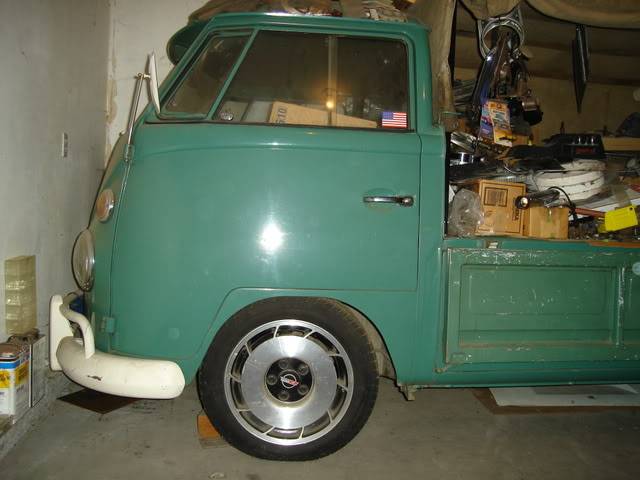
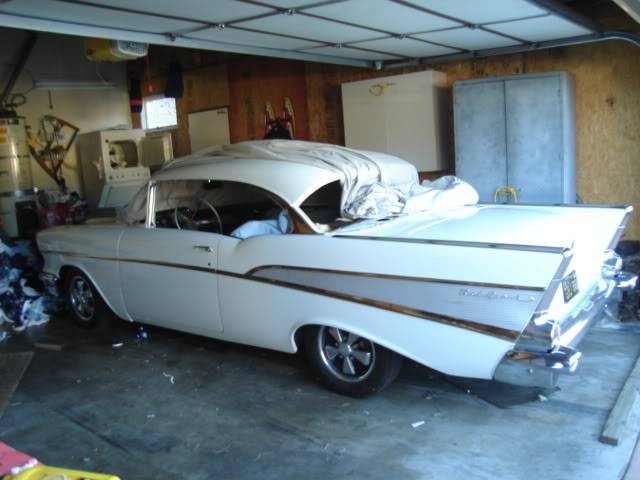
I made the wheel adapters for this '57 Bel Air out of 1-1/2" thick 6061 T6 aluminum plate, so I could run the 5 on 130mm pattern 15 X 5-1/2" early Porsche 911 alloys on it. The adapters are not hubcentric, no problems with them either.
Having hubcentric wheels (or wheel adpaters if you need them) would be ideal of course, but not having this feature isn't a deal-breaker when choosing wheels or a stud breaker either.
08-30-2009 #11 Registered User
- Join Date
- Sep 2004
- Location
- Santa Barbara, Ca
- Posts
- 1,174
Originally Posted by WS6
Trey,
I think you would be totally fine using a hub-centric 1/2" spacer. IMO, adapters are only needed when you need a large spacer. You already have stronger studs and as long as the spacer is made to fit the wheel and hub properly, I see no problem with this at all. I am one of those guys who likes all my wheels to be hub-centric. Having the lugs support the vehicle (while probably fairly safe) doesn't give me much confidence at triple-digit speeds and hard cornering, which is what our cars are built to do.Andy
1967 Camaro RS
Magnacharged LS1/T56
543 rwhp, 516 rwtq
Sold
1968 Firebird
LS427/570 and T56 Magnum
08-30-2009 #12 Registered User
- Join Date
- Jun 2007
- Location
- Oregon
- Posts
- 101
Have you talked to KORE3 about custom hubs. If you are using their brake kit then it should be easy to figure out a way to fit the caliper to the new offset of the brake rotor. So for instance just add 1/2" to the hub face add the correct bolt pattern and the space the caliper a 1/2" out then your done with it.
08-30-2009 #13
Registered User
- Join Date
- Aug 2004
- Location
- Dunwoody, GA
- Posts
- 4,983
Already have the kit and have it installed. Honestly, the issue with the front is rather dumb. I never noticed that all the people running BMW M-Parallels weren't using the center caps and just had the bearing cap sticking out. I'd rather not do this. I'm not even sure I can move the front wheels out 1/2". This will put the 18x8 rims at approximately 4-5/16" BS. I'll need to get the front sheet metal back on first. Right now, I'm just researching and talking. However, my question does help me with the rear for sure as the rear needs a 1/2" less backspacing since the 18x9.5 rim is at 6" BS now. Originally Posted by AButler
Trey
"The early bird may get the worm, but the second mouse gets the cheese."
~ Jon Hammond
1979 WS6 Trans Am stock LT1/T56 drive train out of my Formula. BMW M-parallel rims. C5/C6 brakes
build thread https://www.pro-touring.com/showthre...ghlight=begins
08-30-2009 #14
Registered User
- Join Date
- Aug 2004
- Location
- Dunwoody, GA
- Posts
- 4,983
Thanks b. I appreciate the feedback and info. I'm always still learning. If I am wrong, please explain how and why. Originally Posted by b-man
Trey
"The early bird may get the worm, but the second mouse gets the cheese."
~ Jon Hammond
1979 WS6 Trans Am stock LT1/T56 drive train out of my Formula. BMW M-parallel rims. C5/C6 brakes
build thread https://www.pro-touring.com/showthre...ghlight=begins
08-30-2009 #15
Registered User
- Join Date
- Dec 2006
- Location
- So Cal
- Posts
- 920
1) It really wouldn't make any difference if the spacer was right against the hub or if the rotor was sandwiched between the hub and spacer.
Simply threading the spacer (with the threads tapped 'in sync' with the hub threads) isn't the same as attaching the the spacer to the hub with bolts that can be tightened down.
There will be no clamping with the studs simply threaded through both the hub and spacer, so you're really accomplishing nothing more than you would if you just used a spacer with through holes drilled in it slipped over the studs.
The way you want to do it won't accomplish your goal of making the hub 1/2" thicker and obtaining the same structural integrity as a one-piece hub that's 1/2" thicker.
2) The spacer being hubcentric won't affect the ability of the wheel to stay on the car. The wheel itself needs to be 'locked' (for lack of a better word) onto the hub by being hubcentric to do you any good. Sure, the spacer is better if it's hubcentric, but it's not adding any strength to help keep the wheel on the car.
The spacer is a hinderance, hubcentric or not, to the overall mechanical integrity of the wheel to hub interface. It will put more stress on the studs, as I mentioned above they are now clamping 6 surfaces together instead of just 4. The additional 1/2" of stud length doesn't help, there is more leverage trying to break them off.
The whole issue is you have a spacer that is essentially 'floating' between the wheel and the hub. It's not part of the wheel or the hub, so the spacer being hubcentric won't add integrity like a hubcentric wheel would. If the spacer thickness doesn't prevent a hubcentic wheel from engaging on the hub at the center then at least the hubcentric feature of the wheel can do some good, but again the spacer being hubcentric isn't a big plus for adding strength to the unit.
Threading the spacer to go on with your hub studs won't make it part of the hub, only by literally bolting to the hub (like an adapter) would it be part of the hub or hub/rotor (depending on where you want to put it).
08-30-2009 #16
Registered User
- Join Date
- Aug 2004
- Location
- Dunwoody, GA
- Posts
- 4,983
That makes sense. I guess the ultimate question is, would I be safe using a 1/2" spacer even if it is not as strong as I'd like?
Another option would be for me to thread the M12 holes that are in the hub to accept a bolt. I could then bolt the spacer down using something other than a lug nut like normal adapters. I would think I could find something from ARP that has a small enough head and washer to fit in the bores on the back of the rims. Or bore a small relief for the washer so it sits flush and then it doesn't matter if it's diameter will fit in the bore on the rim. The issue with doing this is I would have to drill five more holes in the rotor. They are steel though. Think this would be safe?
Too bad this does nothing to help the rear out. For the time being, I'm going to upgrade to ARP 7/16" studs. I'm not planning new axles anytime soon. In all honesty, I'm not going to even be pushing the car hard or even driving it much at this point. I just like to do things right the first time.Trey
"The early bird may get the worm, but the second mouse gets the cheese."
~ Jon Hammond
1979 WS6 Trans Am stock LT1/T56 drive train out of my Formula. BMW M-parallel rims. C5/C6 brakes
build thread https://www.pro-touring.com/showthre...ghlight=begins
08-30-2009 #17
Registered User
- Join Date
- Dec 2006
- Location
- So Cal
- Posts
- 920
Attaching the spacer to the hub with bolts (as I explained in my first post here thinking about the possible use of a thin adapter) would be the way to do it right in my opinion.
The spacer would have to be made with a hubcentric center pilot built into it (like on the adapter shown below) in order to to really do the job right.
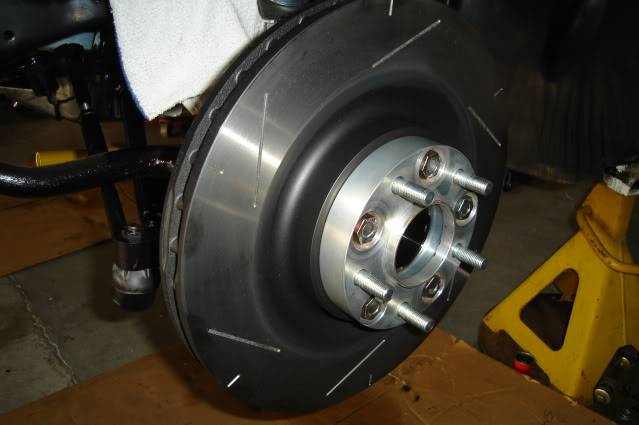
If the hub doesn't protrude far enough through the spacer to let the hubcentric wheel center on it you won't have the best integrity possible.
08-31-2009 #18
Registered User
- Join Date
- Aug 2004
- Location
- Dunwoody, GA
- Posts
- 4,983
The front hub does stick out far and the spacer would be hubcentric for sure. The rear I am not sure of yet how much the hub sticks out from the axle flange. I'll have to look into that.
So you think the front rotors could handle having five more holes drilled into them so I could run bolts through the spacer and into the hub?Trey
"The early bird may get the worm, but the second mouse gets the cheese."
~ Jon Hammond
1979 WS6 Trans Am stock LT1/T56 drive train out of my Formula. BMW M-parallel rims. C5/C6 brakes
build thread https://www.pro-touring.com/showthre...ghlight=begins
08-31-2009 #19
Registered User
- Join Date
- Jan 2006
- Location
- Oregon
- Posts
- 1,773
You can run multiple hole patterns in the rotor without any issues. We do it all of the time on our 5x4.5 and 5x5 kits. Since the rotor is just sandwiched between the wheel and the hub (just like a loose spacer in fact), there really isn't any negative impact to having an additional pattern. In fact, most wheels like the late model wheel shown above with the pockets won't even make contact with the rotors in those locations. The pockets serve to more evenly distribute the contact stresses between the wheel and the wheel mounting surface.
Hub-centricity is a great feature that ensures minimal runnout in any given installation. Most lug-centric applications tend to have a few thousandths of an inch more runnout once properly torqued...and possibly more if not properly torqued in an incremental criss-cross pattern. This is due to tolerance stack-up between the pattern, wheel studs, lug nuts, wheels, etc.
Some cars can be very sensitive to runnout and others not so much. Others have specific design considerations that require hub-centricity for assembly purposes. Those vehicles running wheel bolts instead of studs benefit since it gives you something to align the wheel with while installing the bolts. That said, the only time the wheel studs see any force in excess of the initial preload achieved by tightening the lug nuts to the specified torque is when that preload of the fasteners is exceeded by the loading. The goal of any fastened joint is to never exceed the preload of the fasteners as that's what gives you the longest service life and lowest chance for failure. The wheel studs are in pure tension so long as this remains true, so the whether the spacer and/or wheel are hub-centric is a moot point aside from the runnout benefits during assembly.
Now if you exceed the preload of the wheel studs for any reason, the wheel studs then experience fluctuating loads which can lead to rapid failure. This can be caused by too low of an initial torque, impact loading, too high of an initial torque exceeding the yield strength of the fastener, etc, and that's when you break studs and lose wheels. In my experience, the most common cause for wheel stud failure is either under-torquing or over-torquing during installation. Wheel studs can lose torque/preload as well when mating surfaces "settle" into one another. Any contact stresses in excess of the mating materials yield strengths will cause permanent deformation and potentially a loss of preload. This is why we always suggest running torque-rings/pockets in wheels and wheel adapters as well as rechecking your wheel torques frequently when running new components initially.
Trey, the primary limitation with bolt-on type wheel adapters is that you need room for both the heads of the outer pattern studs and enough room for the lug nuts on the inner pattern. There are several ways to get around both issues, but with standard parts and materials, 7/8" seems to be about the minimum practical thickness for a standard type of adapter. You could swap to steel to get around some of the deflection and fatigue issues associated with going thinner, but you'd still have to deal with the packaging issues of fitting everything in less space.
For just 1/2", I'd probably run a loose spacer that was machined to match the snout of the KORE3 hub with about a +.002" to +.004" slip fit. You've got about 1.15" of hub snout extending past the face of the front C5/C6 rotor, so if the wheels are hub-centric already, then they should remain so with a standard spacer without a hub-centric lip. You can only add a hub-centric lip if the spacer/adapter extends beyond the cylindrical portion of the hub snout.
Tobin
KORE3It's what I does.
08-31-2009 #20
Registered User
- Join Date
- Aug 2004
- Location
- Dunwoody, GA
- Posts
- 4,983
Thanks for taking a look at this Tobin. I greatly appreciate it.
My BMW rims are designed for a hub that has a larger diameter than the snout on the Kore3 hubs. I figured I would have the spacer made up to be hub centric to take up that difference in diameter. Should I not bother?
Thanks everyone. This has been a good learning experience I think with lots of good in depth info.Trey
"The early bird may get the worm, but the second mouse gets the cheese."
~ Jon Hammond
1979 WS6 Trans Am stock LT1/T56 drive train out of my Formula. BMW M-parallel rims. C5/C6 brakes
build thread https://www.pro-touring.com/showthre...ghlight=begins

 Reply With Quote



