


Results 1 to 4 of 4
Thread: brake line size
-
09-21-2008 #1
 Registered User
- Join Date
- Jul 2006
- Location
- Hackettstown, NJ
- Posts
- 1,026
brake line size
I'm doing the brake lines on my 78 t/a and typically I use 3/16" tubing. I noticed on some used mock-up parts that the rear line on the stock application (astro van m/c & prop valve) has a 1/4 line going to the rear. I checked an 81 4 wheel disk t/a and a 74 t/a and they too have a 1/4" ling from the prop valve to the rear junction where it then turns into 3/16".
the question is: why can't I run 3/16" line from the m/c to the rear flex hose? Also, is the rear feed line always the front line from the m/c?
my setup at the moment is as follows
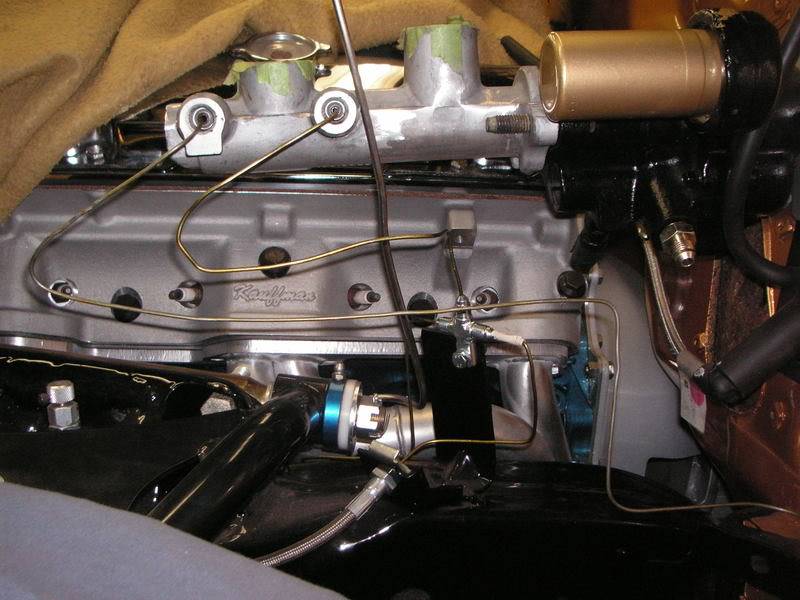
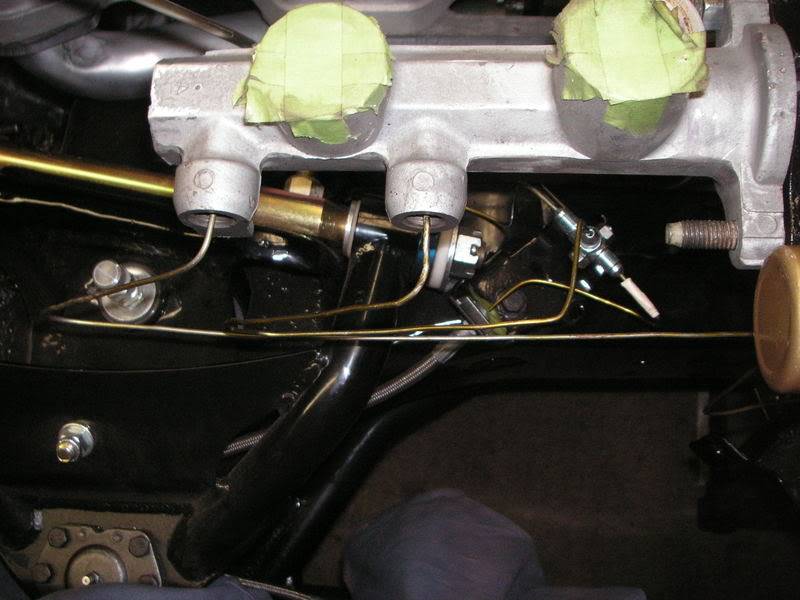
hydroboost and m/c ( 1.25" bore) from 95 astro van. 3/16" line from m/c (rear port) to Tee fitting feeding the front calipers via 3/16" line. 3/16" line from m/c (front port) to adjustable pressure valve (typical in/out knob style) and then to the flex hose on the rear axle.
I saw this on a chevelle and the owner said it worked ok. it looked clean too.
is my current setup ok or should I run 1/4" line to the rear?
here are some mock up pictures. the rear adjustable valve would go in the front line just as it passed the second line. that is if I have teh front and rear line correct. hangers - not just a contraceptive anymore.
-
09-21-2008 #2 Registered User
- Join Date
- Dec 2002
- Location
- Lost Wages, Nevada
- Posts
- 2,684

The answer will depend on your rear brake system. What is that exactly ??
Since Ill be gone all week, Ill just throw this in now. If you are running rear disk brakes... I would run 3/16"... if you are running a drum rear... I would run 1/4".
This is a "pressure to volume ratio" issue. With rear drums you needed that extra volume to move the large bore cylinder in the drum... and... you also needed that volume to actuate the drum mechinism... which requires more mechanical movement than that of a disk brake.
With the adjustable valve... I think you'll be good to go with 3/16" front and rear... as long as the rear system is disk.
09-22-2008 #3
Registered User
- Join Date
- Jul 2006
- Location
- Hackettstown, NJ
- Posts
- 1,026
the brake setup is regular C5/C6 vette disk on all fours. however, in the future I may step up to a set of alcons or some monoblock setup.
I originally thought that the 1/4" line was for drums, but then my 81 rear disk t/a also had a 1/4" rear line. that threw me off. could have been a production thing as it would be cheaper to run the same line on all applications.
based on your replay and my fluid dynamics/ mechanics knowledge, the 3/16 would generate higher pressures. also lets volume. should the rears lock up too quickly, I could adjust the volume of fluid w/ the valve thus reducing the pressure. that is if I was awake that day in class and retained the proper information. I did pass and graduate though
09-22-2008 #4
Registered User
- Join Date
- Jan 2006
- Location
- Oregon
- Posts
- 1,773
I'm thinking it was just cheaper to run the same thing in both the drum and disc applications since the 4-wheel disc cars were the minority with respect to production numbers, but that's just a guess on my part.
Line diameter however doesn't effect pressure or volume when assuming an incompressible fluid...which we always do, otherwise the calculations get flat nasty. Expansion/deflection is simply a function of the internal hoop stresses (sigma) in the thin walled tube, as defined by the relationship between the pressure (p) and the radius (r) of the tube versus it's thickness (t); sigma = pr/t. As pressure or radius increase, so does the hoop stress and therefore so does the deflection given the properties of the tubing material. Stainless is more rigid than steel is more rigid than copper etc.
Larger lines do have more compliance due to increased deflection, defined in technical terms as a "squishy" pedal. That said, the line size is independent of the volumetric flow rates and pressures as generated by any given MC/caliper combination. For a given system, the only thing changing the line size will have an effect on is overall system compliance (which ideally you want to minimize for tunability and consistency) and fluid velocity due to constant volumetric flow rates and differences in cross-sectional area.
I feel like I'm back in my fluids class...where's my nerd hat? :P
Tobin
KORE3It's what I does.

 Reply With Quote