


Results 1 to 7 of 7
-
07-23-2024 #1

 Registered User
- Join Date
- Sep 2009
- Posts
- 2,997

Looking for Advice Building a Triangulated 4 Link; 1955 Nomad
Hey guys,
I'm looking to change things up on my car and have come to realize that this may be an opportunity for me to go away from the stock leaf spring rear suspension. There are really two things that I would like to accomplish by doing this swap. First and foremost is to improve on the ride quality of the rear suspension, secondly I want to upgrade the weak factory rear end. I have some unknown rear leaf springs and stock Monroe shocks on the rear along with some home made rear shackles. My initial plan was to inboard the shocks for bigger tires down the road, upgrade the very weak factory 55P rear end and drop the rear a few inches. I'm planning on a 9" mostly because I've never had one before. But after thinking about the fabrication work that it's going to take to inboard the springs, I may want to upgrade them as well. After shopping around for a pair of drop leaf springs, I started checking out what triangulated for link kits were out there. I've seen some pretty decent looking kits out there, but have also considered building my own because it's something I've always wanted to do. If I did decide to go that route, I was hoping that someone could provide me a good starting point with articles that I could read. I don't mind doing some homework to figure out what will work best for me.
As I was looking around, I did see a few Jeep JK brackets that had dual mounts upper and lower in one nice bracket that could be welded to the inner frame. Not sure about any of the measurements needed, but one of the first things that I noticed was that the frame mounts were very close together on the off-road stuff whereas all of the performance street kits seemed to have a higher upper mount. Not sure if that is a product of packaging or suspension optimization, but just an observation.
Another thing that I had considered was using one of those frame pocket kits for when guys inboard the springs, but use that as the lower mount straight back to the rear. Would provide a strong mount and a nice line back to the rear end. Then all I'd have to worry about is the upper and how I wanted to mount that.
The biggest thing that I don't want to lose sight of is that this car is a cruiser and I want to keep it that way. I'm hoping that after the 4 link kit is built, that I can find some coil over shocks that will give a nice ride. This car will likely never see an autocross track, but I have never taken a car down a drag strip and would like to give that a try. But again, not building the suspension for that but it would be nice to have a suspension that would hook well when I want to.
Thanks,
Ryan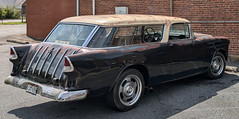
1955 Nomad project LC9, 4L80e, C5 brakes, Vision wheels
1968 Camaro 6.2 w/ LSA, TR6060-Magnum hybrid and etc SOLD
1976 T/A LS1 6 Speed, and etc. SOLD
Follow me on Instagram: ryeguy2006a
-
07-23-2024 #2
Registered User
- Join Date
- Aug 2007
- Posts
- 738
So on my 98 Wrangler with a LS6/4L60E swap I used a Explorer 8.8 rear end.
I used JKS adjustable upper and lower control arms for both front and rear designed for the Wrangler. Made adjusting the pinion angle a piece of cake.
Maybe they would work for your project?
Just a thought?
07-23-2024 #3 Registered User
- Join Date
- Nov 2006
- Location
- Mountain Springs, Texas
- Posts
- 4,870
I put one of these under my 57 Buick wagon. Not cheap but I trust DSE to supply decent bushings etc with their stuff and I like the swivel link ends. Unfortunately no miles on it yet.
https://www.detroitspeed.com/product...ar_suspension/
Don1969 Camaro - LSA 6L90E AME sub/IRS
1957 Buick Estate Wagon
1959 El Camino - Ironworks frame
1956 Cameo - full C5 suspension/drivetrain
1959 Apache Fleetside
07-24-2024 #4
 Registered User
- Join Date
- Sep 2010
- Location
- Beach Park IL
- Posts
- 3,048
I am a big fan of the DSE Swivel links. Packaging a proper panhard bar in a Nomad is difficult.
Where are you located? I got a 55 Chassis that we just took out of a car that is already 4 linked with a 9" and ridetech coilovers. ridetech control arms in the front with coil overs, Baer brakes all around, exhaust and LS headers. The only problem is that it has a garbage rack and pinion conversion on it and all the brackets for that are welded in, so you would have to cut that off and get a steering box and all the linkage......or just swap the parts to your chassis and sell of the frame rails.Donny
Support your local hot rod shop!
07-26-2024 #5
Registered User
- Join Date
- Sep 2007
- Posts
- 459
Triangulated 4-links are popular but they aren't ideal.
Fabricating from scratch . . . my first choice would be a 3-link + watts or panhard. The geometry is a bit more straightfoward to understand & tune. And the control arm bushings don't bind up as much.
Not to say a triangulated 4-link is bad. It isn't. A well-sorted one is definitely a step up from factory leafs.
The only leaf-spring cars with decent rear suspensions were the muscle Mopars. Those were different from Ford & GM leafs at the design stage.
07-31-2024 #6
Registered User
- Join Date
- Sep 2009
- Posts
- 2,997
Thanks for all of the input! I'm trying to wrap my head around the whole process and figure out what calculations I'll need to make in order to get this setup properly. Is there a site or other reference material that will allow me to calculate how long my lower and upper links should be? As well as things like instant center and other things that I'll need to take into consideration?
I'm not dead set on a triangulated 4 link, but like someone said take a step up from leaf springs without compromising on the current ride quality.
1955 Nomad project LC9, 4L80e, C5 brakes, Vision wheels
1968 Camaro 6.2 w/ LSA, TR6060-Magnum hybrid and etc SOLD
1976 T/A LS1 6 Speed, and etc. SOLD
Follow me on Instagram: ryeguy2006a
08-04-2024 #7
Registered User
- Join Date
- Sep 2007
- Posts
- 459
It's a complicated subject and I'm not sure what the best online reference is.
The Herb Adams "Chassis Engineering" book covers a lot of basics, although it's not a perfect bible on the matter.
The big real-world advantages of going to a linked setup are these things:
#1 - Losing the unsprung weight of the leaf springs.
#2 - having the rearend's location/movement controlled better with rigid arms.
#3 - being able to set the rear suspension geometry (squat, roll center, etc) to shapes that are not possible with leafs.
The drawbacks are the added complexity. If you don't design it reasonably well then it can be a real mess, just because your options are wide open.
Things to understand:
Side-view swing-arm length.
Anti-squat.
F/R roll centers & roll axis.
It's like with a lot of customized designs - if your setup looks very different from the common OEM versions then you should start getting suspicious. There may be a problem you are missing.
Also, polyurethane bushings are a mixed bag with these linked axle setups. The common factory designs RELY ON rubber bushings to absorb a certain amount of misalignment & twist as the control arms swing. The engineers were banking on that flexing rubber being there to deal with it. Polyurethane cannot stand being twisted the way rubber can, and that's a liability in applications like this. Poly bushings function more like a soft block of wood than rubber. Aftermarket swivel links on control arms are popular for this reason.

 Reply With Quote