


Results 1 to 20 of 29
Thread: Backpressure issues w/Hydratech
-
01-18-2012 #1

 Registered User
- Join Date
- Dec 2004
- Location
- charleston, SC
- Posts
- 853

Backpressure issues w/Hydratech
If it's not one thing it's another. Have a Hydratech booster to go along with my Wilwood 1.125 master cylinder. The problem is 5 seconds after I start the car, the brake pedal lowers about 3 inches and applies pressure. Enough pressure that you have to really push to turn the front wheels when raised in the air. I went over the instructions again today and all the hoses are run to the correct ports. I do have a fluid cooler. It is a 2 row single pass with the outlet going back to the power steering pump reservoir. It seems the entire system becomes pressurized. Taking the cap off of the power steering pump is akin to taking the cap off of the radiator. It is a stock pump for the LS1. I've call and talked to Hydratech. He was real helpful and will call him again tomorrow. I just wanted to see if anyone else had run into the same problem. I'm hoping I don't have to take the unit off and send it in for repair/rebuild.
Robert's 1969 Camaro - 2002 LS1/T56, 10pt cage, Global West Stage III front suspension, HTH truck arm rear suspension, Sprint Cup 9" full-floating rear end, Fikse Mach V 17" up front 18" in the back and still working on it...
-
01-18-2012 #2 Registered User
- Join Date
- Dec 2002
- Location
- MusicCity
- Posts
- 477
Hi Robert - Back pressure is the key to this discussion. The low pressure return line from the hydraulic brake assist unit must vent to atmospheric pressure when you let your foot off of the brake. Excessive low pressure return line back pressure will cause brake self apply, whether it is due to the method of plumbing and / or a PS pump cap that is not venting properly. If it is a PS cap that is not venting properly, the problem will immediately dissipate if you release the pressure built up in the PS system by cracking the cap loose once warmed up. Blowing off the thermal expansion pressure when hot will determine if this is the case - pop the cap loose = problem goes away. If the problem persists after popping the PS cap loose (to vent off pressure caused by thermal expansion in the PS system), then it is not where your issue is. If the pedal is self applying when the engine is running, kill the engine. If the pedal comes up to a fully released position when you kill the engine, then this means that you have excessive back pressure on your low pressure return line (going from the low pressure return line nipple on the brake assist unit back to the PS pump reservoir). In speaking with Jim earlier, I'm sure that he coached you to run a low pressure return line bypass test.
Here are the test procedures:
Excessive back pressure in the brake assist unit’s low pressure return circuit can cause PS system overheating and brake self apply. A quick test you can run to rule out restrictions or problems in the low pressure return line plumbing if you are running a T fitting arrangement: Place a towel under the brake assist unit to catch any PS fluid, then disconnect the low pressure return hose from the brake assist unit's low pressure return nipple and temporarily plug this hose. Then perform a complete bypass of the low pressure return line circuit by connecting up a suitable temporary hose to the brake assist unit low pressure return line nipple, and then running the other end of this hose either into the "mouth" of the PS reservoir or into a windshield washer jug. The only time you will see any real flow from the low pressure return nipple on the brake unit is when you are releasing the brakes, at which time the brake unit will exhaust roughly a couple tablespoons of PS fluid. When your foot is not on the brake, there should only be a drip, drip, drip (if anything at all) coming out of the brake unit's low pressure return. If you find the PS system does not heat up anymore and basically acts in an improved fashion, then this indicates that there must be a bottleneck or restriction of some sort in the low pressure return line plumbing that must be reworked to remove restriction as needed.
Note that you must also verify that your PS fill cap is of a vented design. If the PS fill cap is not vented, pressure will build up inside of the power steering system due to thermal expansion. This pressure will exert pressure against the back side of the power output piston inside of the brake unit, and may cause the brakes to start self applying as a result when warmed up. If you should experience this, pop the PS cap loose – if you hear a release of pressure similar to opening a carbonated beverage and the brakes are no longer dragging / self applied, then this indicates that your PS fill cap is not venting to atmospheric pressure. The obvious fix here would be to replace the cap with a vented design, though some have also found their success in using a pin drill to carefully provide venting.
If you still have brake drag even with the PS cap cracked loose, and the engine is off, then you may have a clearance issue with the Wilwood MC - more on this here:
http://www.lateral-g.net/forums/showthread.php4?t=17060
"ADVANCED TECH: We have observed that this Wilwood MC pushrod slug or spacer bullet has some mild innaccuracy to it from MC to MC, so double check that there is no MC piston preload by sliding this bullet into the MC, then placing the MC up against the face of the hydraulic brake assist unit. You should then experience a perfect MC casting to brake assist casting fit without any preload - if the MC seems to be floating off of the face of the brake unit casting (to where it would seem like you would want to draw the MC snug to the face of the brake unit by tightening down the MC mounting bolts), you should first double check that you do not have the brake pedal rod adjusted up to aggressively under the dash (back it off some if in doubt or disconnect the clevis at the brake pedal temporarily). If you still have the MC floating off of the face of the brake unit casting, coax the Wilwood spacer bullet back out of the MC (compressed air works well) and then grind the end of the spacer slug a few thou at a time and recheck. Continue to buzz the slug until you are confident that you have acheived a +/- .010" MC pushrod interface - essentially sneek right up to the point where you have just eliminated any MC piston preload when bolted up to the face of the hydraulic brake assist unit. If you had to err in either direction, you would be better off to have a slight air gap between the tip of the MC pushrod and the spacer slug - try to keep this at a .025" MAX. You can use some white lithium grease or suitable other material to see if / how the two interface for clearance (Plastigauge is going a bit into the splitting of hairs that isn't truly necessary). What we are really looking to do here is to insure that the MC pistons are allowed to go into a full definite state of release when the brakes are not applied. Excessive MC piston preload can cause delayed brake release in borderline cases, full on brake lockup when hot in sever cases (due to brake fluid thermal expansion just like engine coolant)."
An overfilled master cylinder can also cause brake drag when hot. Make sure that your brake fluid level is only 3/4 of the way full in the fluid wells of the master cylinder. Brake fluid expands when hot just like engine coolant does, and needs an air gap in the MC fluid wells to accommodate this.
There are also many times where a cooler installed into the PS system will actually cause back pressure, creating heat and overall PS system woes when it does not flow properly. I know this may sound 'backwards', though a restrictive PS cooler can cause more harm than good (which is why we suggest the use of a trans cooler as opposed to a PS cooler) - more on this here:
https://www.pro-touring.com/showthre...boost-on-track
Rest assured that there is nothing wrong with the brake assist unit, and there will be no need to have to yank it back off and send it in. All of our systems are very thoroughly tested for proper operations before and after production to insure perfect operations. A minor change in the PS system plumbing is all that is needed. Do please follow up with Jim once you have performed the low pressure return line bypass testing.
Thank you for choosing Hydratech - you can always count on our full support. There IS a difference - Thank you for choosing Hydratech!
Paul M. Clark
Founder / Master Engineer
Hydratech Braking Systems ®
www.hydratechbraking.com
01-19-2012 #3
Registered User
- Join Date
- Dec 2004
- Location
- charleston, SC
- Posts
- 853
Thanks for the feedback. I am always impressed by your level of service to your customers. We took the power steering reservoir cap off and then started the car, but with the same results. I will try to put up some good pictures later on to show the routing. Thanks again for your help.
Robert's 1969 Camaro - 2002 LS1/T56, 10pt cage, Global West Stage III front suspension, HTH truck arm rear suspension, Sprint Cup 9" full-floating rear end, Fikse Mach V 17" up front 18" in the back and still working on it...
01-20-2012 #4
Registered User
- Join Date
- Dec 2004
- Location
- charleston, SC
- Posts
- 853
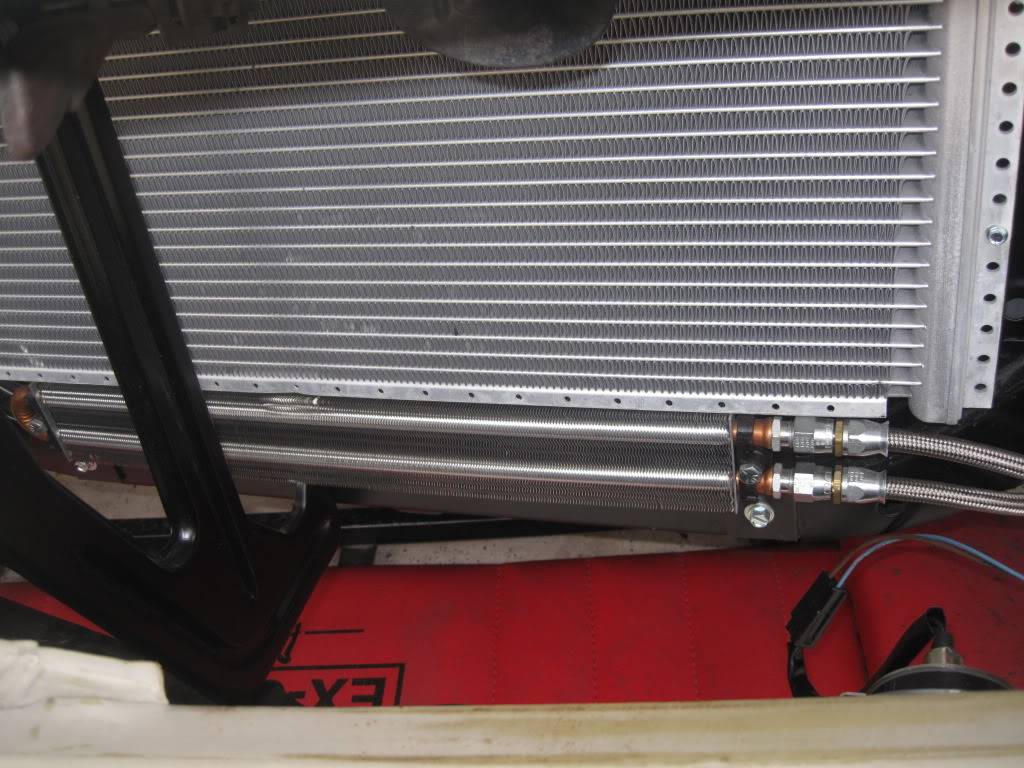
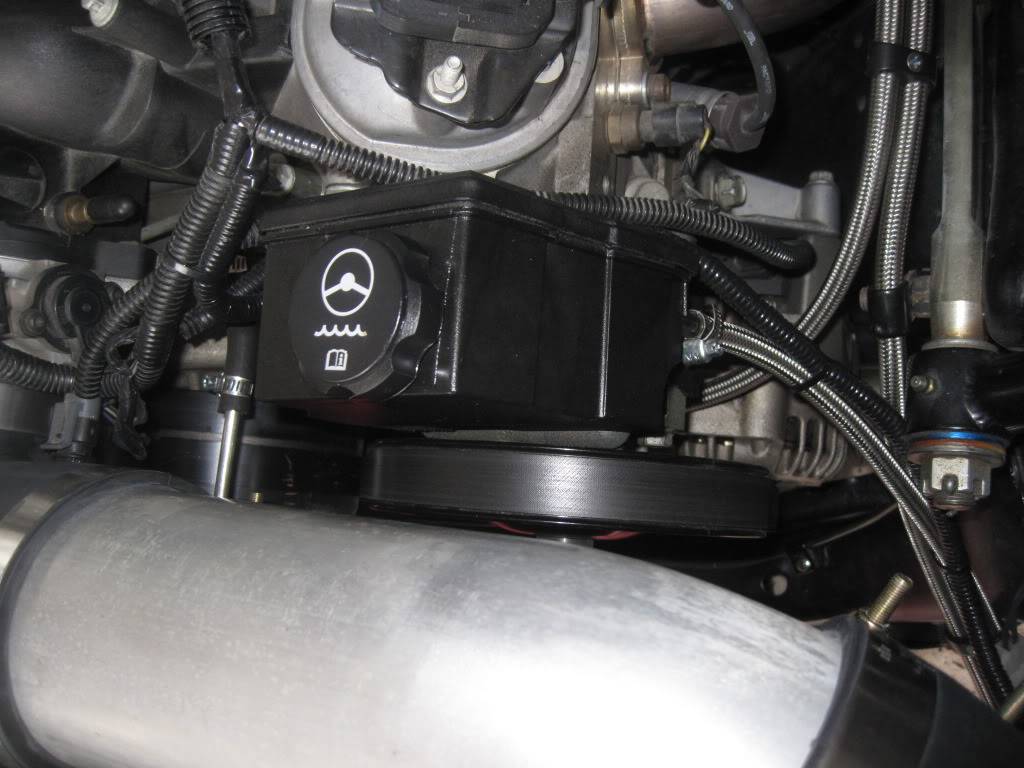
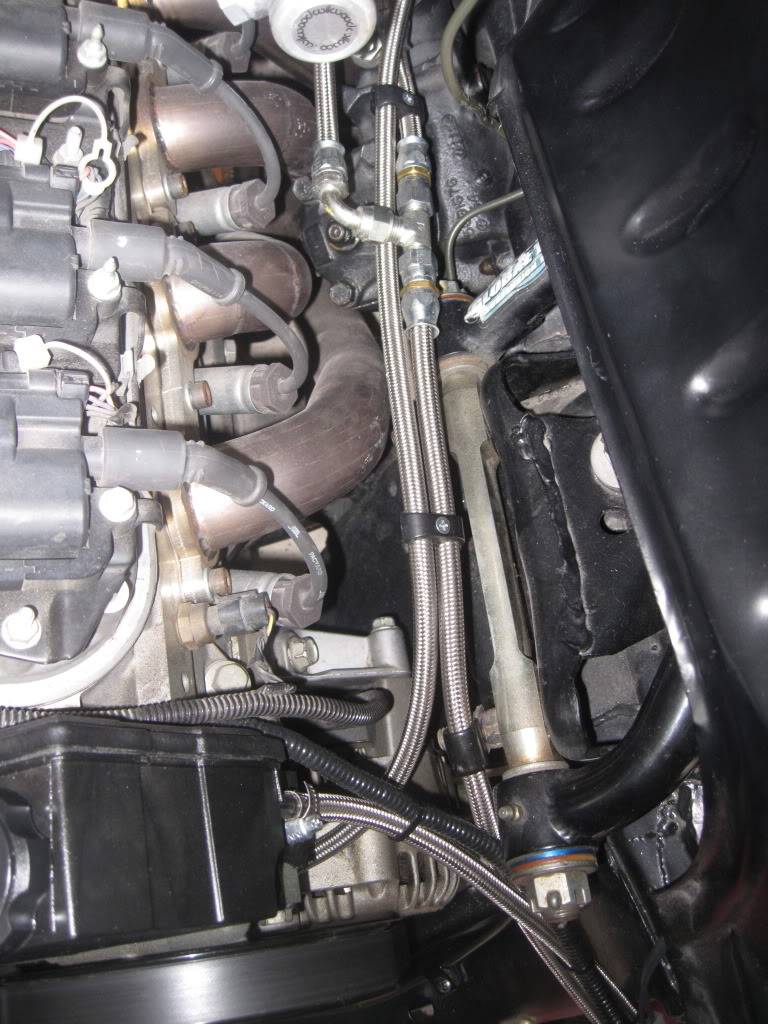
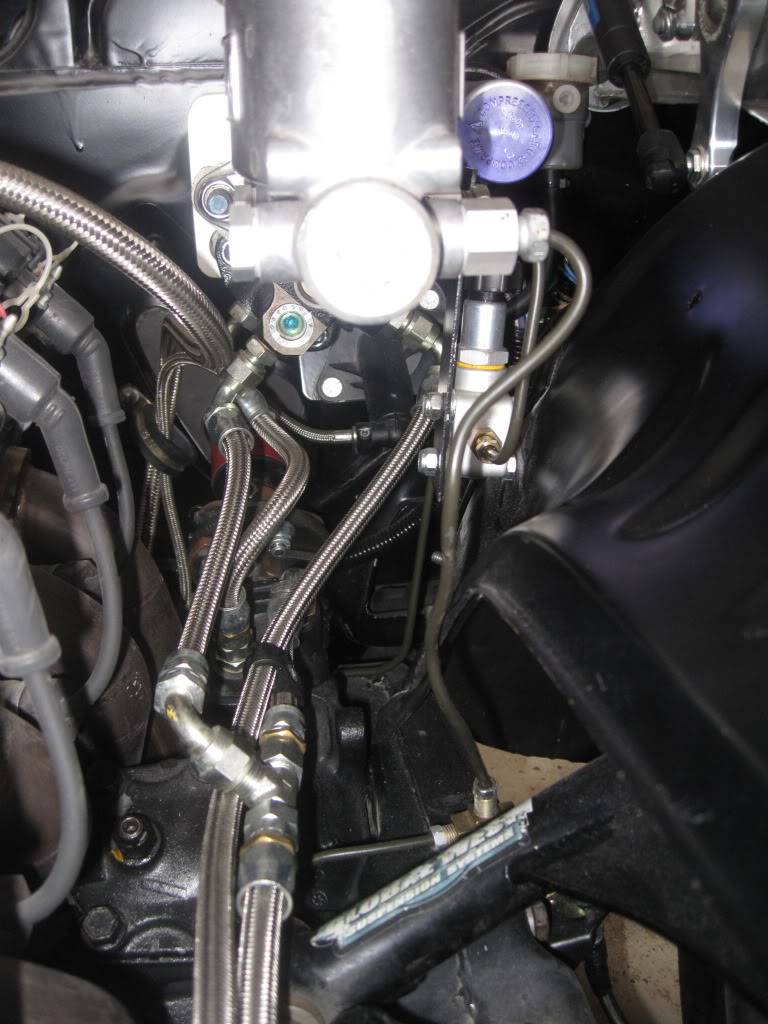
Ok, here are some pics of the routing...
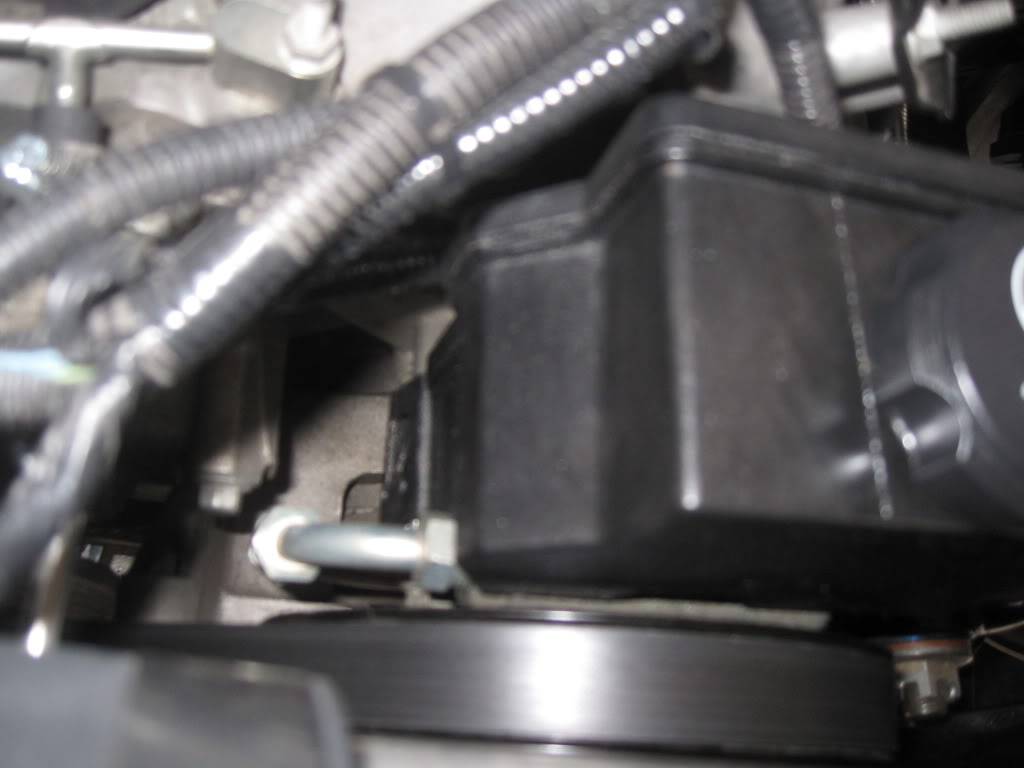
The fluid cooler
 Robert's 1969 Camaro - 2002 LS1/T56, 10pt cage, Global West Stage III front suspension, HTH truck arm rear suspension, Sprint Cup 9" full-floating rear end, Fikse Mach V 17" up front 18" in the back and still working on it...
01-20-2012 #5
Registered User
- Join Date
- Nov 2004
- Location
- Tupelo,MS
- Posts
- 22
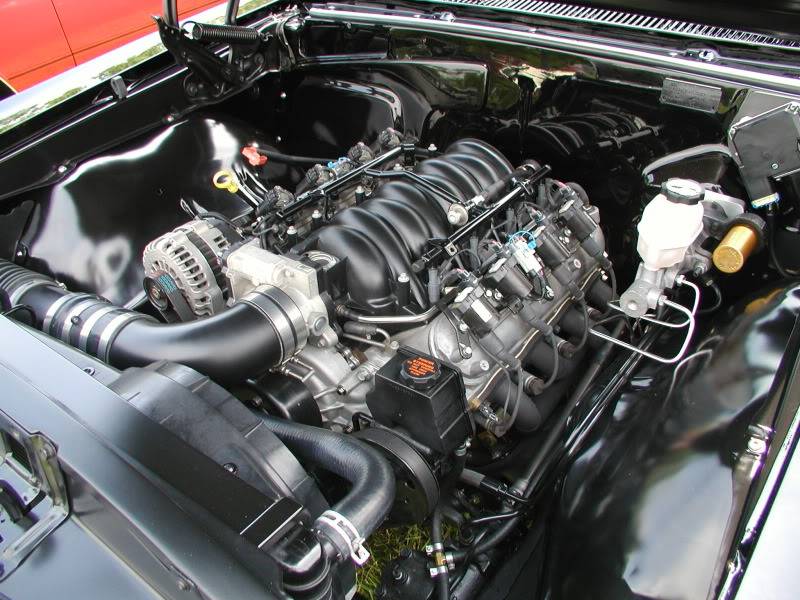
I had my low press return "T"ed into the line between my steering gear and cooler and was experincing
simular problems you describe. I moved the Tee to the line between the cooler and reservoir and solved my problems. Has worked great since, over 6000 miles. I'm also using a stock LS1 pump, although I may
have a different cap than you. The temporary bleed line that Paul mentioned sounds like a good way to
check.
01-21-2012 #6
Registered User
- Join Date
- Dec 2004
- Location
- charleston, SC
- Posts
- 853
Thanks for the tip. I may end up trying that. Great looking engine bay you got there!
Robert's 1969 Camaro - 2002 LS1/T56, 10pt cage, Global West Stage III front suspension, HTH truck arm rear suspension, Sprint Cup 9" full-floating rear end, Fikse Mach V 17" up front 18" in the back and still working on it...
01-23-2012 #7
Registered User
- Join Date
- Dec 2002
- Location
- MusicCity
- Posts
- 477
Your plumbing work looks good, though you still need to run the low pressure return line bypass test. The cooler you have installed looks very generous and unrestrictive, though some coolers have "turbulator" spirals inside that can induce restriction to flow. I have also seen the injection molded low pressure return nipple on the plastic PS reservoir with an inadequate inner diameter that can bottleneck return line flow. Running the low pressure line bypass test holds the key to see where we're at. If the brakes stop self applying when the temporary bypass is in place, we'll have to hunt down where the restriction is and correct it. Introducing a bulk head adapter into the side of the reservoir (to provide a dedicated / independant low pressure return point from the brake unit) will cure any backpressure issues to the brake assist unit, though you'd still want to relieve any backpressure between the steering gear and the pump housing (as the PS pump will always be straining to function against the restriction between the steering gear and the PS pump housing return).
Here is some further reading:
http://www.lateral-g.net/forums/showthread.php4?t=15052
An image of the Russell 670850 AN-6 bulkhead adapter installed into the side of the reservoir:
http://www.lateral-g.net/temp/hydratech_return_line.jpg
We have also solved some backpressure issues by slowing the PS pump flow down a bit, as some of these LS pumps flow like mad. If you tame the flow down a bit, you also slow overall flow through the system which eases up the backpressure (caused by high flow rates). I believe Detroit Speed and Engineering has a replacement PS pump output fitting for your pump to bring it down in flow, www.pscmotorsports.com is also another highly recommended source for a replacement pump output fitting. Here is yet another really cool way to introduce a knob adjustable pump control:
http://www.lateral-g.net/forums/showthread.php4?t=29580
Jim will call you tomorrow to discuss further.There IS a difference - Thank you for choosing Hydratech!
Paul M. Clark
Founder / Master Engineer
Hydratech Braking Systems ®
www.hydratechbraking.com
01-23-2012 #8
Registered User
- Join Date
- Dec 2004
- Location
- charleston, SC
- Posts
- 853
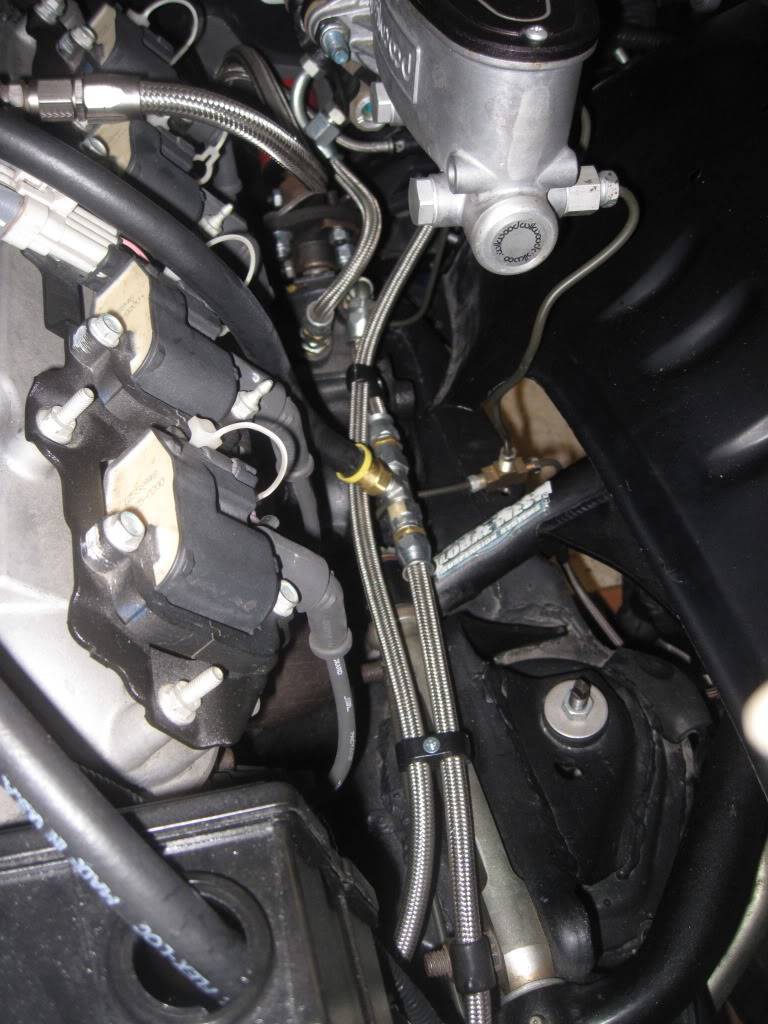
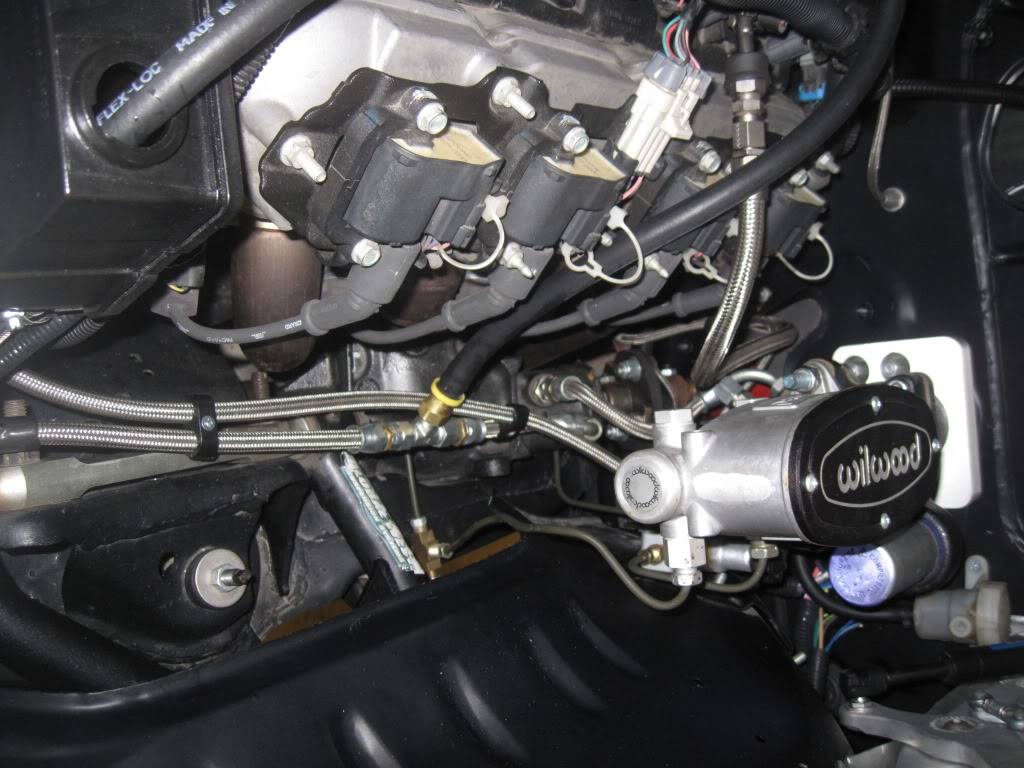
Here's some pics of my bypass setup. We will try it out tomorrow to see if it makes a difference.
 Robert's 1969 Camaro - 2002 LS1/T56, 10pt cage, Global West Stage III front suspension, HTH truck arm rear suspension, Sprint Cup 9" full-floating rear end, Fikse Mach V 17" up front 18" in the back and still working on it...
01-23-2012 #9
Registered User
- Join Date
- Dec 2002
- Location
- MusicCity
- Posts
- 477
The bypass test is exactly the other way around. Put the AN-6 nipple cap on your T fitting, and put the rubber hose onto the brake assist unit's AN-6 nipple.
There IS a difference - Thank you for choosing Hydratech!
Paul M. Clark
Founder / Master Engineer
Hydratech Braking Systems ®
www.hydratechbraking.com
01-24-2012 #10
Registered User
- Join Date
- Dec 2004
- Location
- charleston, SC
- Posts
- 853
Will do. Thanks. Glad I bought a long enough length of hose.
Robert's 1969 Camaro - 2002 LS1/T56, 10pt cage, Global West Stage III front suspension, HTH truck arm rear suspension, Sprint Cup 9" full-floating rear end, Fikse Mach V 17" up front 18" in the back and still working on it...
01-24-2012 #11
Registered User
- Join Date
- Dec 2004
- Location
- charleston, SC
- Posts
- 853
We switched the cap and the line as instructed. The brakes did not engage as I started the car. They worked as I applied the brake pedal and then released when I let off of the pedal. One question, what size lines do you guys recommend? All of the lines in the system are 4-AN. What if I switched out the removed hose with a 6-AN line instead? Would moving the T-fitting to the return line from the cooler to the reservoir help?
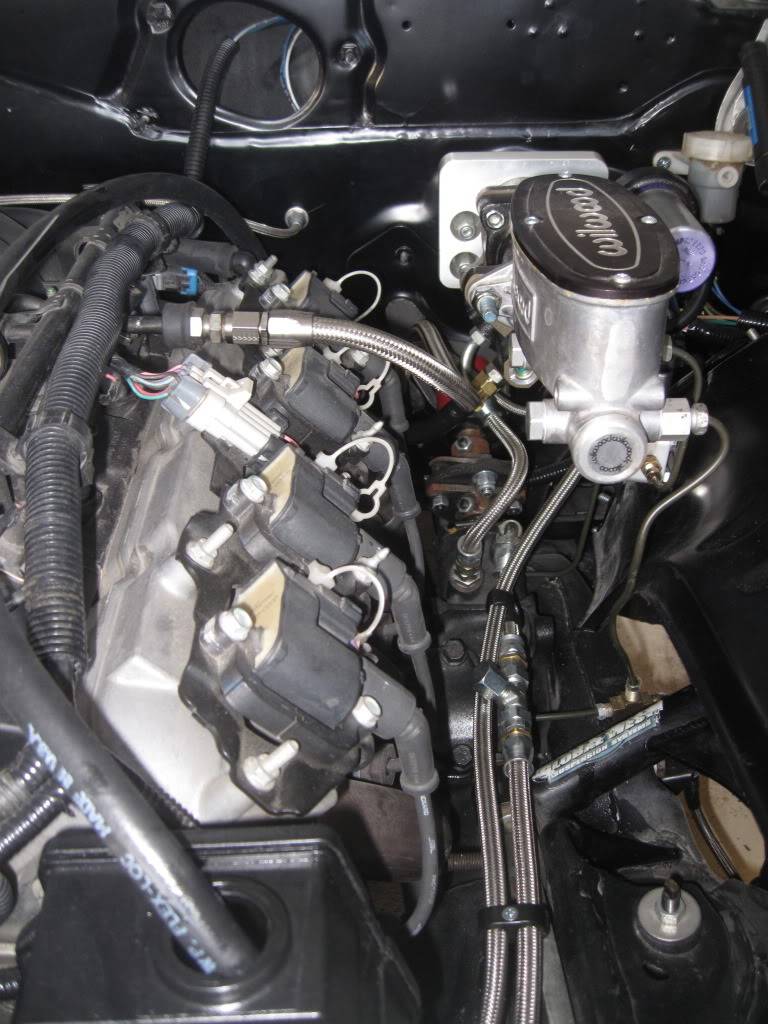 Robert's 1969 Camaro - 2002 LS1/T56, 10pt cage, Global West Stage III front suspension, HTH truck arm rear suspension, Sprint Cup 9" full-floating rear end, Fikse Mach V 17" up front 18" in the back and still working on it...
01-25-2012 #12
Registered User
- Join Date
- Dec 2002
- Location
- MusicCity
- Posts
- 477
Great to hear that we are making positive diagnostic progress. What we have proven out here is that the brake assist unit IS indeed fine, and was self applying due to the back pressure on the PS system low pressure return line circuit. Any back pressure higher than 3+ PSI on the hydraulic brake assist unit's low pressure return line will induce brake self apply. The problem that we must now pursue further is where and why this back pressure exists in your original plumbing arrangement. You should ideally see only 1-2 PSI of pressure in the low pressure return line circuit(s) of a PS system. What would be neat and highly informative would be to have you remove the cap on the T fitting you currently have installed to gauge what back pressure levels we are dealing with. Connecting up a 0-20 PSI gauge onto the T fitting would speak volumes to see exactly how high the back pressure is...
There are 4 thoughts that come to mind:
* Restriction in the PS cooler (even though it looks to be a nice design of free flowing nature)
* Restriction in the plastic injection molded low pressure return line nipple (in the PS pump reservoir housing)(possibly molded incorrectly with bottle necked inner diameter causing a choke point)
* Possible collapsed internal Teflon hose liner in one of the hoses (very rare, but nevertheless possible) (or an obstruction of foreign nature clogging free flow)
* Excessive PS pump flow (optimum target is 2.2-2.6 GPM (gallons per minute of pump flow) (some truck spec pumps can flow up to 3.5-3.8 GPM)
If I was there working with you, the next move we would make would be to restore everything back the way it was initially plumbed (putting the original braided stainless low pressure return line you had back in). I would then take the rubber test hose you have on hand and use it to bypass the braided hose running from the PS cooler back to the PS pump reservoir. This would tell us if my suspicion is correct in having a bottleneck to flow at the PS pump reservoir low pressure return line nipple (injection molded in the plastic PS pump housing). IF you run from the cooler to the "mouth" of the PS pump reservoir with your bypass hose that you have on hand, and experience no brake self apply when you start the engine, this tells us that your restriction is NOT in the placement of the T fitting (before the cooler) AND it is NOT the cooler causing the restriction to flow.
IF all is well with the bypass hose in place as spelled out above, then we could take a look at possibly drilling out the inner diameter of the low pressure return line nipple molded into the PS pump housing JUST A LITTLE BIT. Can't do much though, as you don't want to weaken the plastic nipple molded into the reservoir as it may then just snap off when least expected. IF the same problem exists with the bypass hose connected from the output of the cooler to the mouth of the PS pump reservoir / fill cap opening, then we could suspect the cooler as the restriction to flow (and would then bypass it completely to test).
Summary? You do have -6 AN lines from what I see (not -4 AN) Increasing line size will likely not help. I do suggest that you try to determine where the bottleneck causing back pressure exists. Placing the T fitting AFTER the PS cooler will only help IF the cooler is indeed the point of restriction. IF the restriction point is indeed a bottleneck at the low pressure return line nipple at the PS pump housing, moving the T fitting will NOT help one bit. If you don't want to get into all of the diagnostics, you could install the AN-6 bulkhead adapter into the side of your existing PS pump reservoir to run a second dedicated low pressure return line from the brake assist unit straight to the PS reservoir as shown in the links in the previous posts. *OR* slow the pump flow down with the installation of a replacement PS pump output fitting (with a 1.125" orifice size as supplied by DSE or PSC discussed in the posts above). Slowing down the overall pump flow with the simple / inexpensive swap out of the PS pump output fitting could very well take care of business for you, as less flow from the pump = less fluid being bottle necked up through any points in the low pressure return line plumbing.
Please feel free to call Jim to discuss further.
There IS a difference - Thank you for choosing Hydratech!
Paul M. Clark
Founder / Master Engineer
Hydratech Braking Systems ®
www.hydratechbraking.com
01-26-2012 #13
Registered User
- Join Date
- Dec 2004
- Location
- charleston, SC
- Posts
- 853
I'll try to run the test hose from the cooler into the reservoir later today when I get home. The fuel line in the pictures is 6-AN, but the lines for the booster/power steering are the same size as my 4-AN return line. However, I am starting to think that you are right in that the restriction/backpressure is related to the pump somehow. Hopefully this will remedy the situation. Thanks for you continued support.
Robert's 1969 Camaro - 2002 LS1/T56, 10pt cage, Global West Stage III front suspension, HTH truck arm rear suspension, Sprint Cup 9" full-floating rear end, Fikse Mach V 17" up front 18" in the back and still working on it...
01-26-2012 #14
Registered User
- Join Date
- Dec 2002
- Location
- MusicCity
- Posts
- 477
You can always count on our full high quality support - before, during, and well after you receive any items from Hydratech Braking Systems.
As far as line size? You cannot judge Army / Navy (AN) line size from comparing outer diameters. Your fuel hose may be -6 AN, BUT it is a different class of hose - it is all about inner diameter. If you have wrench sizes of 5/8 on the engine side high pressure port hose end (Aeroquip FBM1144) and 11/16 on all of the other hose ends in your system (such as the Aeroquip FBM 1103 and 1122), then you are indeed running AN-6 TFE series hose and hose ends. Pics can be deceiving, but I'm confident that I am seeing AN-6 plumbing in your hydraulic brake assist / power steering hoses. The outer diameter on the Teflon lined stainless steel overbraid AN-6 hoses will be 7/16", while the outer diameter on nitrile rubber lined hoses with stainless overbraid can be as large as 1/2"...There IS a difference - Thank you for choosing Hydratech!
Paul M. Clark
Founder / Master Engineer
Hydratech Braking Systems ®
www.hydratechbraking.com
01-28-2012 #15
Registered User
- Join Date
- Dec 2004
- Location
- charleston, SC
- Posts
- 853
So i tried the bypass from the cooler to the mouth of the reservoir this morning. Started up the car and everything is fine; rotors continue to spin. After applying the brake however, it wouldn't release when I let my foot off of the pedal. I repeated this a few times to make sure.
Robert's 1969 Camaro - 2002 LS1/T56, 10pt cage, Global West Stage III front suspension, HTH truck arm rear suspension, Sprint Cup 9" full-floating rear end, Fikse Mach V 17" up front 18" in the back and still working on it...
01-28-2012 #16
Registered User
- Join Date
- Dec 2002
- Location
- MusicCity
- Posts
- 477
Just to be clear as to where we're at in the tests: If I'm understanding correctly, you put the original stainless braided low pressure return line back in the way it was set up originally? From the low pressure return line port on the brake unit to the T fitting? And then ran your rubber bypass test hose from the output of the cooler to the mouth of the power steering reservoir? (to test and see if the bottleneck may have been the low pressure return line nipple on the power steering reservoir). You put it all together back the way it was in this picture - correct?
If the above is correct, then there is indeed a restriction in the cooler (and not in the low pressure return line nipple on the PS pump housing).
The next test to prove out a restriction in the cooler would be to now bypass it completely: Disconnect the hose end at the T fitting that runs down to the trans cooler (the part of the T fitting that is closest to the front of the vehicle / looks like it is touching the upper control arm in the above pic). Then disconnect the braided stainless hose from the PS cooler (the one that runs from the cooler output back to to the PS reservoir) Connect that straight female hose end (that was previously connected to the cooler output) to the T fitting instead, which will then provide a direct flow from the T fitting to the PS pump reservoir, completely bypassing the cooler. The other way you could do this would be to disconnect both hose ends at the cooler and connect them together with a -6 AN male to male connector.
If all is well with the cooler bypassed, it means that we have indeed identified the cooler as the point of restriction. You would then consider either one of the following solutions:
BEST SOLUTION: Install a dedicated AN-6 bulkhead adapter into the side of the PS pump reservoir, then running the low pressure return line from the brake assist unit straight to the bulkhead adapter installed into the side of the PS pump. You would then remove the AN-6 T fitting, and run a new hose from the steering gear box low pressure return to the input side of the cooler.
2ND SOLUTION: Move the AN-6 T fitting location after the PS cooler (into the line that runs from the cooler to the PS pump reservoir). While unlikely, this could still be a source of slight further back pressure unless pump flow is slowed down (high PS pump flow can cause a T fitting plumbing arrangement to still be problematic even if installed after the cooler).
3rd SOLUTION: Slow the PS pump flow down through replacement of your PS pump output fitting (slowing the pump flow down to 2 GPM will flow less overall fluid through the system and may allow you to keep all of your plumbing exactly the way it was when you first put it all together). Less flow = less back pressure. You should check with Detroit Speed to verify if this pump fitting will fit your pump for certain. If it does, you may consider ordering it in, restoring all of your original plumbing, and you then may find all is well:
http://www.detroitspeed.com/1967-1969 Camaro-Firebird-Products/091401-pwr-strng-vlve.html
Performing the 1st and 3rd solution is what I recommend. It would completely optimize the installation and call it done.
Let us know what you find in your testing.There IS a difference - Thank you for choosing Hydratech!
Paul M. Clark
Founder / Master Engineer
Hydratech Braking Systems ®
www.hydratechbraking.com
01-30-2012 #17
Registered User
- Join Date
- Dec 2004
- Location
- charleston, SC
- Posts
- 853
In the Best Solution scenario, where would the output from the cooler go? I'll call Detroit Speed in the morning. Moving closer everyday.
Robert's 1969 Camaro - 2002 LS1/T56, 10pt cage, Global West Stage III front suspension, HTH truck arm rear suspension, Sprint Cup 9" full-floating rear end, Fikse Mach V 17" up front 18" in the back and still working on it...
01-30-2012 #18 Registered User
- Join Date
- Sep 2006
- Location
- Southern Indiana
- Posts
- 4,709
As for me I have helped swap in the newer units with reservoir as such we would tap out the old return, and install a set screw with sealer on it. We would then install appropriate number and size of returns with bulkhead connectors. THIS eliminated any restriction as I always figured there to be one because many of the ones my customers use are from 4 cylinders and might be getting more speed than needed also.
Also by removing the hose return that came stock we could move the bulkheads to different spots for clearance.
Ill look for pics of last set up I did for a guy.Lee Abel
AFTERMARKET PERFORMANCE
1977 Chevy Monza 2+2:Project "Cheap Trick"
1978 C10 Long bed , On air and trailer puller
2006 Buell Blast ,Just a bike to ride and for mileage
1966 Caprice 4dr Sports Roof fact.327/now 350/SOON 454???? Project "II Old,,,ZERO BUDGET OR LESS CAPRICE!"
02-02-2012 #19
Registered User
- Join Date
- Dec 2004
- Location
- charleston, SC
- Posts
- 853
Just got off the phone w/Detroit Speed and they weren't sure that their flow control fitting would work. The salesperson wasn't really comfortable with recommending anything as they don't work with hydroboost at all. He said the fitting was for GM Type II pumps but wasn't sure that would include my stock pump. Also, he didn't know what I would have to do to adapt it to a 6-AN fitting other than running an additional hard line to it from the flor control fitting.
When I get home today I'll try to bypass the cooler entirely.Robert's 1969 Camaro - 2002 LS1/T56, 10pt cage, Global West Stage III front suspension, HTH truck arm rear suspension, Sprint Cup 9" full-floating rear end, Fikse Mach V 17" up front 18" in the back and still working on it...
02-02-2012 #20
Registered User
- Join Date
- Dec 2002
- Location
- MusicCity
- Posts
- 477
Call PSC Motorsports and ask for Kevin or Lance: http://www.pscmotorsports.com These guys are REALLY GOOD at what they do, hence the name PSC = Performance Steering Components.
Make sure to tell them Paul from Hydratech sent you, and they will be able to hook you right up with a replacement pump output fitting that will plug n play directly in place of your existing pump output fitting (with a 1/8" orifice sizing that will slow the pump flow down to 2.0-2.2 GPM)(gallons per minute pump flow rate). They will need to know the approximate year / make / model your PS pump is from. Tell them that you are connecting a 5/8-18 hose to this fitting, and they will likely be able to install the flare seat insert into the fitting for you. You could aslo take a pick or woodscrew and fish the insert we supplied out of your original PS pump fitting and transer it into the replacement PS pump fitting, or let me know and I'll send you another one: http://www.hydratechbraking.com/hose...AB01C0112E3750
(the smaller of the two inserts)There IS a difference - Thank you for choosing Hydratech!
Paul M. Clark
Founder / Master Engineer
Hydratech Braking Systems ®
www.hydratechbraking.com

 Reply With Quote