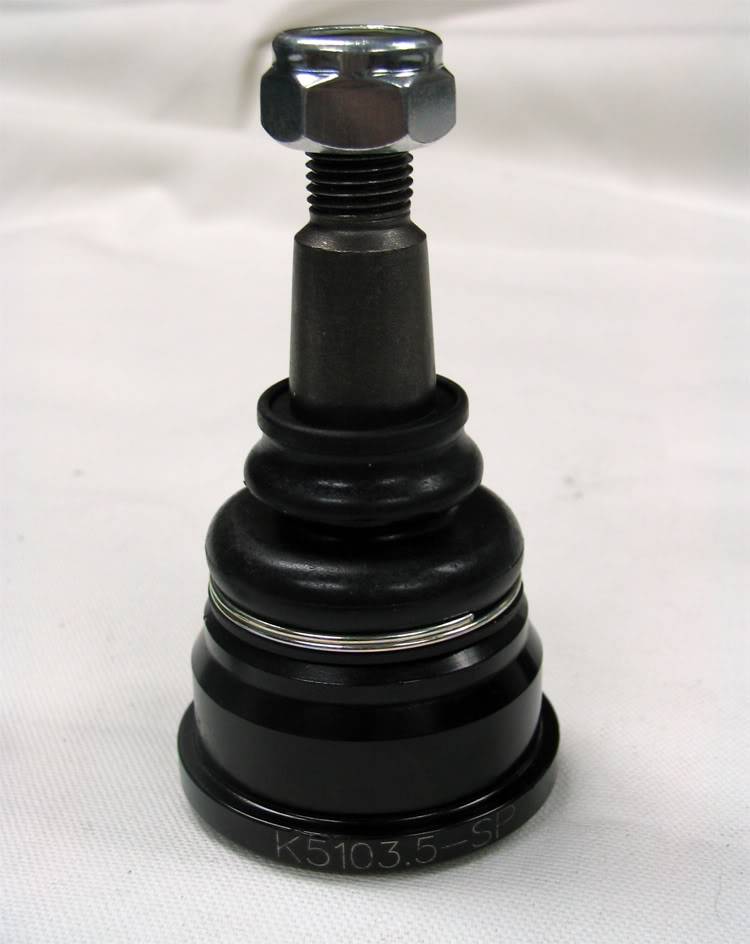

PDA

View Full Version : PPM/ Proforged tall ball joints for 1st gen Camaro - Chevelle


greencactus3
02-19-2009, 05:12 PM
http://www.s10forum.com/forum/f178/power-performance-tall-ball-joints-390083/#post6048706

im sure lots of you have heard of and know powerperformance and their balljoints. they are considering R&D and production of tall balljoints for us, and as of now are gauging interest/demand level.


We've received some requests for a "tall" version of our upper S10 ball joints.

We just green lighted production on the 1st gen Camaro / A-body "tall" upper ball joints. I'm considering doing the S10 ones too, but have concerns that there isn't enough demand for them.

So...how many people would be interested in this?

bochnak
02-20-2009, 10:04 AM
Link to their site/product?

greencactus3
02-20-2009, 10:30 AM
well this is their 'feeler' on whether or not they want to produce them for us or not.
http://www.powerperformancemotorsports.com/main.sc
this is their main site

Rick Dorion
02-20-2009, 10:57 AM
They're asking about S10 interest?

bochnak
02-20-2009, 11:03 AM
They're asking about S10 interest?

Yes. They also mentions that A-body BJ's are in production:

"We just green lighted production on the 1st gen Camaro / A-body "tall" upper ball joints. I'm considering doing the S10 ones too, but have concerns that there isn't enough demand for them."

Is there a link to the A-body stuff?

greencactus3
02-20-2009, 10:29 PM
ill send him a message with those questions.

since ive never had a g-body i wouldnt know, but the balljoints from s10 and gbody are a direct swap correct?

Eric Howell
02-24-2009, 05:28 AM
but the balljoints from s10 and gbody are a direct swap correct?Yes. The UCA, LCA, spindles and ball joints are all the same. The front bushing in the LCA has a larger inside diameter for the S trucks.

greencactus3
02-24-2009, 05:50 PM
Yes. They also mentions that A-body BJ's are in production:

"We just green lighted production on the 1st gen Camaro / A-body "tall" upper ball joints. I'm considering doing the S10 ones too, but have concerns that there isn't enough demand for them."

Is there a link to the A-body stuff?got a response

They are on the path to production. I think they will be ready for sale June 1 - I wish it could be sooner, but we are swamped.

bochnak
02-25-2009, 04:38 AM
No mention of price at this point?

65MALI
02-25-2009, 08:05 PM
I would be interested, if don't compromise strength and durabilty. Wouldn't mind a set on my DD. The chevelle gets all the pricey brand name parts, and the DD can get generic brand. Put me on the list, Ill take a set for the GMC.

Proforged
06-09-2009, 05:22 PM
there's some new info over at S10forum.com...

http://www.s10forum.com/forum/f178/power-performance-tall-ball-joints-wait-list-now-open-404441/

bochnak
06-10-2009, 03:18 AM
there's some new info over at S10forum.com...

http://www.s10forum.com/forum/f178/power-performance-tall-ball-joints-wait-list-now-open-404441/

Thanks. Posted it over at the chevelle forum also:

http://www.chevelles.com/forums/showthread.php?p=2387282#post2387282

Eric Howell
06-10-2009, 03:21 AM
Great, right after I get the Howe's.

derekf
06-10-2009, 03:24 AM
Query, though:

Why would one want to go with these rather than the Howe tall balljoints? I know the Howes cost a little more, but are "rebuildable", right?

bochnak
06-10-2009, 03:28 AM
Query, though:

Why would one want to go with these rather than the Howe tall balljoints? I know the Howes cost a little more, but are "rebuildable", right?

How much does it cost to rebuild a Howe? Can one do it themselves?

Eric Howell
06-10-2009, 10:30 AM
Query, though:

Why would one want to go with these rather than the Howe tall balljoints? I know the Howes cost a little more, but are "rebuildable", right?Depending what wears out the PP ball joints might be cheaper then the rebuild parts plus they are forged so they should be stronger.
Howe parts
http://www.howeracing.com/c-510-howe-precision-ball-joints.aspx
Rebuild instructions (PDF)
http://www.howeracing.com/Adobe/BallJointsPrecision.pdf

Marcus SC&C
06-11-2009, 07:31 AM
I have a box full of the PP balljoints on the workbench right now,including some they haven`t listed yet. Despite the EXTREME DUTY moniker they`re really stock replacement type ball joints just 1/2" taller. Mind you I`m not saying they`re EXTREME DOODIE at all either. The quality looks just fine but I haven`t seen anything yet from the parts themselves or heard anything from the manufacturer that makes them qualitatively better than stock. They do use a forged upper housing vs. the stamped stock one but I`ve never seen or even heard of an upper housing failure so I`m not sure why they chose to change that particular area. Forging vs. machined from billet steel is only one very small factor and by no means makes one stronger than another unless you know the alloys used, heat treat used and they`re of exactly the same design otherwise, which these certainly are not.
I`ve asked to see some comparitive testing vs. OE parts to see how the additional height affects durability on these basically OE format ball joints. The tests that they`ve shown me so far at least look fine but were done in a vacume (no control parts to compare them to). Personally I`d like to see much better than stock numbers because the factory engineers at GM never imagined the severe performance use we put these cars through today.
The Howe balljoints are on a whole different level than OE parts (as they should be), better alloys, better heat treat,better construction, better quality control etc. and have been used so extensively by motorsports and even the military that their outstanding durability is a matter or record thus we feel very comfortable using them in tall pin high performance applications. For those who care they`re also made entirely in the good ol USA.
Howe ball joints are rebuildable for race cars that crash at high speeds. Impacts that destroy stock ball joints outright usually just require a simple pin change (take a few seconds and yes, you can do it yourself) for the Howes. In actual racing use up to an including Sprint Cup they generally outlast premium stock ball joints 5:1. You will never have to rebuild them in your street car, unless you use it as a taxicab. We have a set with near 100,000 hard miles on them with no measurable wear in them yet.
Like any new part these new PP balljoints will have to prove themselves. I`m giving them careful consideration as a possible budget alternative to the Howes for street driven cars looking for modest performance gains (since we`d only have one height to work with,at least for now). They may well find a niche there. I want to see some more data and do some testing of our own on some final production parts but so far I`m still considering them as a possibility. I`m a firm believer that parachutes and minds are the same, both work best when they`re open. :) Mark SC&C

FirstGenZq8
09-19-2009, 09:30 AM
marcus, did you ever get any additional information from the power performance guy? have you installed these on one of your cars, driven on them, and beat the hell out of them?

Proforged
12-02-2009, 06:03 PM
My name is Zack Kanter and I own Power Performance Motorsports. Moderators: I won't be posting up any pricing or links to our website, I just want to put some information out there before the rumor mill gets going. I hope that this is within the rules of the forum.

We've been working on these "tall" ball joints for 7 months and we have finally finished the first production run.I wanted to share some of the R&D that has gone into them - we're pretty proud of the finished product, but I know P-T can be a tough crowd and we are going to have to prove ourselves!

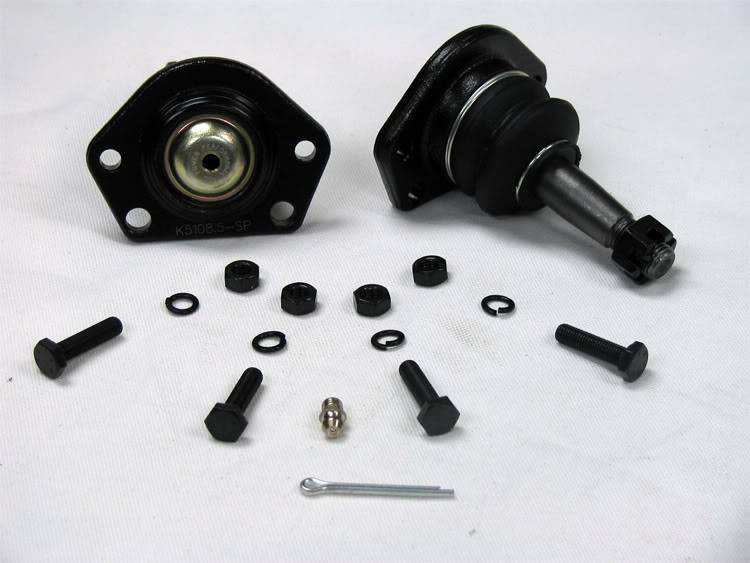
Our ball joints are made using forged SAE4130 ball studs with high-polished ball heads. The studs are situated inside a forged, SAE1045 greasable housing. The housing are e-coated black - the coating is virtually impermeable to rust and is capable of passing a 240 hour salt spray test. We seal the unit with our signature, ring-retained, accordion-style boot. The boot design is crucial for the longevity of the ball joint - the traditional, clamp-on style boot is prone to tearing or pulling out of the clamp, which causes rapid wear once the joint is exposed to the elements.
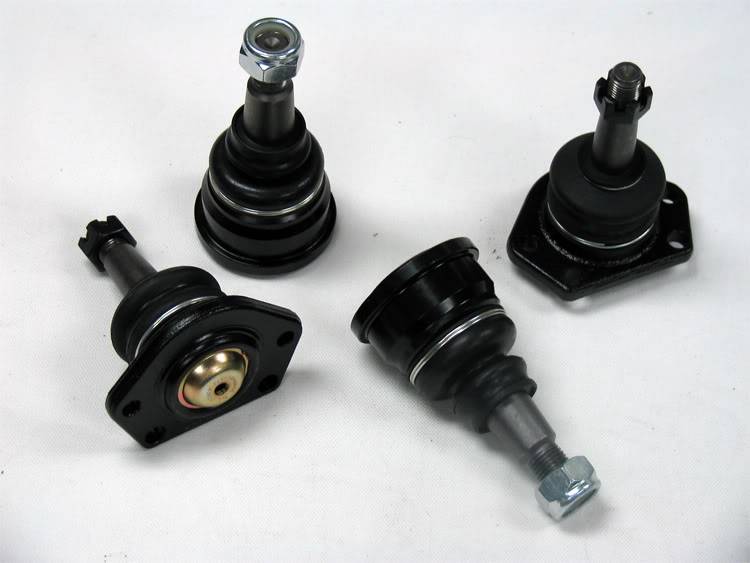
https://static1.pt-content.com/images/pt/2009/12/upperslowers-1.jpg

We're no stranger to heavy duty applications. While we're relatively new to the musclecar market, we have a fairly big following in the offroad as well as lowered truck market. We also supply ball joints, idler arms, tie rod ends, and center links to many of the "big name" musclecar suspension companies out there. Here is an example of one of our customers "exercising" our ball joints (note: I don't recommend anyone doing this. It voids the warranty for sure :D):

https://static1.pt-content.com/images/noimg.gif

After listening to the demands out there, we were told that a 0.5" extended length upper and lower ball joint for the Chevelles/Camaros/Novas would be optimal, so we started investigating some designs. Now, we've made the standard size A/F/X upper and lower ball joints for many years and sold many thousands of them with no problem, so I have a lot of confidence in the housing design. We use a forged housing for maximum stud pullout strength. Power Performance focused most of the effort on validating the stud design - whenever you're going to add length into a stud, you want to make sure that the stud is still going to be strong enough.

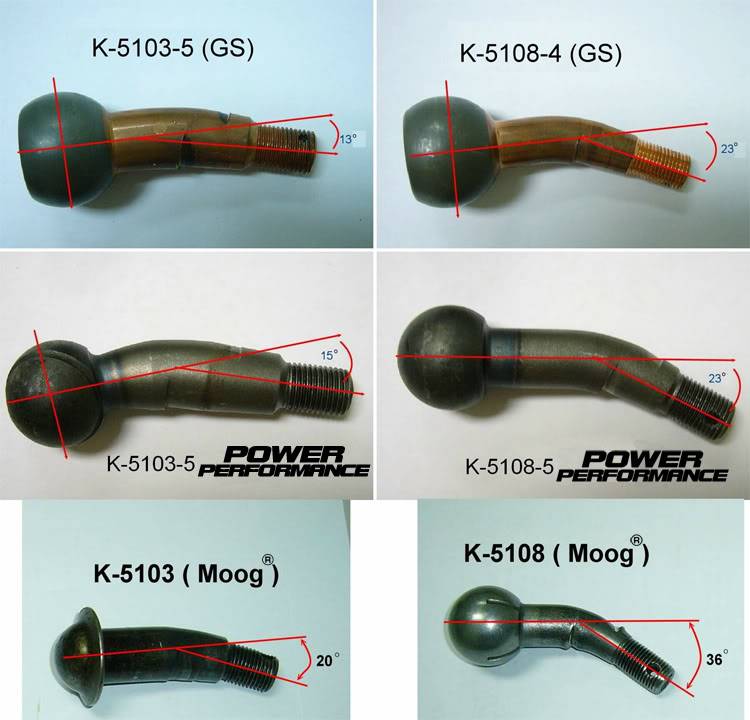
As a benchmark, we went out and purchased a set of boxed MoogŪ Problem SolverŪ ball joints and a set of what we call the "GS" (gold standard) 0.5" extended length ball joints that are popular on this forum. We performed two tests - stud pullout and stud impact. A stud pullout test measures the amount of force required to pull the stud out of the housing (higher number is better). A stud impact test is performed by screwing the stud into a wall and dropping a 110 lb weight from 5 feet onto the ball head. The angle of deviation is then measured (a lower number is better, as it means the stud is stronger).

A note about the tests - these are not independent, 3rd party tests. While I am very confident in the results, I am going to avoid naming the competitor's parts because they aren't independently verified. That being said, I would be happy to submit samples of our products for independent testing if any other manufacturer wants to go head to head.

The results are as follows:

Stud Pullout Testing - Peak Force

Upper
MoogŪ: 18,284 lbs
GS brand: 16,812 lbs* <---this test was performed on a second-gen Camaro version, as we didn't have a first-gen version available at the time of test
PPM: 18,481 lbs
NOTE: Each of these 3 ball joints VASTLY exceed the ~10,000 lb stud pullout rating of the original GM stamped upper ball joint

Lower
MoogŪ: 19,686 lbs
GS brand: 16,929 lbs
PPM: 19,649 lbs
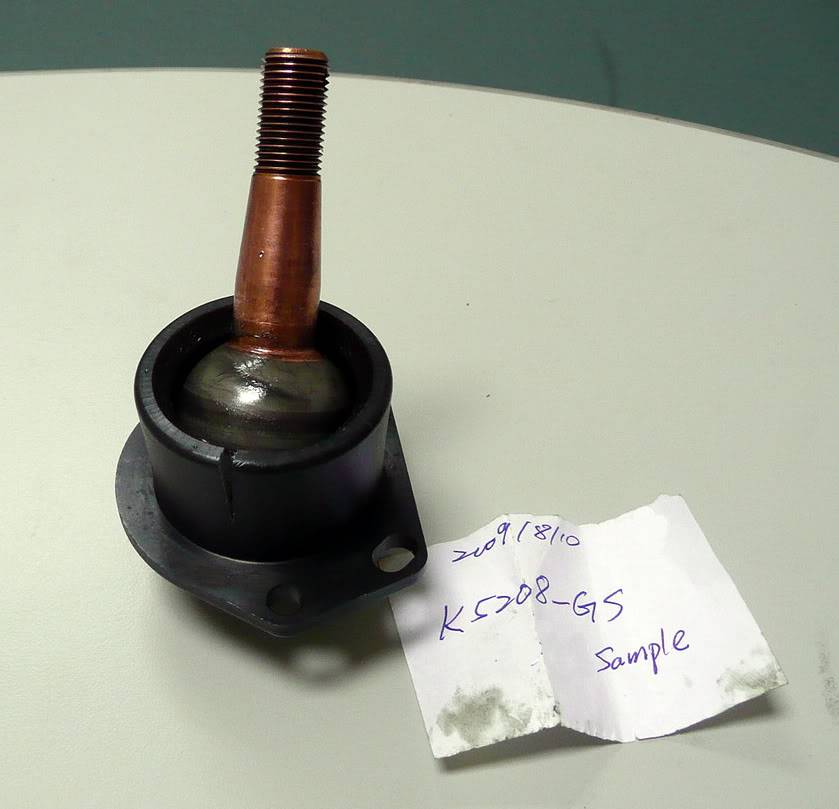
https://static1.pt-content.com/images/pt/2009/12/brokenballjoint-1.jpg
(the "GS" ball joint is shown, post-pullout test. It failed in the expected area - a crack in the housing)

Stud Impact Testing - Degrees of Deviation

Upper
MoogŪ: 36 degrees
GS brand: 23 degrees
PPM: 23 degrees

Lower
MoogŪ: 20 degrees
GS brand: 13 degrees
PPM: 15 degrees
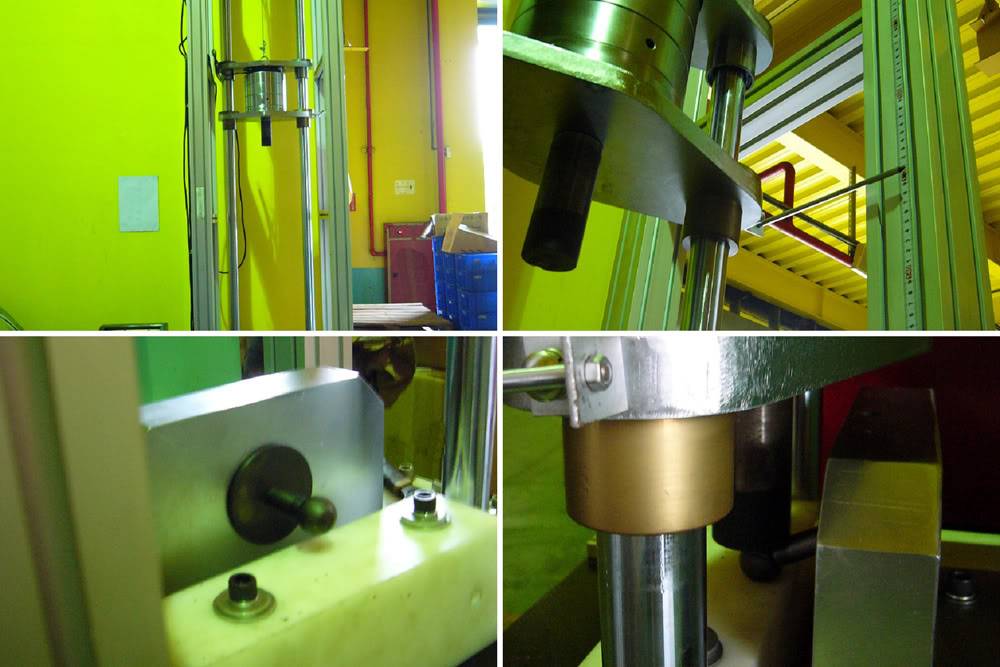
https://static1.pt-content.com/images/pt/2009/12/impacttest-1.jpg
(the Stud Impact Test machine)

https://static1.pt-content.com/images/pt/2009/12/studcomparo-1.jpg
(studs are shown post-impact test)

As you can see, the Power Performance and the "GS" ball stud are quite a bit stronger than the MoogŪ part. The really interesting thing is that the MoogŪ part is standard length - if it were 0.5" longer, it would be even weaker! We accomplish the massive additional strength through special heat treat processes, higher quality steel, and a fundamentally better stud design.

The final thing we focused on was a low friction design. We investigated several designs out there and found that "low friction" designs on the market use a reduced rate spring in the ball joint to reduce friction. Well, you're essentially buying a half-worn ball joint because a weak spring will take half the time to wear out of spec.

Instead, we polished the ball stud after machining for smooth, low-friction operation. A before-and-after photo can be seen below.
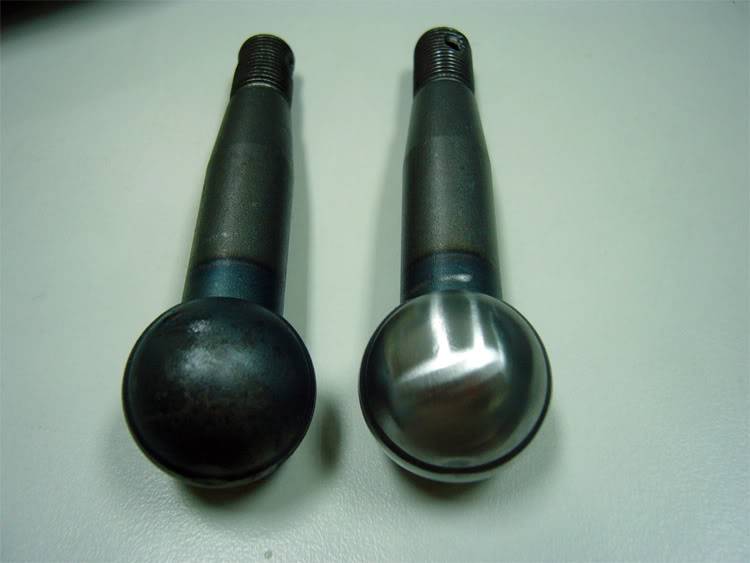
https://static1.pt-content.com/images/pt/2009/12/polishingbanda-1.jpg

I hope that this addresses some questions about our products. After 7 months of investigating the "other" designs out there, I have a lot of respect for the "gold standard" ball joint. It is a very nice piece - the only bad thing I can say about it is the price!

The main advantage of the "GS" ball joint is the ability to easily swap in different length ball studs. If you plan on playing around with many different length combinations, our ball joints are not for you. If you want to use a 0.5" extended length upper or lower ball joint, then our's are exactly what you need.

Power Performance has a 1,000,000 mile warranty against manufacturer's defects - and we receive virtually 0 warranty claims each year.

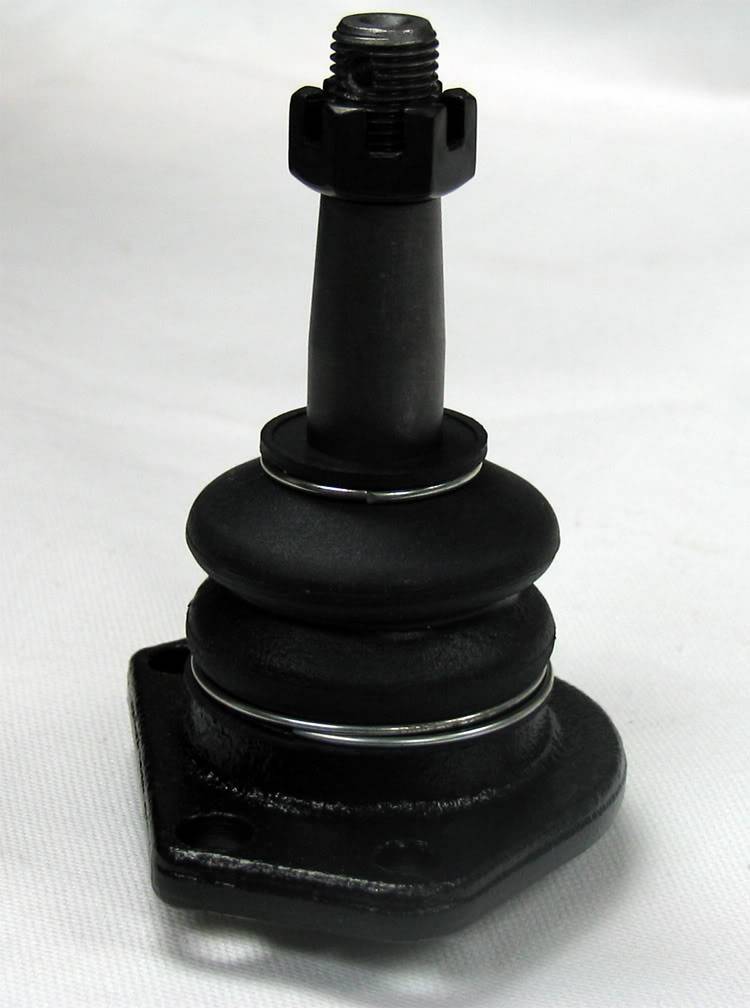
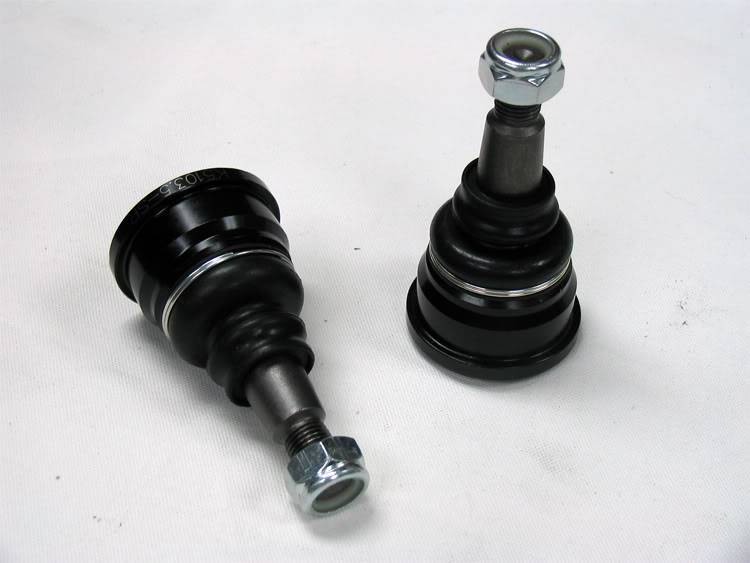
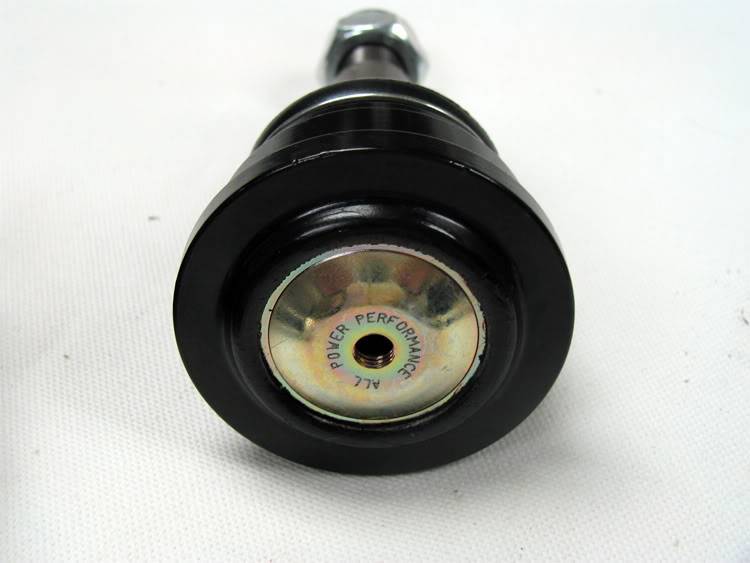
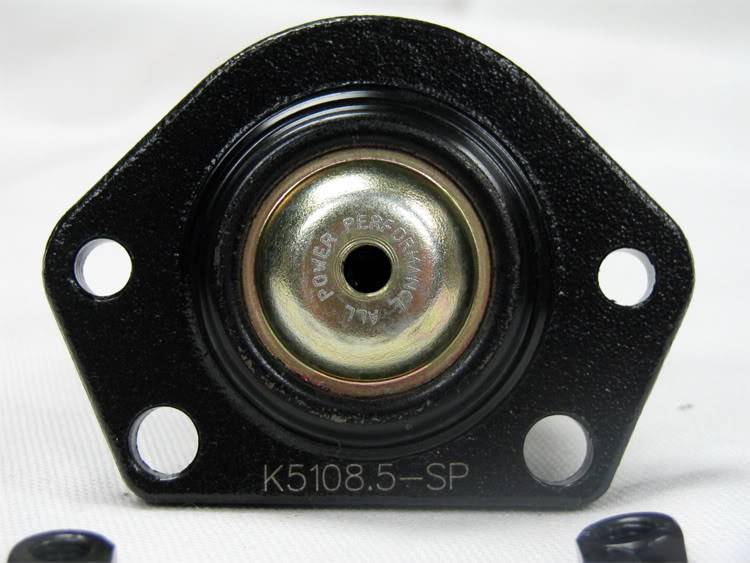
We look forward to answering any questions or concerns that you all may have. Below are some product photos for you to review:
https://static1.pt-content.com/images/pt/2009/12/uppers-1.jpg

https://static1.pt-content.com/images/pt/2009/12/uppers2-1.jpg

https://static1.pt-content.com/images/pt/2009/12/uppers3-1.jpg

https://static1.pt-content.com/images/pt/2009/12/lowers-1.jpg

https://static1.pt-content.com/images/pt/2009/12/lowers2-1.jpg

https://static1.pt-content.com/images/pt/2009/12/lowers3-1.jpg

Chad-1stGen
12-02-2009, 06:52 PM
Are tall lower ball joints cumulative with the uppers for camber gain or is that to lower the vehicle?

ROEINONDUBS
12-02-2009, 09:02 PM
ima stick with sc&c's recommendations and go with Howe

David Pozzi
12-02-2009, 10:40 PM
MrSuspension
Thanks so much for contributing. It's fine to post info as you have done and we really appreciate you providing it.

David

LowBuckX
12-03-2009, 12:23 AM
ima stick with sc&c's recommendations and go with Howe
Thats good to know.

bochnak
12-03-2009, 05:11 AM
MrSuspension
Thanks so much for contributing. It's fine to post info as you have done and we really appreciate you providing it.

David

I agree. Thanks for bringing the tech.

So are these installed on any vehicles?

Proforged
12-03-2009, 06:18 AM
I agree. Thanks for bringing the tech.

So are these installed on any vehicles?

Not yet. We are willing to send someone a free set of uppers and lowers if they can post a step-by-step install with nice photos within a week.

bochnak
12-03-2009, 06:54 AM
Not yet. We are willing to send someone a free set of uppers and lowers if they can post a step-by-step install with nice photos within a week.

PM sent

JRouche
12-03-2009, 07:13 PM
Not yet. We are willing to send someone a free set of uppers and lowers if they can post a step-by-step install with nice photos within a week.

WHOA!!!! You prolly just got 50 messages!! And you should. It looks like you guys have been doing what a company should do. Continued advancements in design to better the companies profile and product. Not just sitting on your past accomplishments and waiting for the orders to come in. And Im not even saying all companies do that, but I see enough of it. There is ALWAYS room for advancements. Sounds like you guys understand that. Great post you provided. JR

jake72ss
12-03-2009, 08:02 PM
does anyone know how much longer than stock the Howe ball joints are? I know that they can be ordered in different lengths, but which length is popular for chevelles and camaros.
Jake

79T/Aman
12-04-2009, 06:21 AM
does anyone know how much longer than stock the Howe ball joints are? I know that they can be ordered in different lengths, but which length is popular for chevelles and camaros.
Jake

Just look at the Howe website, they are available in .100 increments up to .500, as for the second question it's not what is popular but what is correct for the application, you may want to check with Markus at SC&C he may have different length available, because you need a bit more than +.500 on the lower of an A-body with the stock spindles, but again it's what is correct for the application

Charley Lillard
12-04-2009, 07:34 AM
Great presentation...

silver69camaro
12-04-2009, 10:54 AM
It's nice to see somebody else who goes through the proper procedures to make a good product.

pdq67
12-05-2009, 08:06 PM
Both Marcus and David P. have helped me w/ my '67 1st Gen. car's front suspension numbers w/ my Pro Motor Sports 1-15/16" tall bolt-on spindle extenders!

I gotta try them before I go on to something else.

And I am thinking hard about Marcus's double turnbuckle upper a-arms.

pdq67

bochnak
01-05-2010, 05:13 PM
Install threads:

http://www.chevelles.com/forums/showthread.php?p=2687674#post2687674

https://www.pro-touring.com/forum/showthread.php?t=63876

Proforged
01-05-2010, 06:24 PM
It's nice to see somebody else who goes through the proper procedures to make a good product.

Matt,

Thanks! I'm sure AM goes through similar processes during R&D.

Proforged
03-30-2010, 05:24 AM
2nd Gen tall ball joints now in stock and shipping!

rentedmule
04-28-2010, 08:21 AM
Looks like the G-body tall BJs are now "in stock and shipping" on the power performance website. I just need to figure out Canadian shipping now, the site isn't set up for it...

David Pozzi
08-26-2010, 10:09 PM
Power Performance sent me a set of tall balljoints for a 67-69 Camaro to test. I created a page and posted the data on it: HERE (http://www.pozziracing.com/power_performance_motorspo.htm)

Tests done were:
1. Camber
2. Caster
3. Bumpsteer

I did 4 variations of the above
1. Stock
2. .5" tall upper, stock lower
3. .5" tall lower, stock upper
4. .5" tall upper, .5" tall lower

I hope this benefits someone, it was a lot of work!

bochnak
08-27-2010, 04:22 AM
Power Performance sent me a set of tall balljoints for a 67-69 Camaro to test. I created a page and posted the data on it: HERE (http://www.pozziracing.com/power_performance_motorspo.htm)

Tests done were:
1. Camber
2. Caster
3. Bumpsteer

I did 4 variations of the above
1. Stock
2. .5" tall upper, stock lower
3. .5" tall lower, stock upper
4. .5" tall upper, .5" tall lower

I hope this benefits someone, it was a lot of work!

Wow...thanks for the info. PP has sent me a set some time ago and I posted an install thread. I "wanted" to post tech info like you did, however do not have the tools or complete knowledge on how to.

A-bodies can benefit from tall lower BJ's as the steering arm is too low in stock form, opposite is true for Camaro's as you pointed out.

bochnak
08-27-2010, 06:45 AM
Are the values for test 1, camber column values at heights 1.5, 2.5, & 3 correct?

https://static1.pt-content.com/images/pt/2010/08/test201-1.jpg

David Pozzi
09-07-2010, 01:26 PM
Those are positive camber, but decimals. I corrected them now.
Be sure and read my notes on my website that explain ride height starting point, etc
https://static1.pt-content.com/images/pt/2010/09/test1test2-1.jpg
https://static1.pt-content.com/images/pt/2010/09/picture_14-1.jpg

David Pozzi
10-18-2010, 07:08 PM
I thought I'd update this thread by posting new data on 2nd gen Camaro tall ball joints: http://www.pozziracing.com/second_gen_camaro_tall_bal.htm
I'll post a new thread on it but wanted to stick this link in here too.
David
https://static1.pt-content.com/images/pt/2010/10/1971_camaro_data-1.jpg

LV42DAY
10-28-2010, 11:36 PM
dave, have you tried the gmod and a taller b-joint together? just curious

Rod
10-29-2010, 09:44 PM
dave, have you tried the gmod and a taller b-joint together? just curious

:confused: me too

neki67
10-30-2010, 12:30 AM
G-mod and 2nd gen F-body????????

firebob
10-30-2010, 11:16 AM
Wondering if there's any kind of discount code for us PTers?

Robert

Rod
10-30-2010, 04:58 PM
G-mod and 2nd gen F-body????????

the thread started out talking about 1st gen and tall ball joints, some how we got a lot of info on 2nd gens also which is awesome since I have one of those now also!:rolleyes:

MrQuick
01-09-2011, 09:59 AM
Hey Rod, when are you going to start stocking these at Got's?


Vince @ Dreamspeed

Rod
01-09-2011, 01:17 PM
Hey Rod, when are you going to start stocking these at Got's?


Vince @ Dreamspeed

we wont stock any protour stuff till maybe summer, Ted and Joe really want to Get a Dragster back on the track! I also need more of your cards so I can send more cars your way!

clancj
02-13-2011, 07:27 AM
Quick question: Since tall lower ball joints would lower the car by raising the lower "A" arm by 0.5", should not all measurements for the tall lower ball joint tests be re-adjusted upward from "0" ride height since zero actually equalls a -0.5 drop? In other words; 0" = -0.5", -0.5" = 1.0", -1.0" = -1.5"etc.

The measurement graphs of tall lowers makes me wonder why theres is no additional gain with more "A" are separation?

clancj
02-13-2011, 07:45 AM
If the above is true, i would think the tall lower is actually superior since it provides the same negative camber in bump AND less positive camber in droop. thus manitaining a higher tire contact patch in both extremes.

am i wrong? am i missing something?

joe c

David Pozzi
02-13-2011, 08:04 AM
All measurements were taken relative to the same ride height, not LBJ position. I started each test with the spindle the same height from the floor. Taller lowers helped a small amount but made bumpsteer worse.

clancj
02-13-2011, 08:12 AM
I started each test with the spindle the same height from the floor.

Does that not represent the suspension in droop sinced the tall lowers would lower the car by 0.5" (or raise the spindle 0.5")?

im in no-way a suspension expert, just trying to convert your test results to my limited knowledege of where the curve would start wth the lower ride height tall ball joints create.

clancj
02-13-2011, 09:08 AM
. Taller lowers helped a small amount but made bumpsteer worse.

I dont have bump steer now w/tall PPM uppers. Could bump steer be compensated for by returning the ride height after installing tall lowers (if it appears), by taller springs or spring pocket spacers?

i'm starting to lean toward not installing the talls on the lower. With hotchkiss front springs, i dont think there's much bump going on in flat autocross courses, i just couldnt get enough negative camber last year. This year i went to a 265 18 35 on a 9" rim (from a 245 40 17 on an 8" rim) up front and dont want to eat the outers with insufficient neg camber. im hoping the 245's were rolling over and the 265 18 35 plants better (car is autocrossed 99%) rarely street driven.

clancj
02-13-2011, 09:24 AM
All measurements were taken relative to the same ride height, not LBJ position. I started each test with the spindle the same height from the floor.

Nevermind, i'm an idiot: spindle height is set by the wheel. i just hit me.

David Pozzi
02-14-2011, 01:27 PM
I don't know if I posted a pic, but the way I did the tests was on a 69 Camaro with no front sheet metal, I raised it up on jackstands and set the spindle height relative to the lower control arm on the subframe. I wanted to keep the ride height starting point for "0" the same for each test.

Adding .5" taller lower ball joints spaces the lower ball joint down .5" raising the instant center height, (the intersect of lines drawn through the upper and lower A arm pivot points. A higher IC is going to reduce neg camber gain curve a little so there is less gain than you would expect from adding the tall lower ball joint. I haven't modeled this, so I'm just speculating what the reasons are here. On a Camaro that is lowered a LOT, the .5" taller lower ball joint will increase bump travel by .5" and that may help prevent bottoming out, but not to say the headers or something else won't bottom out before that is an issue.
David

David Pozzi
07-18-2011, 06:01 PM
Latest news.
Power Performance has changed it's name to Proforged L.L.C http://www.proforged.com/
They are coming out with .5" taller outer tie rod ends. I have tested them and incorporated the results into my spreadsheet below.
The optimum combo is .5" tall upper ball joints, with .5" taller outer tie rod ends.
To put a little pressure on the boot, you can cut a 1/2" slice of neoprene hose and slip it over the ball joint stud. There have been some issues with the bolt pattern, especially with aftermarket A arms, usually two holes need some filing to fit. I had similar issues with the Howe uppers. If your ball joint won't fit through the hole in the A arm, bolt it in from below.
David
https://static1.pt-content.com/images/noimg.gif

MyFriendScott
07-19-2011, 08:31 AM
Thanks for the update David. I thought the bolt pattern issue was with both factory and aftermarket A-arms.

Nessumsar
07-19-2011, 09:35 AM
Well, I posted a reply, but its gone now... Weird

Anyways. David, did you happen to notice how much of the steering arm contacted the steering stop on the LCA with the tall LBJ installed? I have tall LBJ on my Nova and the arm only contacts the uper 1/4 of the steering stop hump; and that is after my LCA relocation, which should make this issue better. I would imagine on a stock subframe the arm may not contact the stop at all?

David Pozzi
07-19-2011, 11:40 AM
Thanks for the update David. I thought the bolt pattern issue was with both factory and aftermarket A-arms.
It's a little worse on the GW uppers I tried them on. The factory upper I used for the test needed filing on two holes.

David Pozzi
07-19-2011, 11:43 AM
Well, I posted a reply, but its gone now... Weird

Anyways. David, did you happen to notice how much of the steering arm contacted the steering stop on the LCA with the tall LBJ installed? I have tall LBJ on my Nova and the arm only contacts the uper 1/4 of the steering stop hump; and that is after my LCA relocation, which should make this issue better. I would imagine on a stock subframe the arm may not contact the stop at all?
Jon, I didn't look at that issue when testing. I'll check it out.
David

Proforged
08-05-2011, 11:18 AM
Hi David,

Thanks for posting up all the info. Here is a post with pictures on our new Bumpsteer Corrected Tall Outer Tie Rod Ends for the 1st Gen:

https://www.pro-touring.com/showthread.php?81995-Bumpsteer-Corrected-Tall-Outer-Tie-Rod-Ends-for-1967-69-Camaro-and-Firebird

409novaman
12-08-2019, 07:41 AM
Latest news.
Power Performance has changed it's name to Proforged L.L.C http://www.proforged.com/
They are coming out with .5" taller outer tie rod ends. I have tested them and incorporated the results into my spreadsheet below.
The optimum combo is .5" tall upper ball joints, with .5" taller outer tie rod ends.
To put a little pressure on the boot, you can cut a 1/2" slice of neoprene hose and slip it over the ball joint stud. There have been some issues with the bolt pattern, especially with aftermarket A arms, usually two holes need some filing to fit. I had similar issues with the Howe uppers. If your ball joint won't fit through the hole in the A arm, bolt it in from below.
David
https://static1.pt-content.com/images/noimg.gifDoesn't mounting the BJ on the underside of the CA make the BJ longer by about 1/2"? It would seem to be moving the CA up in relation to the spindle? I'm just trying to wrap my ignorant head around this concept.

79T/Aman
12-08-2019, 02:20 PM
NO it does not make the ball joint longer it simply moves the arm up. the pivot point of the upper ball joint does not change.

I know it can be confusing but the ball joint is located by the spindle not the control arm.

409novaman
12-08-2019, 04:27 PM
NO it does not make the ball joint longer it simply moves the arm up. the pivot point of the upper ball joint does not change.

I know it can be confusing but the ball joint is located by the spindle not the control arm.
Thank you for the reply.
So I would be correct in thinking that moving the BJ like we are discussing raises the CA into a higher position, further into it's arc and that's a positive. Do I have that right?

79T/Aman
12-08-2019, 07:52 PM
A tall ball joint raises the pivot point, it's not about the control arm it's about the relationship between the pivot points

dontlifttoshift
12-09-2019, 07:22 AM
409, I see what you are getting at. Pretend the control arm is invisible for a second.

The only way to change the curve is to move the actual pivot points. Where the control arm attaches to the frame and pivot in the ball joint are fixed. That relationship between those two points can not change, regardless of how or where the control arm attaches to those pivot points.

It is true that a tall ball joint raises the control arm further up in it's curve but the actual geometric gain is from raising the pivot point of the ball joint, not from the control arm.

409novaman
12-10-2019, 02:16 AM
409, I see what you are getting at. Pretend the control arm is invisible for a second.

The only way to change the curve is to move the actual pivot points. Where the control arm attaches to the frame and pivot in the ball joint are fixed. That relationship between those two points can not change, regardless of how or where the control arm attaches to those pivot points.

It is true that a tall ball joint raises the control arm further up in it's curve but the actual geometric gain is from raising the pivot point of the ball joint, not from the control arm.
I see, said the blind man and thanks!!!