

View Full Version : Are 17" + wheels that important for good handling???
Sammy B
08-20-2007, 04:26 PM
First post...be easy.
I'm in the process of re-doing the entire suspension on my '67 Lemans. My goal with the suspension is to get the car to handle as close as possible to a modern vehicle.
So far, I've installed new springs all around, replaced all the front suspension parts (center link, tie rods, ball joints, idler arm, etc), Lee's power steering box, fat front and rear sway bars, poly-graphite all around, Bilsteins in the front and probably Koni's in the rear. I also have SC&C Stage 1+ UCAs and tall ball joints in the mail.
With all the stuff that I've done so far, how much difference will running a 17" wheel make? I currently have the original 14" Rally IIs with BFG Radial T/A's.
Z06killinSBF
08-20-2007, 04:33 PM
They have less side wall flex resulting in more precise steering/handling.
Although the AC Cobras had 15's.:dunno:
vintageracer
08-20-2007, 04:43 PM
The AC Cobra illustrates the point of how less sidewall flex can make a huge difference in handling and why modern cars and particularly modern tires make such a huge difference. The tire sidewall flex on Cobras in the 1960's was HUGE!
AC Cobras were very poor handling cars. To drive one fast you had to use the huge horsepower and dirt track the car through the turns. Crummy bias ply Goodyears and and that heavy engine made the AC Cobra a handfull to drive. AC's were fast and had a lot of power but actually drove poorly. It took a GREAT driver like Dave McDonald or Ken Miles to drive one fast!
Today in vintage racing the Cobras are much faster than in the 60's mainly due to tire technology. You still do a lot of dirt track driving, just not as much.
Do not believe me. Go rent actual movies of real races from 1963-1966 when Cobra's were in their heyday. You WILL see what I mean and how poorly AC Cobra really did handle in the corners. But that horsepower really made up the difference!
Apogee
08-20-2007, 04:46 PM
A 17" wheel allows you to fit decent sized modern brakes to finish off the handling package you've got already. You stick with 14" wheels and you're more or less stuck with brake technology from the 60's. You also have a ton of performance tire options in the 17"+ range...I can't think of much of anything for 14 inchers, but I honestly haven't looked either. Brakes and performance rubber are probably two of the biggest bang for the buck modifications you can make to your car if you push it to the limits.
Sammy B
08-20-2007, 05:19 PM
Thanks for the replies.
The last owner of the car had already installed a front disk brake conversion. Nothing fancy, just standard 11" drilled/slotted rotors. I may eventually upgrade to disks in the rear and bigger rotors and calipers in the front, but for now the brakes are staying.
After looking around a bit, I really don't care for the way the 17s look on an A body, which is why I'm torn between going with the better handling of a 17" or the more factory look of a 15" or 16" American Racing style rim. If the handling benefits of a 17" rim are negligable compared to a 15" or 16" rim, I'll probably just go smaller.
MrQuick
08-20-2007, 05:35 PM
really? I kinda like the 15" look too but just look at these!
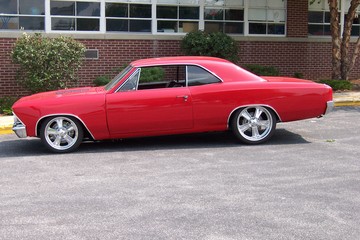
https://static1.pt-content.com/images/pt/2007/08/66chevelle2-1.jpg
https://static1.pt-content.com/images/pt/2007/08/100_1016JPGimgmax512-1.jpg?imgmax=512
parsonsj
08-20-2007, 07:21 PM
It's a compromise. You want the best brakes you can get (bigger wheels) but the smallest moment of inertia possible (smaller wheels). For most street cars in the 3000-3500 lb range, that means a 17" wheel is probably optimal. There seems to be a lot more tire choices these days in 18" wheels, so many of us end up there.
jp
Sammy B
08-20-2007, 07:54 PM
Great looking Chevys, however I really like the classic 'muscle car' look. Personally, when I look at a classic with anything over 16" rims, all I see are the wheels. I may end up going with a set of 17" grey C-5s from Coys. The grey seems to be a little more subtle than a polished or chrome rim.
Bottom line is, I hate to spend all this money on an updated suspension and not reach the cars full potential by using a sub-standard wheel/tire combo. As a reformed off-roader, I definately agree that the tires are the most important component in maintaining traction.
cluxford
08-20-2007, 09:55 PM
I'm caught to between old school cool and the true PT experience.
As such I have decided 13" C5 Vette front and rear brakes
17" Budnik rims
and 325 x 45 x 17 M&H Tyres (rear obviously) up front will be 235 x 40 x 17
This will give me a nice sidewall "prostreet" style look but stoppers big enough to rein in the 800+ Hp of the 632 CI Merlin III big block I am putting in it......
Magntik
08-21-2007, 05:14 AM
I'm not as well versed as some of the other guys, but I'll throw in my 2 cents.
I just went from a 15" wheel and 60 series rubber to 18" and 40 series rubber, and my '67 Firebird drives like a totally drifferent car!!!!
The steering "feels" more responsive, it feels like less body roll and like I am actually driving through the corners.
This is my first experience with wheels larger than 15", and it is worht it.
I understand what you are saying about "seeing all wheel" b/c after I ordered my wheels, man did I second guess it. I kept worrying that it would look like a "donk" or whatever you want to call them.
But the driving experience has all but made me forget about all that.
Now I wish I would have upgraded sooner.
I think it's easy for the guys that have been running larger wheels forever to say its a good idea, but take it from someone that just did it, it really is everything the others guys have said.:bananna2:
69TAPoser
08-21-2007, 06:06 AM
This is an interesting question. I have some friends that are trying to talk me out of 18" wheels for my project saying it will have an ADVERSE effect on ride (which I understand is different than handling). It is pobably important to think about both ride and handling. It would be interesting to hear from people that have gone fron 15" to 17"-18" and how this effected both the ride and handling.
Magntik-
Do you have any side pics of you Bird with the 18s? Sounds like you don't regret going with 18s? You like the look of the 18s on the Bird? What tire widths are you running?
Phil
Sammy B
08-21-2007, 06:19 AM
Thanks Magntik, that's exactly what I was looking to hear. Unfortunately, since I'm doing all my suspension work at the same time, I really won't know how much of a difference just the wheels will make. With such a heavy car, I wouldn't think that a taller rim will make the ride too harsh, but who knows... This will be may daily driver when finished, so I don't want to shake my teeth loose.
Anyone else want to share their experience with going from a 14" or 15" to a 17" rim? Love to hear it.
Jim Nilsen
08-21-2007, 07:00 AM
The larger the diameter of the wheel ,the smoother the ride. It's the law of physics that makes it that way. It is all based on deflection at the wheel and not the tire. A 32'' tire on a 15'' wheel will ride soft when the tires are soft but when you hit a bump it will depress the tire and then deflect off of the wheel. The time it takes to transfer all of that motion will jerk the passengers and vehicle at the point of finally getting the rim over it. this is not smoother,it is however softer sounding because of the large sidewall.
If you still don't understand deflection just take a hard tire dolly and some other thing with bigger wheel and hit the same size bump and just feel what is smoother.
I know that when you get to 30 series tires and high impact bumps that it feels like you are riding on the rims because there is no deflection but it is still smoother for the suspension movement.
Tires are not meant to be suspension other than off-road.
Getting the right profile tire is what it is all about when it comes to the handling and ride you want and there is a level of compromise to it. Ever wonder why some cars have all of the lowering parts installed and are at the same distance from the ground and the wheels are tucked up inside. They gained handling and have a car that is at a livable ride height. Many get into trouble that get the wheels before the suspension and vice versa.
Magntik
08-22-2007, 05:45 AM
Magntik-
Do you have any side pics of you Bird with the 18s? Sounds like you don't regret going with 18s? You like the look of the 18s on the Bird? What tire widths are you running?
Phil[/quote]
I posted in a different thread, not to good at the picture thing.
I was worrying at first, no regrets.
Love the looks, love it more after I install the 3" DSE drop leafs I just bought!
The fronts are 18 x8 245/40/18
The rears are 18 x 10 275/40/18 Thinking 285/40/18 would have been a better choice.
Magntik
08-22-2007, 05:48 AM
I haven't done anything major.
Sub-frame connectors, Hotchkis 2" drop springs/ Eldelbrock Shocks up front, with rubber bushings every where that I replace about 5 yearsw ago. Just got DSE leafs for the rear.
Thanks Magntik, that's exactly what I was looking to hear. Unfortunately, since I'm doing all my suspension work at the same time, I really won't know how much of a difference just the wheels will make. With such a heavy car, I wouldn't think that a taller rim will make the ride too harsh, but who knows... This will be may daily driver when finished, so I don't want to shake my teeth loose.
Anyone else want to share their experience with going from a 14" or 15" to a 17" rim? Love to hear it.
Boesch
08-22-2007, 06:30 AM
One thing I'm going to throw out there are the sizes that come on new cars. Tires are developed to replace the tires that are on the new OEM cars that everyone drives, that's where the money is at for the tire companies. Most new cars are going to 18" tires, some even larger. (new corvettes run 18/19, new Ford and Chevy trucks with 20") As this trend continues, good performance 17" and smaller tires are going to keep getting harder to find.
That being said, take a look at the ride comfort in new cars and also the handling. Would they be going to the newer larger sizes if it sacrificed ride and performance? Some of todays cars are the best handling available. With all the engineers working on them I'm sure they are examining all the different angles.
...and yes I'm sure someone will mention that a Model T had something like a 22" on it and then they went back down in diameter to get performane. I have a feeling that the 18/19 and suspension on a new C6 will speak for itself on performance and ride comfort.
If you like the look of a 15" on a 60's muscle car, then that is a matter of opinion and no one can argue that. Performance wise though, I think the new car guys are onto something.
parsonsj
08-22-2007, 09:42 AM
Would they be going to the newer larger sizes if it sacrificed ride and performance? Some of todays cars are the best handling available. With all the engineers working on them I'm sure they are examining all the different angles.OEMs make cars that sell at the highest possible profit and lowest possible cost.
You can't argue with physics and moment of inertia. We've had this discussion before ... go have a look. There are several threads on the subject.
Performance-wise, have a look at race cars. Real purpose-built race cars. You won't find such wheels there.
jp
Boesch
08-22-2007, 10:10 AM
OEMs make cars that sell at the highest possible profit and lowest possible cost.
You can't argue with physics and moment of inertia. We've had this discussion before ... go have a look. There are several threads on the subject.
Performance-wise, have a look at race cars. Real purpose-built race cars. You won't find such wheels there.
jp
I hear you on the cost part for OEM, but if you look at the price of an 18" wheel/tire compared compared to 17" they most certainly aren't going the cheaper route. 18" wheel = more raw material = more money. 18" tires are more expensive than 17" tires for the most part.
I understand the physics part, that's what my master's degree in Mechanical Engineering degree does. Mass plays a very critical part of the inertia calculations. A lot of today's high tech rims are using low density materials, such as carbon fiber, or using hallow spoke techiniques which allows them to achieve very low mass. The lower moment of inertia is a balancing act between the tire weight and the rim weight. I dont' argue the laws of phyiscs, there are just a lot of variables in the equations.
When you say "purpose driven race cars" which are you referring to? A lot of the American LeMans series are running 18 and 19 inch diameter wheels. The C6R is running 18 inch wheels with 290/33-18 on the front and 310/41-18 on the rear. (courtesy of a Google search) While rotational interia is important, sidewall stiffness and straight line traction are equally, if not more, important for cornering performance.
parsonsj
08-22-2007, 10:19 AM
Mass plays a very critical part of the inertia calculations. A lot of today's high tech rims are using low density materials, such as carbon fiber, or using hallow spoke techiniques which allows them to achieve very low mass. The lower moment of inertia is a balancing act between the tire weight and the rim weight. I dont' argue the laws of phyiscs, there are just a lot of variables in the equations.You've left out the most critical variable: r (radius). MOI varies by r to the 4th power. Mass is important, but nothing is more important than r.
American LeMans series are using OEM platforms, and as such, OEM-sized wheels. Purpose built mean F1, IndyCar, CART, etc. Nobody knows more than the F1 engineering teams about wheel dynamics in a performance application.
I'm not being confrontational; I'm just emphasizing that bigger wheels usually hurt performance, and that nothing here is free.
jp
Boesch
08-22-2007, 10:22 AM
You've left out the most critical variable: r (radius). MOI varies by r to the 4th power. Mass is important, but nothing is more important than r.
American LeMans series are using OEM platforms, and as such, OEM-sized wheels. Purpose built mean F1, IndyCar, CART, etc. Nobody knows more than the F1 engineering teams about wheel dynamics in a performance application.
I'm not being confrontational; I'm just emphasizing that bigger wheels usually hurt performance, and that nothing here is free.
jp
Don't forget that F1 also regulates the tire sizes/wheels used by all teams. That's not a design variable for them. A while back that rule was implemented to slow the teams down and generate larger challenges for them.
PS - no confrontation, just discussion. That's what forums are best at!
69Nova
08-22-2007, 10:24 AM
I'm gonna bet a decent set of tires on 17 inch wheels would make a world of difference. Look at some pictures of my car on 15" wheels.
https://static1.pt-content.com/images/pt/2007/05/P1020554-1.jpg
https://static1.pt-content.com/images/pt/2007/05/P1020544-1.jpg
But if anyone finds a killer set of 15" street tires let me know. I'm getting some new wheels soon but I am going to stay with 15's just go a tad bit wider.
parsonsj
08-22-2007, 10:46 AM
A while back that rule was implemented to slow the teams downAnd ... what was the change? Bigger wheels? Or smaller? And was it directed at the wheels or the brakes?
I don't know; I'm just curious.
No confrontationCool!
jp
Boesch
08-22-2007, 11:01 AM
And ... what was the change? Bigger wheels? Or smaller? And was it directed at the wheels or the brakes?
I don't know; I'm just curious.
Cool!
jp
They made them go smaller. Not certain if they geared it towards the brakes, that doesn't seem to be an area they govern yet.
parsonsj
08-22-2007, 12:30 PM
I found this article (http://grmotorsports.com/news/012005/when-shopping-for-wheels-is-bigger-really-better.php), which really addresses the OP.
The article only goes to 17" wheels, and concludes that they are faster than 14s. A quick summary is that 15s are way better than 14s. 16s are better than 15s, and 17s are somewhat better than 16s, based on lap times.
The testing did notice the MOI effect, in that acceleration was affected negatively as the wheels got bigger, but that it was overcome by better lateral response due to shorter sidewalls. If acceleration is affected, then so is braking.
Unfortunately, the testing didn't continue on up to 22", which would have been damned useful.
jp
parsonsj
08-22-2007, 12:34 PM
They made them go smallerBased on some research, I think you mean narrower. I couldn't find any rule changes based on wheel diameter.
Anybody know what size wheels F1 uses? I've always thought they were 16 or 17, but I don't know for certain.
jp
Boesch
08-22-2007, 12:37 PM
I found this article (http://grmotorsports.com/news/012005/when-shopping-for-wheels-is-bigger-really-better.php), which really addresses the OP.
The article only goes to 17" wheels, but concludes that they are faster than 14s. A quick summary is that 15s are way better than 14s. 16s are better than 15s, and 17s are somewhat better than 16s, based on lap times.
The testing did notice the MOI effect, in that acceleration was affected negatively as the wheels got bigger, but that it was overcome by better lateral response due to shorter sidewalls. If acceleration is affected, then so is braking.
Unfortunately, the testing didn't continue on up to 22", which would have been damned useful.
jp
I'd agree, that would have been interesting had they kept going in size. Almost any 22" rim that I've picked up has been extremely heavy. The spokes have to take such tremendous side forces in cornering (since the spokes are a lot longer) that they have to be pretty beafy. Beafy = heavy.
You can always increase your acceleration....more HP and stickier tires!
I was discussing the F1 wheel sizes with a diehard fan here and he said that most teams are limited in what brakes they can use by the limits on the wheel size.
Boesch
08-22-2007, 12:38 PM
Based on some research, I think you mean narrower. I couldn't find any rule changes based on wheel diameter.
Anybody know what size wheels F1 uses? I've always thought they were 16 or 17, but I don't know for certain.
jp
Yes they made a rule change in the 90's as well to limit width of the tires in an effort to reduce traction and slow speeds down. I've been searching for the rule book. I've found the limits on the tire diameters and width written in colums, but can't find all of the rules.
Slow Ride
08-22-2007, 01:17 PM
I was watching Horsepower TV recently when they did the Roush conversion to a F150. They did before and after tests. After adding the larger wheels and tires the truck stopped 20' farther. They had to do a big brake kit to get back to stock stopping performance.
I wish I had the money do do a A-B-A test on various tire/wheel combos and how they affect accelerations in all directions aas well as unsprung weight. It would be cool to find the point where you achieve diminishing returns for wheel/tire packages as well as how much brake can be fit inside the larger wheels.
68Formula
08-22-2007, 01:26 PM
In this case they were comparing overall a shorter tire. Therefore it's good to consider the sidewall height.
Sidewall (calculated)
15s=4.22"
16s=3.63"
17s=3.39"
So the 15s in their example would be more comparable to 17s for our larger cars. Their 17s would be closer to 19s. Maybe it doesn't work exactly like that, but it is a factor. Although thinking about it, they also changed the width at the same time, so who knows how much of an influence this had. Too bad they did not keep that a constant.
slowcamaro
08-22-2007, 01:50 PM
My opinions..based on my limited knowledge. I'll keep it simple and please feel free to correct my errors.
So basically the three aspects to this question are. The biggest concern to me is the availability of decent tire size (width) and compounds in anything under a 17" wheel. It seems as though finding (streetable) tires wider than a 255 in a 16" diameter is quite difficult
Brake size - You dont need the biggest brakes as long as your aren't experiencing fade and they lock up the tires...at this point the tires become the limiting factor again. And larger rotors are likely to add more weight.
Tire availability - Already breifly expressed my opinions heres. Heavy cars, big power cars need big traction. Decent width quality tires just aren't to be found in smaller diameters.
Wheel weights - If you can provide the same contact patch, and clear your brakes, you want the lightest wheel that fits these concerns. Be it 17s,18s or so on...
Some of the sticky performance tires are made in smaller diameters, but once again on skinny widths. Yes they make the bridgestone re-01r (seems to be the street tire which im seeing run the most at local events anyhow) in 16" sizes, but the max width is a 225. Its not just the diameter of the tire and sidewall flex you need to concern yourself with its tire compound if your really interested in performance
My car weighs 3300lbs, Im looking to shove at least 275s front and rear. What does you car weigh?
BRIAN
08-22-2007, 06:11 PM
Interesting topic in regards to 15 vs 17 from a performance standpoint. I think a lot would also have to do with your driving style. 15 with the larger sidewall will give you more notice that they are about to reach their limit of adhesion. Their is a book about slip angles that goes into pretty good detail in regards to sidewall stiffness. I have to find the name.
In a street car I think the number one reason is looks and then the fact that the sizes have pretty much been phased out. If they can stop stock cars with 15" wheels it shouldn't be a problem on street cars. The larger rims are going to be heavier and ride harsher. I think 17's are a fair tradeoff but 17" tires are also getting hard to find in all sizes. 18's are probably the size with the most options.
68sixspeed
08-22-2007, 06:26 PM
I ran my car with 15's for quite a few years before going to 17's and yes, the car handled real good with the suspension changes on 15's, but it was a big, big improvement on 17's. The ride did get a bit stiffer, but not that much. that being said, I sometimes miss the sleeper look of 15" rally's hiding 12" c4 brakes. (that was about as big of a brake as I could cram in.) If you go to 17's or 18's, one piece of advise, avoid the run-flats, I have them on my vette and they ride hard and are noisy. Everyone I talk to that changed to non-runflats found the ride a lot better. -Dan
Slow Ride
08-22-2007, 07:17 PM
It's funny...I've been looking for a wheel that looks like the ones from a Ferrari Testarossa. Call me old school, but I have always loved them. I think they would look cool on my '77 Pontiac Ventura. I did some research and found this...
Tire Sizes F 225/50ZR-16
R 255/50ZR-16
Brake Types Vented Discs w/ Vacuum Assist
Brake Size F 310 mm / 12.2 in
R 310 mm / 12.2 in
Available ABS Not Available
http://images.google.com/imgres?imgurl=http://www.fantasycars.com/derek/cars/images/ferrari/testarossa_1.jpg&imgrefurl=http://www.fantasycars.com/derek/cars/testarossa.html&h=280&w=400&sz=68&tbnid=AX3l5hO67g0aLM:&tbnh=100&tbnw=143&prev=/images%3Fq%3Dferrari%2Btestarossa%26um%3D1&start=1&sa=X&oi=images&ct=image&cd=1
Apparently 16's were good enough fo rsupercars back in the day...
Sammy B
08-22-2007, 07:38 PM
Thanks everyone, for all the replies. I didn't think this thread would generate so much interest.
Just a couple of thoughts:
1. It doesn't seem acurate to say that car manufactures use 17"+ sized rims because the car will handle better. Maybe they do handle better (I wouldn't know, as I'm the one who started this post!), however, I would think that the main reason for the bigger rims is because the cars looks better = they sell more cars = they make more money.
2. I don't know jack about NASCAR, Indy, or any of that stuff. From what I've read here, it seems like that type of track racing is so far removed from real world driving (ie: driving a highly regulated vehicle in a very controlled environment), that it has little relevence on the topic at hand. Not trying to be an ass here, just putting some thoughts on paper.
I guess what I'm looking for is someone like 68sixspeed to say, "Yes, my car handled way better with 17s." (Although the 'seat of the pants' meter can be pretty subjective as well.)
As far as my driving style goes, I'll admit that I drive too fast (not in the Lemans, that thing is a dog with the 326). The Lemans is a daily driver that will probably never see a track, and will spend most of it's time getting me to and from work and speeding up windy mountain roads.
With that in mind, and from what I've gathered from this site, it seems that a 17" rim with moderately wide sidewall and upgrading to 13" disks is the way to go. Yes?
Cheers,
Sammy
68Formula
08-22-2007, 09:17 PM
It's funny...I've been looking for a wheel that looks like the ones from a Ferrari Testarossa.
Apparently 16's were good enough fo rsupercars back in the day...
Well yes, but they had a lot more going for it than wheels and tires (and the sticky tires didn't last long). Weight distribution, center of gravity, suspension technology, chassis stiffness ,etc. It was only good enough then because at the time it was top of the line.
toxicz28
08-23-2007, 05:04 AM
I was watching Horsepower TV recently when they did the Roush conversion to a F150. They did before and after tests. After adding the larger wheels and tires the truck stopped 20' farther. They had to do a big brake kit to get back to stock stopping performance.
Actually, if I remember correctly, after adding the big brake kit they were 20' farther than the stock stopping distance. Before the big brakes they were over 100' farther than stock.
neki67
08-23-2007, 07:39 AM
Anybody know what size wheels F1 uses?jp
When asked what diameter Formula One wheels would go to if the current 13-inch mandate were removed, the head of Michelin's F1 program predicted 17 to 19 inches, adding "certainly not 20 or beyond."
parsonsj
08-23-2007, 09:10 AM
With that in mind, and from what I've gathered from this site, it seems that a 17" rim with moderately wide sidewall and upgrading to 13" disks is the way to go. Yes?Yes. Certainly that's an excellent compromise between looks and performance. Just be sure that you can get the 17" tires in suitable sizes. It is possible you will need to go to 18s to get a workable tire/aspect ratio.
jp
parsonsj
08-23-2007, 09:15 AM
When asked what diameter Formula One wheels would go to if the current 13-inch mandate were removed, the head of Michelin's F1 program predicted 17 to 19 inches, adding "certainly not 20 or beyond."Thanks! So F1 runs on 13" wheels. I thought the answer was 15, so shows how much I know. Do you happen to know if they use inboard brakes? Or are the brakes inside the wheel?
jp
neki67
08-23-2007, 09:41 AM
Do you happen to know if they use inboard brakes? Or are the brakes inside the wheel? jp
As far as I know, they're inside the wheel, which limits the size of the discs. However the braking is quite OK (one of the most impressive things you notice when you see them live).
I'm no F1-expert at all but happened to know that they were running 13" wheels a couple of years ago when I was still following it quite closely. To confirm, I google-ed a bit and found this quote in a recent (2007) interview.
René
68Formula
08-23-2007, 10:12 AM
I think the max that fits on your car without mods (width-wise) is 255/45R17 rear and 245/45R17 front so you should have no problem finding good tires in those sizes.
Boesch
08-23-2007, 07:21 PM
As far as I know, they're inside the wheel, which limits the size of the discs. However the braking is quite OK (one of the most impressive things you notice when you see them live).
I'm no F1-expert at all but happened to know that they were running 13" wheels a couple of years ago when I was still following it quite closely. To confirm, I google-ed a bit and found this quote in a recent (2007) interview.
René
I believe that you're correct on the 13" wheel. They do run their brakes inside the wheel.
neki67
08-25-2007, 11:11 PM
They do run their brakes inside the wheel.
Although this shot is from a 1996 Ferrari F1 it still reflects the current situation.
CarlC
08-26-2007, 08:18 AM
I could not find it in the archives, perhaps it's too old.
About five years ago we ran a test using 15", 16", 17", and an 18"/20" combo. We did not do accelleration/braking tests. It was a simpler slalom test used to determine what worked best. I was also fortunate enough to drive each set on the street.
The 15's were the traditional large sidewall. They were terrible (from a performance standpoint.) The 16's were a 245/50 and worked well. The 17's chosen unfortunately did not fit, and the 18/20 was a 225/55 - 255/50. The the 16" and 18"/20" packages were similar in performance with the nod going to the larger set, but they were very skitish. The 16" combo would give lots of warning before letting go, where the larger set gave little to no warning. The less the sidewall, the less the warning. It was also not fun driving the big set on the street. Every pothole is a potential rim wrecker.
With 16's, tire availability is terrible if you want a large Z-rated tire. Cruising stuff is easy up to a 255/50 size.
Having had 15", 16", 17" (currently on the car), and an 18"/20" combo, the best by far is the 17" with 275/40 on all four corners. Tire selection is excellent and they give lots of warning before losing traction. There are 18" out there that are also very good as long as the sidewall not too short. Something in the 26.5" diameter range would be great and fill the wheelwells nicely from an asthetics standpoint.
Boesch
08-26-2007, 08:58 AM
Although this shot is from a 1996 Ferrari F1 it still reflects the current situation.
That's a full house in there!
High Plains Mopars
08-27-2007, 06:47 AM
Perhaps I'm looking in the wrong places, but the selection of wide 17 tires doesn't seem as good now as it did 5-7 years ago. More often than not, to get above a 295 you have to go 18 or 19 or else the choices are very limited. If that is the case, I'd just as soon stick with a 15" 50 series than go to 18-20 inch rims just to get the width I want.
68Formula
08-27-2007, 08:25 AM
Check the 15s too. They are disappearing quick. The 275/50 and 295s has been discontinued by many manufacturers. Not really important since the technology for most of those were decades old anyway (unless your putting looks above performance).
The 245 and 255/45R17s seem to be easy to find and that is pretty much what you can fit on a '67 Lemans. Since those are popular tire sizes for later model Camaros and Mustangs, they should remain for some time. I'd stay away from sizes that only fit niche vehicles.
High Plains Mopars
08-29-2007, 09:56 AM
Well, as long as Goodyear, Hoosier, and Mickey Thompson are in business, there will still be a decent selection of good 15" tires available. A a matter of fact, I think M/T is expanding their lines of 15" rubber.
I could see 17 eventually going the way of 16s; limited sizes and nothing as wide as us hot rodders will want.
TnBlkC230WZ
08-31-2007, 08:06 PM
Well, as long as Goodyear, Hoosier, and Mickey Thompson are in business, there will still be a decent selection of good 15" tires available. A a matter of fact, I think M/T is expanding their lines of 15" rubber.
I could see 17 eventually going the way of 16s; limited sizes and nothing as wide as us hot rodders will want.
There are a lot of good 15's for the drag strip, the only 15 inch for muscle cars that are suitable for autocross and canyon carving are the BFG Sports in a 225/60-15. Most are just "entry performance" tires.
The good news is there are more max performance and ultra high performance 17 inch tires for the average driver in the 235/50, 235/55, and 225/50 sizes. Way too small for some of the people on this forum, but it is good for those who want good 26 or 27 inch tire on a budget. Not everyone can afford or wants to mini-tub their cars.
High Plains Mopars
09-02-2007, 08:31 AM
the only 15 inch for muscle cars that are suitable for autocross and canyon carving are the BFG Sports in a 225/60-15. Most are just "entry performance" tires.
Hmm, we must be looking in different places. Outside of the obvious BFG and Goodyear offerings, I've found performance 15" tires suitable for handling applications from Hoosier in several dozen different sizes and a few different compounds for autocross or their pro-street line if you want really wide meats. M/T SR series has a multitude of 26-28" diameter tires in widths from 9-15 inches. There also are Avon, American Racer, and Towel City. All designed with stiff sidewalls and high traction treads. Granted, that list if much shorter than the mulitude of offerings in 17" sizes, but really, is a cheap 17" tire any better than a quality 15" tire when it comes to construction?
The good news is there are more max performance and ultra high performance 17 inch tires for the average driver in the 235/50, 235/55, and 225/50 sizes. Way too small for some of the people on this forum, but it is good for those who want good 26 or 27 inch tire on a budget. Not everyone can afford or wants to mini-tub their cars.
This is something I've always found interesting. Max and ultra performance tires are speed rated up to rediculous speeds. I doubt a majority of drivers ever fully utilize this capacity so you are paying for a performance level that is beyond anything they can ever fully benefit from. Perhaps I'm being a bit too practicle about it, but if on a closed course driving school circuit I only ever reach 115 mph, why do I need a Z rated tire? Autocross is even more rediculous since they top speed you'll ever hit is 50-60 mph. Talk about wasting performance dollars. But, I suppose there are plenty of people out there who don't need a 1200 horsepower twin turbo street engine either, but we still see these as well. To each his own.
As far as tubbing goes, I'm much too lazy to want to get into this kind of surgury. Even the smallest wheel wells on my cars can allow 275-285 tires. With careful slection of wheels and suspension components, most of mine can swallow a 295-305 without any trouble. Even my Challenger can take a 335 with the proper suspension layout and no wheel well mods. Except for some first generation mustangs, a lot of cars can take more tire than many people expect. But it requires careful measurement and considreation of suspension motion.
I will admit this, it is not as easy to put good 15" tires under a car as it is to put a good 17" tire under it, but it is not impossble. However, with the muscle car market, I think the variety of 15" tires is at its low point now and may rebound some in coming years. The 17" tire market will continue to shrink as the manufacturers gear up to support new car sales in the 18-22" range. In the past several years on this forum we have seen more and more 18-19 wheels going under builds comapred to 17, andit is usually because "I couldn't find the width I wanted in 17" that drives the increasing wheel diameters. I don't see that trend stopping any time soon.
Powered by vBulletin®