

Results 1 to 13 of 13
Thread: power or manual with big brakes?
-
12-31-2014 #1
 Registered User
- Join Date
- Feb 2008
- Location
- conway arkansas
- Posts
- 38

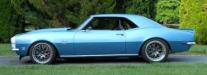
power or manual with big brakes?
I was looking to purchase a big brake kit for 68 chevelle. They are 13 inch front disc, and 12 on the rear. Is anyone running similar set up with out power brakes? Im just curious how much difference power vs manual would be? If it stops fine without power brakes then im just going to go that route, but if it make a big difference to add power then ill go that route. thanks
68 Camaro. 68 chevelle for sale. 77 bronco for sale
-
12-31-2014 #2
Registered User
- Join Date
- Apr 2012
- Location
- Woodstock, IL
- Posts
- 2,410
power or manual with big brakes?
This is very common to run manual brakes on your setup. 7/8-15/16 bore master will likely work out for you.. Others will likely chime in.
Are you looking at Wilwood?
-DaleSchwartzPerformance
The leader in bolt-in muscle car chassis
SchwartzPerformance.com | GMachineChassis.com | Facebook | Twitter | Instagram
Dealer for: Forgeline, RideTech, Tremec, American Powertrain, Silver Sport Transmissions, GM Performance Parts, RECARO, Cerullo Seats, TMI Products, Vintage Air, Baer Brakes, Wilwood, BeCool, AFCO, Tanks Inc, Holley / Hooker, Ultimate Headers, Rick's Tanks, Moser Engineering, Currie, TechAFX, Stainless Works, II Much Fabrication, and many more
12-31-2014 #3
Registered User
- Join Date
- Feb 2008
- Location
- conway arkansas
- Posts
- 38
I haven't really picked out a kit yet, but I was looking at cpp big brake kit, and wildwood. My car has manual drum brakes now and it is really cruddy. I might end up going power brakes if the difference is night and day, but I just don't wont to spend the extra money if not needed. I definatly don't want to have to press the brake pedal hard to stop
68 Camaro. 68 chevelle for sale. 77 bronco for sale
01-05-2015 #4 Registered User
- Join Date
- Dec 2010
- Location
- Fredericksburg, VA.
- Posts
- 3,164
I'm running a 7/8" Willwood mc with Corvette C6Z06 calipers front and rear. Very nicely balanced braking and great pedal feedback. Plus the install is much less complicated.
01-06-2015 #5
Registered User
- Join Date
- Oct 2011
- Posts
- 124
Good info, I wondered the same thing. Also a lot less cluttered on the firewall.
01-06-2015 #6 Registered User
- Join Date
- May 2010
- Location
- Mooresville, NC
- Posts
- 377
power or manual with big brakes?
I am running the C6 front and rear brakes on my 69 Camaro with a 7/8" Willwood manual MC. I personally love the feel and pedal feedback of manual brakes over power in a performance car. My car stops great too with this set up.
Marc Battiste
1969 Camaro
LY6/T56/12 Bolt
01-06-2015 #7 Registered User
- Join Date
- Mar 2008
- Location
- Chicago
- Posts
- 200
I'm running Wilwood manual 4 wheel disc set up. I love the manual disc but it is a different feel than that of power brakes.
Dante'
01-06-2015 #8
Registered User
- Join Date
- Feb 2008
- Location
- conway arkansas
- Posts
- 38
cool, thanks for the replys, Manual brakes it is for me. Im sure its going to make a big difference performance and pedal pressure wise.
68 Camaro. 68 chevelle for sale. 77 bronco for sale
01-19-2015 #9 Registered User
- Join Date
- Mar 2012
- Location
- So Cal (818)
- Posts
- 243
I am running wilwoods 13" front and 12"rear. If I was going to spend a lot of time autocrosssing i would recommend a manual setup. Since most of the time will be spent on the street I went with the Hydratech hydroboost and have been impressed with the pedal feel and feedback. It is a more complicated setup, but worth every penny. I had Tom Lee setup my complete power steering system to work with the hydroboost.
01-20-2015 #10 Registered User
- Join Date
- Dec 2002
- Location
- MusicCity
- Posts
- 477
AutoX thoughts
AutoX versus real time vehicle use (my thoughts as the longstanding owner / founder / chief engineer of Hydratech). Having been highly experienced in most all automotive based experiences, we are looking at specific needs for each type of scenario / real time use. Smoker03 raises a great point that had me drop what I was doing and comment, because he actually hit it on the nail head - each use has its own specific needs. My autocross experiences have led me to believe that you do indeed need to have between 350 and 500 rear wheel horsepower (600? LOL), combined with a fantastic chassis and as much rubber you can put on the pavement. What am I getting at? AutoX is a VERY different world that gets you very excited, very fast. You are on the gas, then cranking the wheel, then on the brakes, then getting back into the gas as fast as you can - repeat everything in milliseconds over and over as fast as you can. So where am I gong with this? Autocross is actually no place for an over powered 1100 horse peaky spiky twin turbo, as you will be eating cones left and right or worse. You would never dare "hit the spray" in this scenario (well, maybe except for only for a very split second on a final straight away). A chassis setup for straight line / drag strip performance would fail miserably in AutoX, and vice versa. It is my opinion that the same goes for brakes - you are just about in panic mode doing everything you can as fast as you can trying not to eat cones, so getting out of control from too much power in ANY driver input scenario is not what you want - too little is too little, too much is too much.
Driving a high speed road course is potentially the exact opposite, in that you do actually have the element of intellect by contrast to split second adrenaline. Managing exceptionally high power levels in this scenario is much more a case of judging how much power to apply coming out of a curve and into a straightaway, then judging how much power to apply to the braking and steering coming up onto the next sweeping set of curves. I have found that an experienced driver in a road course scenario such as this is capable of handling MUCH more available power simply (if only) because there is much more time to react to impending scenarios....
All said, there IS a time and a place for everything. Smoker03 says it best. If you are mostly Autocross, go manual. The reality is that you have to judge where the majority of your real time use for your vehicle is. We have customers that AutoX their builds occasionally with great results, though use their vehicles "multipurpose" 99% of the time otherwise.
To my ears, that says 99% of the time you do want power assisted brakes. Baskin Robins has over 31 flavors available because we are all different. Just because I like one flavor doesn't mean that you will like it, so take my input for what it is worth.
Don't drive faster than your angels can fly!
 There IS a difference - Thank you for choosing Hydratech!
Paul M. Clark
Founder / Master Engineer
Hydratech Braking Systems ®
www.hydratechbraking.com
01-21-2015 #11
Registered User
- Join Date
- Apr 2013
- Posts
- 26
The difference between power and manual disk brakes is the pedal feel. They are both going to stop in the same amount of time but you will have to press the pedal a little harder, as you would currently. All given if you get the correct master cylinder for the manaul brakes
01-25-2015 #12
Registered User
- Join Date
- Dec 2002
- Location
- MusicCity
- Posts
- 477
Of course there is way more to it than that...
The limiting factor of braking is one factor in and of itself, and that is the traction of four tires with brake torque applied. Threshhold braking is where you are right on the ragged edge of all four tires applying as much brake torque as possible before reaching the point of lockup (which is what modern ABS systems provide). Given a perfectly optimized scenario, manual brakes can do the job providing a very well setup system. Proper hydraulic leverages (meaning MC bore sizing versus caliper piston sizing), brake pad friction levels versus rotor diameter, and exceptionally perfect chassis / brake bias tuning adjustments is what it takes for success.
What I see as the drawback with most manual brake systems is that you will have considerable larger pedal travel (via achieving proper mechanical and hydraulic leverage ratios to achieve appropriate line pressures at a given amount of brake apply pressure), VERY dusty short lived brake pad life expectancy and / or heavy wear on your brake rotors with very sharp pads, highly temperature sensitive brake response, and an overall higher pad knockback occurrence in high performance driving scenarios.
We deal with this on an everyday basis, with most all having tried everything they knew to do over the cost of many years and hard earned dollars. After exhausting all conventional / internet wisdoms, here are just two examples the types of e-mails we receive every day:
The brakes now feel wonderful and I couldn't be happier after installing your hydraulic brake assist system.
Driving my 800 hp race car now no longer feels like a dump truck when I stop. Manual brakes are for the birds !!
Thank you my car feels like a whole new ride !
And then this one:
I wanted to let you know that I am very happy with the system you sold me!!
This has solved the problems I have had since I first built my car over 16 years ago and wanted to provide you with a write up that you can use on your web page if you see fit.
My 1966 Mustang started life as a 6 cylinder with 4 wheel drums and a single reservoir master cylinder. When I saved this car from the salvage yard in 1996, I went down the path to modify it for 'spirited' driving in Florida. It now has a 530 HP supercharged/fuel injected 8 cylinder engine in a car that weighs in at about 2800 lb. To be sure that the power to the pavement could be brought under control, I originally installed Ford Granada front disc/Lincoln Versailles rear disc brakes actuated by a manual 1967 dual bowl master cylinder. This installation was not satisfactory and on occasion I had to double pump the brakes so I looked over the web and saw comments that suggested that a larger Ford SVO master would help. This resulted in the installation of a massive aluminum Lincoln Mark 7 master cylinder in manual mode but I only found this to result in a pedal that was rock hard after less pedal travel and no noticeable braking benefit. After some discussion with owners of Mustangs at car shows and more research on the web, I then installed a 7" single diaphragm booster designed for a manual tranny Mustang with a cast iron master cylinder claimed to be for 4 wheel discs. This helped normal stopping, but panic stopping (quick short distance stops) was not very good. To compound my grief, this cast iron master started to leak after about 9 months and its replacement only lasted about 11 months so I eventually installed a polished aluminum master with a bore that was supposed to be good for my system. This did help with a good pedal feel and provided additional eye candy under the hood but I was still not happy with the braking performance of the car. Thinking that my 1988 vintage brakes were a little outdated, I eventually installed huge 2004 Cobra Mustang discs front and rear on my car and upgraded the rubber hoses to Teflon/braided Stainless Steel. My intent was to install a matched braking set and I assumed that the addition of updated calipers that were much lighter with massive rotors originally installed on a performance oriented car would result in improvements to my stopping efforts. Realistically the only performance benefit that this gave me was a better parking brake (the Versailles rear parking brake is not very good and takes considerable effort to fine tune), but they did look cool. I lived with this for about 7 years before I had someone pull out in front of me and I had to hit the brakes hard to avoid an accident. This made me take another look at trying to get the car to stop better with less effort. I am also running a supercharger and had concerns that if I ever blew through the two check valves protecting my master booster I would lose the power assist feature. Taking a look at what Ford did on the 2004 Cobra, I figured that a hydra-boost system might be the answer but thought that such an installation would be impossible on a car that still had the shock towers installed, had a fuel injected intake and a hydraulic clutch master cylinder right up against the brake master pedal hole. After a few emails to Hydratech, I called Jim and talked to him about a kit that would not only help me, but would fit the tight confines of a first generation Mustang. To my excitement, the kit showed up at my house a week earlier than planned, was complete with no need to run to the store for parts, had installation instructions that a grade school kid could follow, and was professionally packaged. I ordered the low budget finished system since I wanted to paint it to match my engine scheme, but found that even that system was nice looking. After the first test application of the brakes in my garage, I was surprised at how easy the pedal was to push and honestly thought that I was not getting a good bleed/air out of my lines. The proof was in the maiden voyage round the block. I have to tell you that this thing solved my issues and my '66 Mustang stops better than my '03 T-bird now. You can't go wrong with this system. Had I heard of this setup earlier, I could have saved time, money, and busted knuckles. This is the answer!
 There IS a difference - Thank you for choosing Hydratech!
Paul M. Clark
Founder / Master Engineer
Hydratech Braking Systems ®
www.hydratechbraking.com
01-25-2015 #13 Registered User
- Join Date
- Jan 2014
- Location
- Seattle WA
- Posts
- 288
I'm about 4 months away (fingers crossed) from firing up my latest project. I've never run hydroboost on my projects so that's what I went with and Baer Pro Plus brakes. Looking forward to seeing how I like it.
1967 El Camino 408ci LSx....and the build begins!
1967 Turbocharged 408ci LSx Chevelle - 1012 rwhp, 959 rwtq 67 Chevelle
2009 Supercharged Silverado - On the Dyno

 Reply With Quote